Showing posts with label short story collection. Show all posts

Wednesday, February 8, 2017

Before Plan 9

Before Plan 9: Plans 1-8 From Outer Space
© 2012 various authors
354 pages


TV Producer:"About the title...it's highly inflammatory. What if we changed it to 'Plan 9 from Outer Space'?"
Ed Wood: ...that's ridiculous. 
(From Ed Wood, starring Johnny Depp)


Greetings, my friends. We are all interested in the future, for that is where you and I shall spend the rest! of our lives. But this is not a book about the future, it is one about the past. Specifically, it's a prequel to the 1950s cult classic, Plan 9 from Outer Space.  For those who have never experience the particular pleasure of it,  the film features aliens making contact with Earth,  who have hopes of convincing us not to blow up the universe by creating three "zombies", two of whom are actually vampires.   I watched it a few weeks ago as part of a series of 1950s SF (along with Them! The Beast from 20,000 Fanthoms, Satellite in the Sky, and World Without End) and have since become morbidly fascinated with the work of Ed Wood. How could I resist this little volume, each story-chapter documenting the nine previous plans that the mysterious aliens visited upon the Earth?    Like the movie, this book of tales is more comedic than thrilling, and by plan 8 the novelty had worn off on me entirely.  The premise is that roughly since the Age of the Dinosaurs, the same group of aliens has been cloning itself and maintaining a watch over Earth, attempting to persuade Earthings (first intelligent dinosaurs, then humans) not to blow up the galaxy.  The stories are most clever early on, as the authors insert the aliens into the tale of Odysessus (turns out all those gods and monsters were alien creatures, who knew?), ancient Egypt (aliens did build the pyramids!), and the story of the Pied Piper.    There are numerous references to other SF stories and legends -- Roswell, obviously --  and even one particularly funny hat-tip to Ed Wood himself. In a chapter set in Victorian America, a scientist named Glen must pretend to be a woman to find out where mind-control corsets are taking all the wives of his village; naturally, he asks people to call him Glenda.  The Nazi antics seem like something out of an old Captain America plot (Heil Hydra!), and then we get a bunch of monster movies towards the end.   Some references attempt to explain the silliness of the film, like the alien saucers being suspended by wires:  an alien complains that Earth's atmosphere is so turbulent that their ships are damaged and having to be towed by other ships in higher orbits.

If you find Plan 9 from Outer Space to be in the "so bad it's good" kind of movie,  you may enjoy these little stories to a degree.  My enthusiasm waned after the Victorian story, which I think is my favorite.

Monday, April 25, 2016

The Memoirs of Sherlock Holmes

The Memoirs of Sherlock Holmes
256 pages
© 1894 Sir Arthur Conan Doyle


Has it been five years since I read a Holmes collection? I remember picking up Memoirs shortly after reading The Further Adventures of Sherlock Holmes, not nothing that Memoirs was published well before that, but I fell into distraction at some point. More's the pity, because here collected are eleven classic stories that include both the beginning and the (first) end of Holmes' career, "The Gloria Scott" and "The Final Problem".   It contains a few iconic scenes; Holmes stalking about in his cape and seeming to read Watson's mind, as well as some of his best lines:

"Is there any other point to which you would wish to draw my attention?"
"To the curious incident of the dog in the night-time."
"The dog did nothing in the night-time."
 "That was the curious incident."

Some Trek author inserted those lines into a novel years ago and it absolutely mystified me. Well, glad to have cleared that up. (On that Trek note, I must say that The Next Generation deceived me in regards to Professor Moriarty. He's charming onscreen, but decidedly uncharismatic here. Granted ,his only appearance is to threaten Holmes with death if he doesn't keep plotting the 'Napoleon of Crime's" Waterloo.)  Memoirs has the same engaging writing as the previous collections, and adds some interesting aspects to Holmes' character, namely his eccentric home decor (storing cigars in Persian slippers, using the wall as target practice).

A few of the mysteries:

  • "Silver Blaze": A prize horse has gone missing. (Okay, granted, it's not as ambitious as the missing train from Further Adventures, but it's still very mysterious.)
  • "The Musgrave Ritual": A brilliant butler vanishes after being caught studying nonsensical couplets used in an initiation ritual. Could it be that he divined some meaning into the lines?
  • "The Gloria Scott":  What secret does a cranky sailor have over this nervous country squire?
  • "The Greek Interpeter": A man is driven into the middle of nowhere and used to question a Greek man being held against his will --- why?
  • "The Cardboard Box":  Who ordered two human ears packed in salt? 


I think I've gone through all the short stories my library has access to, so when next I visit Baker Street, it will be for a full novel!


Thursday, April 7, 2016

My Man Jeeves

My Man Jeeves
© 1919 P.G. Wodehouse
132 pages

"There's only one thing to do," I said.
"What's that?"
"Leave it to Jeeves."

What ho, readers all!   My Man Jeeves renews my acquaintance with young Bertie Wooster, exemplar of the aristocracy in decline.  Bertie has loads of money and no sense in the least, but is saved from the worst of his foibles by the ever-present Jeeves, he of the unrivaled brilliance.  The work gathers a handful of Bertie-and-Jeeves stories,  ranging from the whimsical to the inane.  There are also a couple of stories about Reggie Pepper, a  character who was a prototype for Bertie, and is just about as thick but lacks a Jeeves to see him through.   If he survives, let alone triumphs, it is only through that bit of wisdom that God preserves fools.  The premise is the same in this as in other collections; either Bertie himself, his aunts, or his friends have gotten him into a fix, and Jeeves must contrive to find a way out of it.  Plots thicken, Jeeves stirs, Bertie's out of the soup and into his recliner to enjoy a whiskey and soda and contemplate the wonder that is his man Jeeves.

In this collection, his friends are typically the culprits.  One notable exception is the arrival at his American apartment of one of his dreaded Aunt Agatha’s friends. She is on a tour of American prisons and wants Bertie to take care of her intensely repressed son, Wilmot. No sooner has mummy dearest run off on business than has Wilmost escaped the apartment to engage as much sordid revelry as he can. This is his one chance to accumulate a storied and sinful past, and he’s intent on making the most of it. It’s up to Bertie to keep him from ruining his health with all-night binge drinking and partying, so naturally the ward winds up in prison. There’s often an element of backfire here;  Jeeves suggests, for instance, that if friend Corky wants his uncle to approve of his girlfriend, that they arrange to impress said uncle with the young lady’s authorship of a book on said uncle’s favorite subject – not expecting the uncle to be so taken with her that he  marries her.  The Reggie stories are all backfire  While Bertie’s scrapes and Jeeves’ ingenuity are fun reading in themselves, as I’ve noted in prior volumes, part of the fun of reading Wodehouse is the writing.  Bertie is an eccentric character and an enthusiastic narrator,  the sort who manages to make sitting in a  chair fun to read about. He’s like laughing gas, nonsensical and with a contagious effect.

"Lady Malvern was a hearty, happy, healthy, overpowering sort of dashed female, not so very tall but making up for it by measuring about six feet from the O.P. to the Prompt Side. She fitted into my biggest arm-chair as if it had been built round her by someone who knew they were wearing arm-chairs tight about the hips that season."

Here, in a sentence, is part of what makes Bertie a ball to read. There's such energy to his narrative, the way he slings out descriptive fun with a healthy sampling of odd slang, some of it assuredly made up on the spot.  There is no one funnier to read out loud than P.G. Wodehouse, especially if you do it in a Hugh-Laurie-as-Wooster voice.  Even more giggles are to be had from Bertie's interactions with Jeeves, who reins in his employer's questionable fashion choices and is often allowed to destroy an offensive article as a reward. While Bertie professes to resent being dominated sartorially by his valet,  Jeeves is such a master at getting Bertie and company out of trouble, getting rid of pink ties and colorful sports jackets are a small price to pay.  If your interest is piqued, My Man Jeeves is available online for free via Gutenberg,  or through Amazon. 


Wednesday, April 8, 2015

The Inimitable Jeeves

The Inimitable Jeeves
© 1923 P.G. Wodehouse
225 pages


Bertie Wooster is something of an imbecile, but his preference for the quiet life would keep him out of trouble were it not for the fact that his relations and idiot friends are constantly getting him into scraps. If his domineering Aunt Agatha isn’t constantly trying to get him married, or worse, employed, his friend Bingo Little is plotting some elaborate scheme to win the heart of the girl-of-the-week. (Even if she is a socialist revolutionary, and Bingo a contented member of the Idle Rich.) Fortunately for Bertie, he has Jeeves, the epitome of an efficient and clever valet. Jeeves hasn’t yet encountered a predicament too difficult, no Gordian knot too tangled, to  finesse.  The Inimitable Jeeves  collects a series of escapades, colorfully and hilarious rendered, in which Jeeves pulls Bertie’s chestnuts out of the fire. This particular set of stories is more or less pulled together by the many love affairs of Bingo, who doesn’t think twice about introducing  Bertie to his uncle as an acclaimed author, so that Bertie might better influence the uncle into giving Bingo more of an allowance. The scenarios are  absurd in themselves, but what truly sells  Wodehouse’s storytelling is the narrative voice.  Bertie tells these stories personally, and his delivery is a riot -- so earnest, so energetic, so full of quaintly charming slang. Bertie never walks anywhere, no, -- he legs it.  And while Bertie is catastrophically throwing himself into whatever obstacles come his away, Jeeves is hovering in the background and working his magic. He is unflappable, and I have rarely been so delighted by any set of stories.

At any rate, now I know why Isaac Asimov constantly referred to Wodehouse writing his Black Widower series!


Monday, December 8, 2014

The Wild Birds

The Wild Birds
© 1989 Wendell Berry
160 pages


            Within the membership of Port William, a close knit farming village, lays another  more intimate still. It is the membership of a neighborhood of families who, working adjoining lands, make it their business to help each other through life. They help sow one another’s fields, and help reap them.  Hannah Coulter, the story of a young widow adopted into this private membership, introduced it; in Wild Birds, Wendell Berry delivers six stories about its other members,  advancing through the years, and delivering a sense of real people developing through time and through their relationships with one another.  The young mature into older adults; Wheeler Catlett opens the piece as a young newlywed, tasked yet again with hunting down his drunken uncle, and closes it as an older  lawyer contemplating retirement.  There's a prevailing theme of coming of age and owning one's responsibilities here, though as always Berry creates a sense of timelessness: his characters have moments in which every season of their life is being lived simultaneously  This is best exhibited in "The Boundary", which for me is the most tender piece I've ever read by Berry, about an aging farmer who decides to go on one last patrol of his fields to inspect a boundary fenceline. Leaving home, he departs from his wife with  a hug, noting that she seems to have changed while he held her from schoolgirl to grandmother, a lifetime lived in one another's embrace. As he eases down a hill he scrambled down as a child, he relives the many times he and his fathers before him, and he and his sons after that, had walked those paths before, tended those places together.   Berry is a master at creating intimacy, inviting the reader to draw close to his characters, so endearing even in their flaws.  To read these stories is to take a deep draft of the milk of human kindness, to be loved almost by an author who delights in stirring one's soul and bringing to remembrance a sense of being at home in the world.  

Related:
Hannah Coulter, Wendell Berry
Jayber Crow, Wendell Berry


Tuesday, December 31, 2013

Sharpe's Christmas

Sharpe's Christmas
© 2003 Bernard Cornwell
104 pages


Sharpe's Christmas collects two stories which do the seemingly impossible, in honoring the Christmas spirit while simultaneously being action-adventure tales starring Richard Sharpe. Sharpe doesn't lend himself easily to Christmas stories; he is not lovely or kind. He is a soldier whose battle-scarred face has frightened women, and whose rifle and cavalry sword have frightened men, from Indian to France.  He is a wonder as a soldier, grimly effective, but dismally unlucky outside the killing fields.  His attempts at love have met in disaster as his beloved ones die or vanish, along with whatever fortune he entrusted to them.  And yet the Daily Mail asked Bernard Cornwell to write two Sharpe-related Christmas stories for them, and so he did.

 The stories are not unusual in their Christmastime setting;  the series has seen battles set around the Christmas season before.  But while there Christmas was the background, here it is the abiding theme.In the first story, "Sharpe's Christmas",  Sharpe is participating in the invasion of France, and caught between two forces of Imperial troops in a narrow mountain pass, some of them commanded by an old friend. In "Sharpe's Ransom", disgruntled Hussars break into Sharpe's postwar home in Normandy and hold his wife and child hostage unless he produces the gold  the evil masterspy Ducos framed him for stealing in Sharpe's Revenge.  After outwitting the dopes guarding him, Sharpe must effect a rescue of his family.  Readers are treated to the usual elements of a Sharpe novel -- desperate battles between riflemen and massed columns of French troops, small-scale action by Sharpe himself, plenty of humor (especially between Sharpe and his usual compatriot, Patrick) but with a Christmas twist. Sharpe creates a miraculous victory out of disaster out of nothing but cleverness, skill, and cutting remarks, but the discovery of an old friend allows him to act as an agent of mercy; in "Ransom", he doesn't take out the entire band of Hussars singlehandedly, but turns the crisis into an opportunity to win the trust and acceptance of the local villagers, who -- being French -- resent an English war hero taking up residence among them and taking as his mate a once-noble widow.  Sharpe's Christmas is as exciting, historically grounded, and funny as any Sharpe novel -- but it's also heartwarming. It's positively touching.  I thought it quite appropriate.

Friday, October 7, 2011

The Union Club Mysteries

The Union Club Mysteries
© 1987 Isaac Asimov
210 pages


Evening falls in New York City, and inside the aristocratic Union Club, four gentlemen sit ensconced in their usual chairs in the club library. Three talk softly among themselves while a fourth -- an older gentleman with a white, puffy mustache -- seems to doze. But their conversation makes a turn that interests his still-awake ears, his somnolent mind springs to life, and he takes a sip of his scotch and soda. Griswold has awoken, and that last bit of conversation reminds him of a story...

So begin thirty evenings inside the Union Club, wherein Griswold -- formerly in the employ of a shadowy government Department which gave him plentiful opportunities to solve domestic mysteries and international espionage plots -- regales or abuses his dining comrades with a mystery from his life, a story which he expects them to solve by the end.  If they do not -- and they never do -- he faithfully explains the solution.  Although the setting seems similar to the Black Widowers -- a stag club who meet once a month for conversation and drinks -- Griswold's tales are much shorter, and the appeal of the stories is different. While Black Widowers stories feature the gentlemen discussing literature, science, history, art, and the like in order to find a solution to a given mystery, here the burden is laid entirely upon the reader, and the solution is often more subjective than in a Widower's story. It's a bit like working a crossword puzzle in that in reading, you must try to think like Asimov, to find some odd angle at which to hang the plot.   The solution's clue is usually obvious, but the trick is  matching Asimov in thinking of why that clue is relevant.

I enjoy little puzzlers like these, and have reading a tale or two at lunch every day since I received the book in the mail. Although the stories aren't nearly as entertaining as the Black Widowers tales, I enjoyed most of the mysteries and even solved a fair few of them. There were a few groaners, but on the whole I'd recommend this to short-mystery or Asimov readers.

Monday, September 19, 2011

Tales of Beedle the Bard

The Tales of Beedle the Bard
© 2007 J.K. Rowling
111 pages

"Translated from the ancient runes by Hermione Granger.
Commentary by Albus Dumbledore
Introduction, Notes, and Illustrations by J.K. Rowling"

If the end of the Harry Potter story this summer has left you sad, this charming little collection of stories set in-universe will bring a smile to your face. Mentioned in The Deathly Hallows, the book was 'defictionalized' as part of a charity drive, along with Quidditch through the Ages and Fantastic Beasts. Alas, there are only five stories included, but each is followed by commentary from Albus Dumbledore, who comments on the story's meaning and legacy with his usual wise and gentle wit. The commentary is not only amusing, but it fleshes out the wizarding world all the more for fans of the series. Any and all fans of the Harry Potter series should enjoy this little collection of heart-warming fairy tales from a world where magic actually exists.

Friday, November 26, 2010

I Was a Teenage Dwarf

 I Was a Teenage Dwarf (Wild Adventures of a Pint-Sized Don Juan)
© 1959 Max Shulman
182 pages


I purchased this book online through a used book store during the summer, and picked it up to read last week when I wanted a fun story and had exhausted my weekly reading to the point where my only options were genetics or theology. I purchased the book immediately after finding out that it is the predecessor of one of my favorite books: The Many Loves of Dobie Gillis.While Many Loves collected twelve different stories about the same character (with endings so varied they cannot possibly fit into the same continuity),  Teenage Dwarf follows Dobie through middle school into marriage and tell in ten separate parts a larger story -- Dobie's pursuit of love and what he learns along the way. In almost every story (save "The Costly Child"), Dobie pursues the girl next door. Since people constantly move out of the home next to his (its flat room attracts sea gulls, who constantly drop clam shells on it to get at the meat inside), Dobie is constantly pursuing a different girl and invariably sees his every triumph or loss rendered moot.


Though the book was fine for a laugh (and was strangely serious at the end),  it didn't send me into spasms as I'd expected from Dobie Gillis. I love this guy -- I've been re-reading Many Loves since high school, collapsing on the floor in a fit of laughter every time, and I fully expected lightening to strike twice. This book's  Dobie isn't near the outrageous scamp of Shulman's following collection. Proto-Dobie seems to have few outside friends, no other drive other than to find female company.  Dobie is more like Archie Andrews here than the cocky, 'sensitive intellectual' whom I'm so fond of. Of course, hilarity is in the eye of the beholder. While I was smirking  and merely chucking while reading this, another reader had this reaction:

 I was asked to leave my high school library because it was study period, and I was reading Teenage Dwarf, and I started laughing so loudly that I could not control myself. Basically, I GUFFAWED into the studious silence. Tears streamed down my face, despite the fact that I was being “Sh”ed left and right. I finally had to just gather up my book bag and stagger out into the hall, where I stood, and literally HOWLED with laughter, by myself, for a good 5 minutes.
I can count the writers on one hand who are that feckin’ funny.
I enjoyed the book, but not as much as Many Loves or Barefoot Boy with Cheek. I found it mildly silly: not absurdist, but just a little wacky. 
Related:


Friday, August 20, 2010

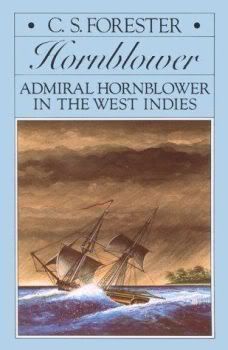
Admiral Hornblower in the West Indies

Admiral Hornblower in the West Indies
© 1957 C.S. Forester
250 pages


Although not the last Hornblower book published -- Hornblower during the Crisis was a work-in-progress when Forester died -- it is the novel set latest in Hornblower's life. The Napoleonic wars are over: after twenty years of tumult, Europe is finally at peace. Owing to his many years of excellent service, Rear Admiral Hornblower has earned a position in the peacetime navy, keeping watch over Britain's forces in the West Indies. Though described as a novel, West Indies is more kin to a book of interrelated short stories. Hornblower has no singular campaign to manage, but the storm-tossed seas of the tropical Atlantic give the admiral little rest. There are pirates and slavers afoot, and the Americas are awash in revolutions as various people attempt to rid themselves of colonial overlords.

West Indies has an altogether different tone from the rest of the books, save Midshipman Hornblower. While its stories offer drama, the consequences of failure are less severe than they would be in wartime. Instead of gathering intelligence and striking blows that will defeat a tyrant, Hornblower is kidnapped, chases pirates and slavers, and contends with a hurricane while settling into a contented old age.  It's cozy, comfortable. For my own part I enjoyed it. Though not the great adventure that other books -- Lord Hornblower, for instance -- were, it's a gentle farewell to the man whose adventures I've enjoyed reading so much through the spring and summer.

Fair winds and clear horizons, captain.

Tuesday, July 20, 2010

Hornblower and the Crisis

Hornblower and the Crisis
© 1967 CS Forester
174 pages


Hornblower and the Crisis is the last of CS Forester's Hornblower books, as Forester died in the midst of writing it. This book collects the first 130 pages of the intended novel, adds a portion from Forester's notes establishing how he intended to develop the book further and end it, and then tacks on two short stories. The first, "Hornblower's Temptation", is set during Hornblower's lieutenancy aboard the HMS Renoun, where he makes a potentially lucrative discovery when overseeing the execution of an Irish deserter-turned-insurrectionist. "The Last Encounter" takes place in 1848, where an elderly Hornblower receives a late-night visitor -- a man claiming to be the Emperor Napoleon Bonaparte.

The death of Forester in the middle of the Crisis is truly a loss for his readers, for the book was shaping up to be one of the better additions to the series. Newly-minted Captain Hornblower is returning to England from his blockade duties as a passenger aboard the Princess, a small utility vessel, when the book begins. His former ship, the Hotspur, is still at sea under a new captain, but Hornblower has been ordered to return to Liverpool for new orders.  After a French brig harasses the lowly Princess, Hornblower urges his fellow passengers -- also royal officers -- to ambush Boney's boat. Although they are too few men to take the ship as a prize of war in total, Hornblower fights his way to the brig's command office and steals the French captain's orders. They are fixed with the seal of Emperor Bonaparte, and contain orders from the Corsican himself.  When Hornblower dutifully takes them to the Admiralty, they and he contrive a plan of espionage that will draw the French navy into a decisive battle -- the monumental battle of Trafalgar.

I tend to enjoy Forester's books more when they center on diplomatic intrigue, shore adventures, and espionage, so the plot of this naturally drew me in. Although the notes included are short, they do more than relate the rest of the plot.  The two short stories are both far shorter than those in Mr. Midshipman Hornblower, and each was a treat. "The Temptation" shows Hornblower's humane side, one we don't often get to see in a series dominated by war, and "The Last Encounter" is both amusing and almost serves as an afternote to the Hornblower series:  1848 is a year beset by revolution, where rail lines and naval steam engines have brought modernity, supplanting Hornblower's old, familiar world.

Although I read this when I did for its setting (French Revolution and Napoleon), it more than made up for Hornblower and the Hotspur.  While the novel's opening chapters and the short stories are enjoyable in their own rights, I suspect newcomers to the series would enjoy a more complete work. Still, for Hornblower readers this is certainly worthy.

This is not my last Hornblower read: I still have Admiral Hornblower and the West Indies to read, and there's one Hornblower-related book I intend to read following that. It's ah....going to be a bit different.

Sunday, June 20, 2010

Tales of the Dominion War

Tales of the Dominion War
Published in 2004, editor Keith DeCandido
370 pages


O'Brien: Engage, retreat, engage, retreat. I tell you, that's becoming our favorite tune. 
Bashir: Well, we'd better think of a new tune fast or the only song we're going to be singing is "Hail the Conquering Dominion". 
Dax: I wouldn't start learning those lyrics just yet. ("Favor the Bold")


If you've ever seen an episode of the original Star Trek series, you know the essential formula for most of the rest: a crew of gallant Starfleet personnel travel through the galaxy, solving a mystery or problem every week amid playful banter and warm idealism. These standard series each have their strengths and weaknesses, but their foundation is the same. Deep Space Nine stands alone: set in an outpost at the outskirts of the Alpha Quadrant, its stories are not weekly events but large arcs. The Dominion War was one such  arc: the series' second season introduced a vast trade federation known as the Dominion, protected by super-soldiers whom everyone feared. The Dominion matured through the show's early seasons, eventually being realized in full as a vast empire controlling much of the Gamma Quadrant -- a region of the galaxy so far removed from the Alpha Quadrant that only a stable wormhole providing a shortcut from Deep Space Nine to the fringes of the Dominion's borders made traveling between the two feasible. A group of aggressive shape-shifting xenophobes known as the Founders created the Dominion to protect them from outside persecution, and they used their empire to establish order by subordinating weaker powers.  In season five, the Dominion set its sights on subduing the various powers of the Alpha Quadrant, resulting in a war that lasted several seasons and culminated only at the series' finale.

Tales of the Dominion War is set during that time, in which the Dominion fights and nearly destroys the Federation as well as the Klingon and Romulan Empires. The book begins with a tribute to Deep Space Nine, crediting it for making Trek literature more varied: in breaking with the format of the original series and The Next Generation,  Deep Space Nine allowed authors to explore the entire galaxy, creating book series about characters and powers not mentioned in the television shows. Many of the characters from various series produced following Deep Space Nine's beginning make appearances here, like Michael Jan Friedman's Stargazer crew and  Peter David's New Frontier cast and ship. The stories here not not just set aboard ships, though; authors take us to Earth, when Breen ships stage a surprise attack and level Starfleet Command; to Romulus, where Ambassador Spock watches as Romulan politicians and generals struggle for command of Romulus' fate, and decide whether or not it shall enter the war; and to a world of the Klingon empire, in which a one-armed Klingon fights off a ship of Jem'Hedar warriors on foot. There's even a story about Shinzon, the foe from Nemesis who led Reman combat troops on special operations, one that sets the stage for Nemesis. Scotty and McCoy also have a day in the sun, although the Voyager crew is excluded -- having spent the war lost in the Delta Quadrant. The collection's captstone story ("Requital") is the only one that includes Deep Space Nine's characters: a young Federation officer assigned to guard the Founder who instigated the Dominion War and the slaughter that follows struggles with his desire for vengeance while reliving in his mind some of the war's most vicious battles.

For my money this book is strong indeed; I've never been able to enjoy New Frontier or Klingon stories before, but the authors of those respective stories kept my interest. David's New Frontier story is one of the few stories in the collection that comment on war itself -- while his comments on the way emotional appeals are used to glorify, promote, sell, and maintain wars, the collection's final story addresses the way individual psyches are warped by battle. The rest simply explore themes common in Star Trek war stories: bravery under fire, idealistic determination, the value of quick wits. This is a superb collection of Trek stories that is an easy recommendation to Trek fans.

Related:

  • "Tales of the Dominion War" Memory Alpha article.
  • "Call to Arms" video depicting one of the Dominion War's largest battles from Deep Space Nine. The music fits it well, I think, and the video chosen will give you an idea of the scale of the conflict.
  • The Dominion War, a four-book set divided between one of the Enterprise-E's most crucial missions during the war and the novelization of DS9's story arcs with greater context. The TNG books are two of my favorite Trek novels. TNG fans may enjoy the inclusion of Ro Laren and several characters from "Lower Decks".
  • The Battle of Betazed, set during the Dominion's occupation of Commander Deanna Troi's homeworld, which  she infiltrates in order to rescue a gifted telepath whose abilities might help the Betazoids create a potent resistance. This book integrates with the post-DS9 Relaunch canon. 

Monday, January 18, 2010

The Best American Short Stories (2008)

The Best American Short Stories 2008
© 2008 Salman Rushdie, editor.
358 pages


Although I've read quite a few short-story collections, most of them are by the same two familar authors -- Isaac Asimov and Kurt Vonnegut. Even when I read a collection outside of those two,  I still never wander into unfamilar territory -- I choose authors or subjects with whom I am familar.I decided to go exploring this week, though, after spotting an array of short-story collections in this series on my home library's shelves.  I have no experience with the Best of Series, so I would be sailing into the unknown.

The unknown, at least in this case, turned out to be a very interesting place. Salman Rushdie has collected a set of stories, twenty all told, that  exhibit tremendous variety.  There are stories of family, science fiction, fantasy, culture, friendship, and love in here. Most of the stories lack the conventional conflict-climax-resolution plot format,  not that this hurts them.It lends many of them a certain air of authencitiy, as if this is something that could happen in your life or mine: as the story comes to its end, the reader is left to mull over the consequences of what happened, since the narrator isn't doing it for us.  Rushdie has included no fluff: all of the stories left me pondering at their end. A few are worth mentioning here:


  • "The Year of Silence" by Keven Brockmeier is set in a city whichexperiences period outbreaks of silence that always lead to spikes in the quality of life and seeks to create a constant atmosphere of silence  -- and experiences the consequences.
  • "Man and Wife" by Katie Chase may have been the most disturbing story in the collection, as it is set in an altered United States in which arranged marriages between older men and young girls is common.
  • "The Quality of Life" by Christine Sneed explores the consequences of an inescapable affair.  
  • "Vampires in the Lemon Grove" by Karen Russell is the story of two very old vampires who subsist on lemons from a exquisite grove in Italy and have found that being immortal isn't all it's cracked up to be.
  • Thomas Wolff's "Bible" sees a woman kidnapped by a "terrorist" who turns out to be a concerned parent.
  • "Buying Lenin" by Miroslav Penkov is the story of a young Russian-American immigrant buying "Lenin's body" off of eBay to make amends with his cranky Communist grandfather. 


All told, this amounted to an interesting collection. I'll probably be reading from the Best Of series more as the year develops.

Wednesday, January 13, 2010

The Lives of Dax

The Lives of Dax
© 2002 various authors, ed. Marco Palmieri
367 pages

Photobucket


One of the more interesting species introduced in Star Trek Deep Space Nine were the Trill, a symbiotic race consisting of two species: humanoid hosts and slug-like symbionts, which fit inside an abdominal pocket and join minds with the hosts. The resulting personality is a combination of both the host and the symbionts. There are far more symbionts than hosts, and so symbionts are passed along from generation to generation, being joined to hosts who prove themselves worthy in the eyes of the Trill Symbiotic Commission. The symbiont retains its memories and personality, and becomes ever more knowledgeable and seasoned as the generations tick by.

One such symbiont, Dax, constituted two characters on Deep Space Nine, both of which are displayed on the cover. Lieutenant Commander Jadzia Dax, in the rear, served as DS9’s chief science officer for six seasons until her demise, at which point the Dax symbiont was hastily placed inside Ezri Tigan, who subsequently took the name Ezri Dax and received an assignment as counselor. Dax’s preceding hosts were frequently mentioned, and in one case (“Facets”) even temporarily brought to life through an ancient ritual, but not until The Lives of Dax were Dax fans given a thorough look at their lives.

The Lives of Dax is in effect a collection of short stories, as each preceding Dax host (Lela, Tobin, Emony, Torias, Audrid, Joran, Curzon, and Jadzia) is spotlighted in a story. These stories are book ended by Ezri Dax’s attempts to come to terms with her new and totally unexpected status as a joined Trill. The stories were all written by different authors, although one DS9 veteran, S.D. Perry, contributed to two.  Most of the stories are written in the third person and focus on Dax as the main character, but two differ by focusing on Leonard McCoy and Benjamin Sisko as main characters. Interestingly, the Sisko story, featuring Curzon Dax, is told in the first person. Although Ezri’s story is set in the Deep Space Nine relaunch period, the stories themselves are placed at various times over several hundred years (No dates are given, only surmised given the history that unfolds within them and the lifespans of the hosts.)

I think the collection fairly strong: I thoroughly enjoyed all but two stories, and they weren’t badly done. The book obviously recommends itself to DS9 fans and less so to Trek fans in general. I think the book is also enjoyable by non-Trek fans, as elements traditionally associated with Star Trek -- the main ships, their crews, latent philosophy -- are by and large absent.  Although McCoy and Sisko both tell two of the Dax’s stories, they are the only “intrusion” of this sense and knowledge or affection for them is not required. As they are both “young”, their personalities as seen on the shows have not developed yet.

Tuesday, December 29, 2009

Ford County: Stories

Ford County: Stories
© 2009 John Grisham
320 pages

I was delighted to receive John Grisham’s Ford County: Stories for Christmas. I’ve been a Grisham reader since reading a battered paperback copy of The Firm years ago, and many of my favorite works (The Summons and The Last Juror, to name a couple) of his are set in fictional Ford County, Mississippi. Grisham has returned to Ford County and its county seat of Clanton for a novel approach -- a book that is not a novel. Ford County is a collection of seven short stories, most of which are written in the third-person. Grisham’s intent with this book was to spotlight some of the more varied characters in Ford County, and there are many. There are a few lawyers inside -- Grisham is known for his legal thrillers -- but the law is not a dominant theme in the book.

None of the stories failed to delight me, and the variety is genuine. Some are silly, some are serious, and most contain the mild level of author commentary typical of Grisham. He develops a new host of characters, bringing back only one character (Harry Rex Vonner) from his previous Ford County stories.This collection should please Grisham fans, particularly those who enjoy short stories and who have not been too discouraged by The Appeal or The Associate, both of which Ford County betters. I suspect it will become one of my Grisham favorites, alongside The Last Juror and The Rainmaker. Here's a preview of three of Ford County's stories:

  • "Casino": After his wife leaves him, Sidney becomes an inadvertent professional gambler and gets revenge on the man who his wife left him for by breaking the man's casino. 
  • "Blood Drive":  Three good ol’ boys pile into a pickup truck intending to drive to Memphis to give a fellow Ford County man blood. Hilarity begins ensuing when they drive past a liquor store. The result sounds like a perfect “This one time, we got so wasted….” story. 
  • "Funny Boy":  one of Ford County’s outcast sons comes home to die of AIDs. Rejected by his family, he’s taken care of in his final days by an older black woman who finds his lifestyle suspicious but learns to care for him. This one of the more heartwarming stories in the collection. 


Monday, December 7, 2009

Asimov: The Complete Stories, Volume I

Isaac Asimov: The Complete Stories, Volume I
© 1990 Isaac Asimov
614 pages

I finished this book over a week ago, but academic responsibilities have seen my writing limited to papers for class and my creativity beyond that slightly dampened. I acquired this book a few months ago and have read from it ever since, little by little. The set it is part of was never completed: only two of the three planned books were ever released. Volume I contains two of Asimov's short-story collections, Earth is Room Enough and Nine Tomorrows. The former is a mix of science fiction and fantasy, while the latter is straight science fiction with humorous and -- as always with Asimov, self-depreciating -- poetry rounding things out. This collection contains some of my favorite pieces by Asimov, and of course I would recommend it to any fans of the good doctor or to classical science fiction fans. Here are a few of the stories you might be interested in:

  • The classic "Nightfall", a short story about a world with six suns and a history of civilization-destroying madness. Scientists and cultists both predict the end of the world is at hand. 
  • "The Feeling of Power" depicts Earth in the future, where reliance on computers has grown to the point that humans can no longer do simple arithmetic: computers themselves design and manufacture the newer generations of computers. A technological historian sorts out how to work through simple mathematical formulas and begins teaching them to his fellow citizens, only to be horrified when the military realizes math's uses.
  • "Profession" is one of the more interesting stories, at least for me, and shows an Earth similar to the Earth in "Feeling of Power". Technology is used to teach children to read and to train them for their professions, but when one man tries to beat the system and learn on his own, strange things happen.
  • "The Last Question", one of Asimov's favorites: can entropy be beaten? 
  • "The Fun They Had": children in Earth's far future puzzle over the existence of books and communal classrooms in an age where they are taught by robotic tutors.
  • "The Immortal Bard": William Shakespeare is plucked from his own time and finds himself in an English class devoted to analyzing the collected works of Shakespeare.
  • "The Gentle Vultures": Aliens puzzle over why Earth has not yet destroyed itself in a nuclear war.
  • "All the Troubles of the World" features Asimov's "Multivac", the ultimate computer that knows all...which turns out to be too much.
  • "Breeds There a Man?" is another interesting one, also involving aliens and nuclear physics. 

Wednesday, September 23, 2009

Barrel Fever

Barrel Fever: Stories and Essays
© 1995 David Sedaris
208 pages

Three years ago I heard David Sedaris talk about his experience living in Paris and was immediately taken by his style of humor. I don't know how to articulate the Sedaris experience, except to say that he writes dryly about pathetic situations. Beginning with Me Talk Pretty One Day, I began reading his works of collected essays about his life. I believe I've only read two since I started this blog, Holidays on Ice and When You are Engulfed in Flames. Barrel Fever, Sedaris' first work, is much different from the volumes following it. While they consist chiefly of essays based on Sedaris' own life, Barrel Fever is dominated by first-person fictional essays and stories, two of which are repeated in Holidays on Ice owing to the Christmas theme. (They don't lose anything in repetition, especially not his SantaLand Diaries.)

The stories' narrators don't share much in common beyond being kooky and pathos-inspiring. I said before that the only way I know how to describe Sedaris' writing is to say that he writes dryly about pathetic situations, and the same is true of these stories. In one, a teenage suicide attempts -- through her suicide letter -- to instigate a lynch mob at her own funeral, including a CD containing "Music for Stoning". The humor here is dark, morbid, and more than a little perverse -- moreso than his biographical essays, I think, and not quite as funny. While I enjoy his fables (as read on This American Life), I didn't enjoy his stories here as much as I expected. The essays were typical of his essay collections, meaning that they made for disturbingly funny reading.

Thursday, August 20, 2009

Casebook of the Black Widowers

Casebook of the Black Widowers
© 1980 Isaac Asimov
222 pages

Readers who have been with me since last summer know how delighted I was to find the Black Widower mystery series. In the year since, I have checked out of a library or purchased through Amazon every Widower collection I could find. With Casebook of the Black Widowers, I have come to the series' end for myself, having read the others before. This is not to say I won't be enjoying them in the future: I chronically re-read my books and Widower solutions are frequently esoteric enough that I can be puzzled all over again.

Although it is last for me, Casebook is actually the third of the collections that gather stories of the Black Widowers social club -- a group of intellectuals seven strong (including the waiter, Henry) who meet monthly at the Milano restaurant in New York. Every month's meal is hosted by a different Widower, and it is customary that he bring a guest. The guest is treated to a fine meal and an evening of "hopefully edifying conversation" for the price of an interview: after the meal is done, the host appoints an inquisitor who "grills" the guest. In the Black Widower tradition, the guest invariably presents a puzzle for the Widowers to reason out a solution. Someone may approach the seated six for help, like an aspiring author did here in "The Backward Look". At other times, one of the Widowers may spot an unanswered question in the lives of their interviewees, as was the case in "The Cross of Lorraine". Whatever the question, the Widowers will hash it out, exhausting all of the possibilities until everyone save Henry is stumped. Although the stories all follow this same formula, including Henry seeing the solution that no one else saw, they do not grow tiresome.

The stories are written with Asimov's characteristic wit and are happily followed by a short afterword. It was as ever enjoyable.

Thursday, August 6, 2009

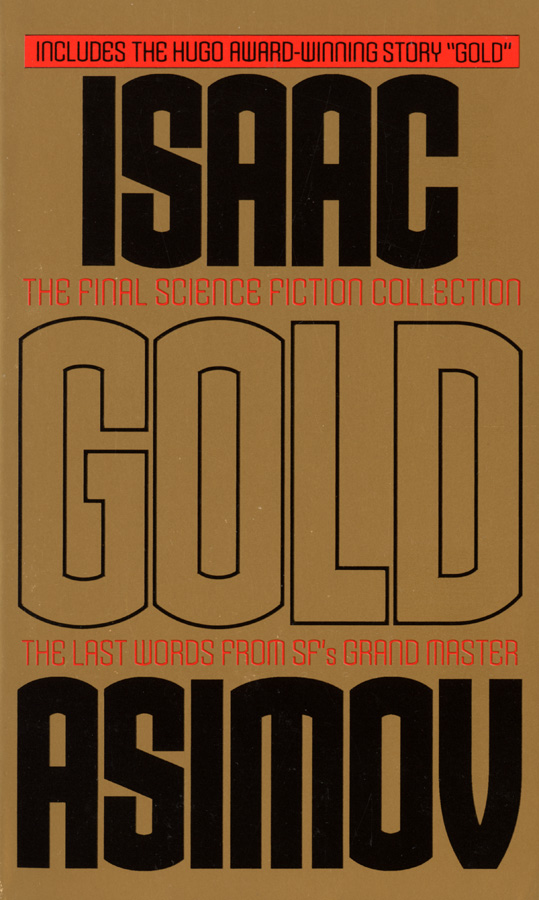
Gold

Gold
© Nightfall, Inc. / The Isaac Asimov Estate
345 pages

"At present, when there are a great many writers attempting to scale the mountainside of science fiction, it must be rather annoying for them to see the peak occupied by elderly has-beens who cling to it with their arthritic paws and simply won't get off. Even death, it seems, won't stop us, since Heinlein has already published a posthumous book and reissues of his old novels are in the works." - p. 146, from "Inventing a Universe".

Frequent readers know how big a fan I am of Isaac Asimov, and how much I especially love his short-story collections, so I was very much looking forward this to collection of previously uncollected work. The book is possibly a companion piece to Magic, as both were published in the same year, both share the same format, and both have similar cover art. Like Magic, Gold is a collection of short stories and essays by the late and great Isaac Asimov. Like Magic, Gold is devided into three sections: stories, essays, and more essays. The difference here is that the first set of essays deal with science fiction in general while the second set of essays deals with writing, and writing science fiction in particular.

The stories rate as some of the best I've read from Asimov so far, although to be fair my enjoyment may have been heightened by anticipation. The titular piece, "Gold", is especially good: Asimov tells the story of an artist in the future who composes "compudramas" -- works of art that seems to be somewhere between Pixar-type animated works that are serious, IMAX experiences involving both music and etheral images, and a holodeck. The artist is best known for bringing King Lear to life for his "modern" audience despite the cultural gap, and is approached by a relatively unknown science fiction writer who wishes our artists to create a compu-drama based on a very esoteric work of "hard" science fiction where the lead characters are so far from normality that the artist has to push his creative boundaries to make them alien yet relatable to the human audience. Asimov takes us through the artist's process -- something that seemed to me would be difficult to do even for a seasoned author such as Asimov. Some of the stories are elaborate pun setups, and one of them in particular -- "Cal" -- features a robot who discovers something greater than the Laws of Robotics.

The second section consists of essays on science fiction as a genre and seems to pull from anthologies that Asimov edited, using his introductory essays. These are unedited, meaning the reader will experience Asimov referring to volumes of stories they have no access to. At first this seemed clumsily done -- why not edit the references out? -- but it doesn't retract from the essays too much. Some essay topics include the problems with proposed ways to travel the galaxy, robots, women and science fiction, psychohistory, "golden ages", flying saucer literature, and the influence of science fiction. The third and final section seems to consists of editorials from one of Asimov's magazines in which he writes in response to readers' questions (as he does in "Religion and Science Fiction") or muses on his own subject. These concern the writing process -- plot, use of metaphor, and the importance of dialouge.

The collection was a true joy to read: Asimov is as ever funny, lovable, intelligent, and inspirational. Here was a man who loved life, loved his craft, and loved his readers. Gold is a a fitting tribute to him.

Sunday, June 21, 2009

Bagombo Snuff Box

Bagombo Snuff Box: Uncollected Fiction
© 1999 Kurt Vonnegut
295 pages

For some reason, I enjoy reading Kurt Vonnegut. I find his novels and most of the short stories I've read of his hard to follow, but I enjoy them still. I was delighted to find this book a collection of very readable short stories -- twenty-two, in fact, with an introduction by Vonnegut and a "Coda to my Career as a Writer for Periodicals" serving as literary bookends. He refers to them as a collection of "Buddhist catnaps". The stories seem to be of his early works (pre-1953), and their settings are diverse. One takes place in Czechoslovaka as the war ends, while most seem to be set in immediate or early post-WW2 America. There is at least one speculative fiction story covering the otherworldly results from the US military's attempt to put an intelligence operative into Earth orbit. Interestingly, three of the stories involve the same character -- a high-school band teacher whose obsession with winning every band competition he can provides fuel for conflict. There are a lot of interesting stories here --what happens a brutal Godfather-type character who pretends to be Santa Claus is one of them. Most of the stories seem to be sly commentary about some issue or another, but even without this they would be quite enjoyable. If you can find it, do give it a try.