Star Trek: Elusive Salvation
pub. 2016 Dayton Ward
365 pages
Buckle up, readers, this one is a fun one. In the 19th century, a group of scientists with a cure to saving their people from tyranny were forced to take refuge on Earth after their ship was injured. In the 23rd century, these scientists' people have appealed to the Federation to help them find the remains of their lost comrades, for they are still in need of the cure and it could be found within the scientists' bodies or ships. Because there's no way to find them in the 23rd century, Kirk decides to use his previous contact with 20th century personalities Gary Seven and Roberta Lincoln to enlist their help, and -- fifteen years "later" in Seven/Lincoln's POV -- the action culminates in NYC, circa 1985. All the while, a secret government agency organized in 1947 to investigate and sequester all information regarding alien visits to the Earth, follows the trail of both the aliens, Lincoln, and -- finally, Kirk, wondering: WHY ON EARTH IS EARTH SO POPULAR WITH ALIENS?
The last time Dayton Ward played with history like this I enjoyed it enormously, and Elusive Salvation was in that same neighborhood. It wasn't quite as novel this time, but I liked the connections Ward tried to draw between the plot and what was happening in real life, like Reagan's "Star Wars" program. The last time Ward did this there were numerous connections to the Star Trek time-traveling shows; those are here as well, but they don't fit in the context of the actual story so they're moved to the epilogue. The big exception is Mestrel, the Vulcan left on Earth from ENT's Carbon Creek episode, who also had a big part in Ward's previous playing-with-history title, From History's Shadow. The epilogue also contains an oblique reference to Section 31, which has probably caused raging arguments on Treklit forums given that Ward is apparently advancing an alternate explanation for why S31 has that particular name.
"...if I’m correct, going to war with Section Thirty-one can only end badly for you. Either you will lose, and you and all your friends will suffer gruesome fates I’d rather not imagine; or you will win—and in so doing, end up inflicting more harm than good upon your beloved Federation.”
For four years, Julian Bashir has yearned to destroy the malicious intelligence-and-covert ops organization known as Section 31 from the inside. A rendezvous with a desperate journalist in the frozen wastes of Andor, however, makes him realize more than ever that he is over his head. Running in the background of the entire Alpha Quadrant's technical infrastructure, from replicators to warp cores and shuttle transports is a common code, creating a massively distributed superintelligence which is monitoring and reporting -- but reporting to whom? This AI no doubt has some connection to Section 31, which always seems several steps ahead of its opponents, but how can they be defeated when the very substance of Federation civilization is reporting for it? The truth, as ever, is even more frightening...
Many Trek books are great adventure stories, and some are beautiful bits of drama; the true talents of modern Trek literature are equally able to provide horror and comedy. Control distinguishes itself, however, by its timeliness. The world of Control is not a fantasy, but rather one we are building day by day. Something very much like Control in the real world was already explored by Daemon, Daniel Suarez's cyberthriller, and those who remember its plot may steal a march on the main characters here. Although Bashir and his fellow fugitive, his lover and fellow S31 double agent Sarina, seek refuge and help from trusted sources, no place within the Alpha Quadrant is safe for long, because no matter what they do, Bashir and his friends always seem to be playing right into Section 31's hands. Mack excels in torturing characters emotionally, and that's supplied here with one prominent death and another character psychologically crushed. The ending was...surprising at first, but carries its twist.
For those who have been fascinated by Section 31 since their introduction in "Inquisition", Control explores their past and delivers the final reckoning with them. While it seems a little rushed, the twist ending also indicates that another game is still afoot.
Related:
A brief clip from "Inquisition", the episode of Deep Space Nine in which Section 31 was introduced, and another clip from "Inter Arma Enim Silent Leges", when Bashir learns that someone he admires and respects. Episodes like these are why I believe Deep Space Nine is far and away the best Trek series, not only for its deep bench of complex characters, but the serious moral issues it explored. This wasn't something that slowly developed, either, but was present from the start -- just see the first-season episode "Duet", in which a Cardassian who was a lowly clerk during the occupation assumes the identity of his murderous boss, Gul Darheel, just so that he can be exposed and put on trial -- thereby allowing Cardassia to face its guilt and redeem itself for its past injustices.
"Murder is murder, regardless of whether it is committed by an individual, a group of persons, or the state." - Disavowed, David Mack
Disavowed is the brilliant result of multiple spy plots intersecting one another, bringing together the standard and 'mirror' universes. Following Rise like Lions, a political entity much like the Federation has established itself in the Mirror Universe, and is strengthened by a hidden organization called Memory Omega. Established by Emperor Spock to conceal itself and to become a galactic puppetmaster, Memory Omega functioned rather like Hari Seldon intended the Second Foundation to function in his attempt to shorten the galactic dark age and create a second Republic. Because of Omega, the nascent Commonwealth has tremendous weapons at its disposal -- weapons the Breen of the standard universe have caught wind of, and are planning a covert invasion of the mirror universe in order to steal. Section 31, the amoral organization which pledges itself to protect the Federation without sanction or oversight, which previously nearly effected genocide by turning Constable Odo into a Typhoid Marry, is intent on preventing the Breen from gaining this kind of advantage -- and to help scotch the Breen's plan, they are putting Julian Bashir -- who is helping them only because of the threat the Breen might pose with these weapons -- into play. But there's always another level of conspiracy, and before this one runs its course we'll see a Dominion invasion of the mirror Alpha Quadrant, a beloved character on trial, and a faction who are even better at pulling strings than Section 31. This is, in short, a very cool book.
Many years ago one of Trek lit's best miniseries hit the shelves: Section 31, telling stories of that very interesting organization as it acted in TOS, TNG, DS9, and VOY; I was very glad to see their return, especially under the able pen of David Mack. Mack here writes a sequel to both Rise like Lions and The Fall series, bringing two universes together, and allows us to spend time with a lot of beloved characters who are long gone in the standard universe, but still active in the mirror. People like Weyoun, that merry villain, and Eddington -- a rebel in one universe, an admired head of state here. And not to mention Saavik, whether you're imagining her as Kirstie Alley or Robin Curtis. We get glimpses of some of Section 31's toys, there are the expected allusions ("Not good enough, damn it, not good enough! -- thank you, Captain Picard), and a fair bit of comedy to balance out what is one edge of the seat moment after another. Bashir, for instance, is entering Section 31's service as a double agent; he intends to work for them only to bring them down, and so does his girlfriend. When she 'seduces' him into joining 31, however, members of 31 are in fact observing them and mocking their poor acting skills...even the Vulcan. Why 31 is still using Bashir and Sarina Douglas is one of the wheels-within-wheels ops that won't be unveiled until the end. We also receive regular insights into the Breen and into the mirror-Dominion, who are..very much the same, but different in an important way.
This is a thoroughly gripping tale, and I'm looking forward to the sequel, Control.
Other Highlights:
“Because this isn’t about strength. Justice isn’t decided by power. It isn’t born through the force of arms. It comes from people of conscience taking responsibility for their own lives—and accepting the consequences of their actions.”
Star Trek and its iterations have produced many kinds of shows -- adventures, romances, mysteries, action thrillers, spy dramas -- but its horror episodes are particularly memorable. Since we're nearing Halloween, I thought it would be fun to share some the more appropriate episodes. This isn't an objective list compiled from a survey; there are just episodes I remember as being creepy or appropriate, and naturally there's a bias toward Deep Space Nine given that it's my favorite.
"Catspaw", TOS (02x07)
Although I don't find "Catspaw" particularly scary, it's gotta be here considering that it was deliberately filmed for and aired on Halloween. After losing contact with a landing party, Kirk and his senior staff beam down to find a fog-covered arena of mystery, apparitions of witches warning them away in a threatening chant, and a gloomy gothic castle shrouded in the mist. Inside the castle, their lost landing party waits for them in a dungeon, under the control of a malicious "wizard".
"Macrocosm", ST-VOY(03x12)
Captain Janeway and Neelix return to a Voyager which is strangely empty, except for occasional noises deep in the interior, and see evidence that the crew left their stations abruptly. But there is something else on the ship that's alive...
"Night Terrors", ST-TNG (04x17)
The Enterprise-D is caught in a spatial anomaly that denies the crew the ability to really sleep. As they sink into hallucinations and violence, Deanna Troi -- who keeps hearing the voice within her head intone "EYES IN THE DARK, ONE MOON CIRCLING" -- tries to find an answer to what is happening. A nearby ship adrift, filled with the bodies of a crew that murdered itself, is an ominous reminder of what will happen if she doesn't.
"Whispers", ST-DS9 (02x14)
"Whispers opens with Miles O'Brien escaping from...Deep Space Nine, where his friends and coworkers have inexplicably begun treating him like an enemy in disguise. One of the many "abuse O'Brien" episodes of DS9, viewers witness poor Miles suffering cold distrust from first both his wife and his command, and then everyone -- even children. After using his engineering know-how and knowledge of the station's innards to escape, he looks to Starfleet Command for reprieve. In a related episode, "The Assignment", Mile's wife is possessed by a malevolent alien who wishes to attack Bajor...and if the chief doesn't assist the creature, it will kill his wife and daughter.
"Distant Voices", ST-DS9 (03x18)
Shortly after being physically attacked by an alien in his lab, Dr. Julian Bashir wakes up to a seemingly abandoned and crippled station. What's more, he's aging -- rapidly, and hears faint voices all around him. When he finally finds a few scattered members of the crew, they're acting uncharacteristically. When Bashir's failing faculties seem to align with the crew being killed by a monstrous assassin, the doctor realizes he is fighting for his sanity within his own head.
"One"/"Doctor's Orders" ST-VOY/ST-ENT (04x25 | 03x16)
An effective enough story that it was recycled between shows, "One" features Voyager entering an area of space dangerous to most of the life on the ship. Seven of Nine and the Emergency Medical Hologram are immune to the effect, but everyone else must be put into medical stasis. At first, matters go smoothly...but then the EMH is compromised, and Seven is left alone to battle both technical problems and the creeping terror of being alone for weeks on end. ENT re-used the story, but Seven's status as someone still establishing her own identity apart from the Borg collective made the original far more compelling, with Borg hallucinations driving Seven's panic. The filming of "One" used a lot of perspective shots that made it look like Seven was being followed or stalked.
"The Haunting of Deck Twelve", ST-VOY (06x25) Voyager, for reasons undeclared to the viewer, is shutting down all engines and drifting through a nebula more mysterious than normal. While Starfleet's finest will be at their stations during the darkness, monitoring something Very Important, Neelix is assigned to take care of four children whom Voyager rescued. To entertain them, he tells them a "ghost story" about why it's important that the ship is powered down and at full alert, which mixes fact and fantasy and keeps the kids and viewers alike spellbound. There are comedic elements as well, because one of the children is older and keeps asking about the plot holes.
"Schisms", ST-TNG (06x05)
The Enterprise crew is overtaken by creeping paranoia, flashes of memory from a terrible place, and feelings of being out-of-time. When Crusher and Troi begin comparing notes, they realize there are common points of reference, and begin to suspect that the crew are being abducted in their sleep.
"Empok Nor", ST-DS9 (05x24)
A sudden crisis aboard Deep Space Nine forces a small team to raid an abandoned Cardassian outpost for supplies. Because the outpost is booby-trapped, mysterious Cardassian exile Garak comes along to watch for and disable any traps. But the station isn't quite abandoned, and as members of the team begin to be murdered one by one, a psychotropic toxin turns friends against one another. The experience is harrowing enough that a season later, a survivor's behavior is influenced by it while in another tense situation.
1. "Frame of Mind", ST-TNG (06x21). Commander Riker wakes up in an asylum, accused of having murdered a man. He has no memory of the event, and everyone treats him like he is insane. What's more....he is. What Riker experiences and the reality around him constantly conflict, and even when members of the Enterprise crew show up to check on him, they prove only to be part of the delusion. The episode is a complete mindscrew, keeping the viewer and Riker completely unsettled. "Frame of Mind" is the reason I made this list to begin with, and I went ahead and made it number one before anything else.
Back in the early 2000s, a guy named DarkMateria did three remix songs, using TNG clips and music -- one for Picard, one for Worf, and one for "Frame of Mind". I'm including a fan-made vid above using the music.
All Miles O'Brien wanted to do was visit a research lab and catch up with an old friend, along with his engineering chum Nog. He didn't expect to be thrown into a fight for his life, one involving giant robotic spiders and a massive blob of organic materials using a dead engineer's head as a sock puppet. But that's a day in the life of Miles Edward O'Brien.
Force and Motion had two immediate lures for me: first, the friend O'Brien is visiting is none other than Benjamin Maxwell, the captain who went 'rogue' in TNG's "The Wounded", insisting the Cardassians were re-arming and launching a one-man war to stop them. Maxwell was cashiered and imprisoned after that, but it's been twenty years and now he's out and about, actively avoiding any serious responsibilities. He just wants to serve, why is why a twice-decorated captain is now the maintenance engineer of a private space station. No one watches "The Wounded" and regards Maxwell as villainous; by the end we know perfectly well the Cardassians are up to mischief, and Maxwell had lost so much at their hands -- his wife and children -- that he was determined they'd never ambush the Federation again. Maxwell was a good man, merely one who had made an error in judgement, and I was eager to know him better.
The space station was the other lure for me: it's a privately-owned science station. Star Trek and economics are like reality and political rhetoric; they never intersect. The show writers invariably portrayed business owners as rats and pirates, so I was hoping that a novelist might produce a...well, novel approach. A privately owned research station, home to fringe scientists and the hub for otherwise outlawed genetic engineering? Cool! But....the premise fails to launch. Our enterprising private-owner-of-a-space-station is not a visionary trying to push science outside the smothering watch of a Federation bureaucracy; he's just an amoral eccentric whose self-absorption gets people killed and absolutely ruins O'Brien and Nog's day off. We don't learn too much about the kinds of science and tinkering being done, besides (1) bacteria-eating bacteria (2) robot spiders and (3)..rumors of a shrink ray.
What Force and Motion delivers is good content on the growing friendship between O'Brien and Nog, both of whom have seen their friends drift away. Maxwell himself is a central character, but mostly we find him in flashbacks, brooding with his shrink and doing things like building robotic legs to amuse himself. At the end he takes charge of a crisis and earns redemption, which is nice -- but the book's promise never catches fire and delivers for me.
My introduction to Maxwell, with he and O'Brien singing "The Minstrel Boy". Star Trek has introduced me to so much good music over the years...
Who's up for the Cuban Missile Crisis....in spaaaaaaace? When an otherwise friendly nation on the borders of the Federation and two of its allies signs a treaty with a hostile power, allowing them bases for repair and refueling along the Federation border, Starfleet is understandably concerned -- and doubly so when news arrives that a fleet is enroute to supply the bases for their new tenants, carrying chemicals that could be used in biogenic warfare attacks on the Federation. While the USS Enterprise speeds to meet with the Space Cubans to work the diplomatic angle, the USS Aventime is dispatched to do a little friendly snooping near the proposed base nearest the Federation border. When the Cardassians -- who, along with the Ferengi are the other two threatened allies -- arrive ready for war, and the Space Cubans catch wind of possible spies inserted in their country, events begin to spiral out of control, heading towards a war that no one wants but no one seemingly can avoid. But the drama unfolding in open view is only the smoke and mirrors for another maneuver, one that is using parties on both sides.
I bought this book a couple of years back, intrigued by the possible historical parallels and interested in a book which includes both Picard and Dax. The primary appeal of the book is learning about the Tzenkethi, who along with the Breen were pretty much black holes before the Typhon Pact series began. Romulans, we know, love, and fear; while the Gorn and Tholians can be wrapped up in primal fears about reptiles and insects, respectively. The Tzenkethi are presented as a very stable, very hierarchical society who have a natural affinity for the Space Cubans, another stable and hierarchical society. The Tzenkethi view the Federation as some kind of chaos monster, however, the epitome of their every social fear: it's all argument, class-and-racial intermixing, cats and dogs living together, mass hysteria! Who can tell what they'll do, what new planet will sudden fall under their spell?
Having read beyond this series, I knew that no epic war between the Federation and the Typhon Pact broke out, so the drama was largely dampened for me. I assumed the drama would keep ramping up until something happened out of left field to defuse things, and that's more or less what happens. Still, it's nice to see Picard being the commanding diplomat again, and I'll never say no to a story with Ezri Dax and her ship, in part because the Relaunch developed her in such a commendable way -- turning the awkward 20-something shrink of 2000 into the Captain on the Bridge, and in part because the Aventine looks much different than the other Starfleet ships and I 'm ever curious about it.
“That’s what passes for good news, now? We have a good chance of not dying if we crawl into a hole and keep our heads down? I’d hoped we’d have higher standards by now.”
“We play the cards we’re dealt,” Eddington said. “The real question is: What are we going to do next?
Rise Like Lions is the triumphant conclusion of the Mirror Universe lit series, opening with a catastrophic defeat for the Rebellion that sees the seemingly victorious Alliance undermined by its success. As the rebellion retreats to shelter what's left of its men and material, the Klingons and Cardassians' pride drives them to internecine war, and a long-dead emperor's secret project to build a new Republic activates. Although the Rebellion receives new life by unifying with a slave revolt from the Romulans and is further strengthened by Spock's version of the Foundation, its leaders remain divided and can only be saved by...Luc Picard, tomb raider turned George Washington in Space. Although readers may object to a few deus ex machina moments, overall Mack's redemption of the mirror universe is a terrific action novel that redeems the mirror universe.
Star Trek stands apart from most SF series in its unyielding optimism about the nature of man and the future, which is part of why the Mirror Universe has had such a lingering attraction for trek writers since -- allowing them to write our familiar characters as weak and corruptible instead of icons of Federation goodness. Even so, in Trek good wins out: Rise Like Lions not only features a Miles O'Brien who would prefer to exile himself from power rather than behave like his enemy, but continues to uplift a former tomb raider to make him a model hero. The soul-deadening violence and general viciousness of the MU stories in general here fast give away to familiar patterns, heroes resisting the darkness and making it flee from them. A new way is being forged from the wilderness of violence and waste. There are a few epic battles here, all edge-of-the-seat events, although towards the end it becomes apparent that Spock's secret project is a little overpowered. One of the battles isn't militarily necessary, but happens because the Rebellion wants to prove to itself that it has moral legitimacy: it's not fighting to restore the old Terran Empire, but to establish something greater and better, a republic that offers freedom, peace, and respect for all persons.
I like Rise like Lions, and not just because its general theme is redemption, and despite my frequent cynicism about the world I really do live in hope -- or want to, anyway. I appreciate how formerly minor or misunderstood characters like Michael Eddington here play a major stabilizing role (he's the rebellion's voice of reason), and characters who are regarded as rather mundane in the 'real' universe (O'Brien and Keiko) here are the heroes. That was a mark of the series in general, allowing readers to see more of Cal Hudson, Sito Jaxa, and Eddington than we did on screen. The book was full of memorable moments, particularly a assassination that is utterly unexpected to those who have seen Deep Space Nine. No spoilers, but if you like Corat Damar already you're going to want to give him a high five. Although the ending has a feeling of fulfillment, Mack also tacks on an epilogue that hints that another book may follow if readers are aching to see what happens when the Dominion enters the new arena.
The mirror universe of Trek is chiefly known for its inhabitants' general awfulness and triumphant moral chaos. In The Sorrows of Empire, however, Spock killed his captain and seized control of the Empire not for his own gratification, but in pursuit of a dream. In reforming and weakening the Empire and allowing it to be conquered by its enemies, he established the foundation for a new galactic order, seeding the empire with agents conspiring together to create a peaceful republic from the ruins of both the Terran Empire and the Klingon-Cardassian Alliance. Shards and Shadows consists of over a dozen stories spanning the the mirror universe's trek tenure, and Spock's secret project -- "Memory Omega" -- is a persistent aspect of the latter stories. The collection draws on not only the Trek shows, but various series of literature like Vanguard, Stargazer, and Titan. It also visits periods not covered in shows or books. One story follows a young officer named Kirk as he seizes the Enterprise from its ruined drunk of a commander, and another visits the ruined planet of Betazed, where a brothel madame named Troi is hiding desperate secrets.
Below are a few memorable stories:
"Nobunaga" opens the collection with a mindscrew story, one in which the narrator is losing their mind under interrogation and consequently confusing realities. It's a bit like the TNG episode "Frame of Mind", or the Roman Polanski film The Tenant.
"The Greater Good" revisits the world of Talos IV, where Captain Christopher Pike was once captured by telepathic beings and placed into a zoo. That was in our reality. In this reality, whatever happened turned a brilliant young commander into a lifeless shell -- and a ripe target for a rising officer who coveted the Enterprise.
"A Terrible Beauty" features Keiko Ishikawa, who is definitely more than a botanist and loving wife in this universe.
"For Want of a Nail": only one man can stop a centuries-old plan from being unraveled: Reginald Barclay.
I liked this collection more than the previous two, largely because it's not all torture and genocide; here we have signs that Spock's plan will at least bear fruit, even if it doesn't create some uber-federation from the ruins of various nasty polities. I enjoyed the variety of contributing authors, which included favorites from the Relaunch era (Christopher Bennett and David Mack) as well as authors who were active far earlier, like Michael Jan Friedman.
Noticeably absent from Glass Empires were any characters or stories from Deep Space Nine, the series which revived and expanded the premise of the Mirror Universe. Obsidian Alliances remedies that absence, with three MU stories from both Deep Space Nine and Voyager. The third story is from New Frontiers, which I ignored completely, having zero interest in that (lit-only) series. The stories are grimmer in general than those in Glass Empires, and again are largely action and personal drama.
In "The Mirror Scaled Serpent", two beings from the Delta Quadrant are mysteriously thrown across the galaxy and arrive in the badlands, smack in the middle of a chase scene involving a small resistance craft and a Klingon-Cardassian Alliance warship. After being "rescued", Neelix and Kes are of great interest to both sides: Kes is telepathic, and the Terran Empire destroyed all telepathic species long ago, save for the Vulcans who had the good sense not to expose theirs. Weaponizing Kes could swing the balance of the war. Chakotay and his Maquis crew are transposed as rebels, with slight tweaks: B'Elanna Torres is their enemy, and Kathryn Janeway is now "Kate", running the rebel engine room with a snarl even after she's had her coffee. These are not the Voyagers you know and love, of course; Torres is self-loathing and matricidal, Harry Kim is an emotionally scarred orphan whose aim in the resistance is to kill Klingons, and Tom Paris is a er..sex slave to Torres. Neelix and Kes' characters are largely unchanged, confirming my suspicion that the mirror universe is less a polar opposite of the 'real' universe and more of an alternate history where the point of departure happened on Earth somewhere in the past. (Where, who knows? The mirror-Enterprise title sequences hint that powers like the Nazis won in wars instead of losing, and that some power had taken control of Earth prior to the moon landing.)
The Deep Space Nine story, "Saturn's Children", revisits Miles O'Brien, leader of the rebellion, as he struggles with his conscience over the rebellion's actions in the wake of having spent so much time in the Federation. He knows now that Terrans can be principled and compassionate, instead of acting like Klingons with better teeth, and objects to the scorched earth practices of his peer-generals.A disgraced Intendant Kira is forced to serve Chancellor Martok's bed, but being the Intendant, promptly hatches a plan to return herself to grace and supplant her successor – the ice-cold Intendant Ro Laren. This stories has a host of characters I was delighted to see -- Ro, of course, but also Sito Jaxa, a two-episode ensign from TNG who disappeared on a secret mission in Cardassian space. Unfortunately, her tenure here is similarly abridged.
Both tales are enjoyable-enough action stories, but again I was mostly interested in the characterization, and sorely disappointed that Ro and Sito played such minor parts. The continuing growth of the alternate Miles O'Brien is a plus, however. He's such a doggedly good everyman character, and I'm glad to know he's fundamentally decent in any universe. The DS9 tale is also notable for its author, Sarah Shaw, who is in reality David Mack, Destroyer of Worlds. I didn't realize this until I searched for Shaw on Memory Alpha: it was very odd to me that I'd never heard of her before or since. According to Mack, he submitted the story under a psuedonym because he'd been asked to contribute to two volumes of the mirror anthology (the first being Glass Empires) but didn't want to annoy the other authors who'd only gotten to do one story.
Next up: Shards and Shadows, which has contributions from seemingly everyone in Marco Palimeri's rolodex. Seriously, there are thirteen authors.
The original series episode "Mirror, Mirror" visited an alternate universe where familiar characters and institutions existed, but as vulgar perversions of themselves: the Federation was a cruel empire that bullied smaller powers into subordination, its members preyed on one another for promotion-by-assassination, and man's animal passions rather than the better angels of his nature ruled the day. Deep Space Nine revisited this universe, revealing that the Empire had collapsed and that humans were now slaves to a Klingon-Cardassian alliance, and leaders of a new resistance. Glass Empires is a trilogy set throughout the rise, fall, and aftermath of the Terran Empire -- opening with the reign of Empress Hoshi Sato, who leads the Empire's expansion, continuing with the tale of how Emperor Spock single-handedly destroyed the Empire in an attempt to reform it, and ending with Jean Luc Picard and Vash's tale of resistance as they are forced to choose between the appearance of cybernetic creatures called the Borg, and the hated Alliance.
Action-wise, I enjoyed all three novels thoroughly. I was more interested in the characterization than the plots, since the conclusion of the first story was a given and I'd already read the full novel-sized version of the second story. The third was the only major unknown for me. A few of Trek's more interesting characters are here (Shran, the Soong family), and it's amusing to see once-familiar characters behaving somewhat badly.The Enterprise characters become more interesting in general when they're evil, unlike the DS9 characters who were just silly. (At least, in the show: the Niners are noshows here.) The collection has some continuity bugs, though, not surprising given how many authors contributed. One story alludes to the family of Khaan Noonien Singh as the original imperial family, but another story mentions that genetic engineering was forbidden, almost as if the writers forgot this was the mirror universe. Maybe Khan and his family forbad genetic engineering to make sure they had no rivals, but if so that should have been mentioned. Secondly, as much as I liked the idea of an alternate Wolf 359 where a Klingon-Cardassian fleet is trashed, why were the Borg there? In the original TNG run, Picard was introduced to the Borg by Q, who wanted to punish him for his arrogance; the Borg then became interested in the Alpha Quadrant after reading the Enterprise's databanks and began sniffing around. Here they just show up and start assimilating, as if it were preordained. The problem with the mirror universe of DS9 and much of these stories is that it's just not different enough: the only distinction is that humans created an empire instead of peaceful federation, and interstellar affairs have developed differently as a result. We'll see if things improve..
Related:
Dark Mirror, Diane Duane. Easily my favorite Mirror Universe novel, this was published before DS9 ever revisited the mirror universe and builds on the same premise as the original: the Enterprise-D exists, but all of our favorite characters are corrupted and evil. Humanity itself is darker at its core: when the "real" Picard browses his counterpart's library, he is appalled at the directions mirror-Shakespeare had taken in his work.
The Sorrows of Empire, David Mack. A full-length version of the middle story here, about Spock doing his Hari Seldon impersonation.
At the edge of Federation space, at its shared border with the Klingons and the Tholian Assembly, lies trouble. The area known as the Taurus Reach brims with mineral-rich planets supporting humanoid life, but has remained curiously uninhabited for eons. The Tholians regard it with fearful reverence, as if something is buried there that should remain so. Here enter Vanguard Station, a Starfleet starbase intended to oversee the colonization of the Taurus Reach -- and more secretly, a lab to examine its buried secrets. The ST Vanguard series has combined excellent characters, intriguing scientific mystery and steady drama for five books. Now, in Vanguard Declassified, we find four more stories of intrigue, set throughout the first four books of the series. Three of the authors are familiar for their contributions to Vanguard, but Marco Palmieri is better known as the editor who is responsible for spearheading the Star Trek Relaunch.
In “Almost Tomorrow”, the Klingons enter the scene for the first time, and a spy is revealed. This features our favorite Machiavellian Vuclan, T’Pyrnn, and a sex scene that’s more awkward than most because she has a malevolent ghost in her head who wants to possess her lover. Oh, you wacky Vulcans.
“Hard News” features a world-weary but determined journalist and his girl Friday, developing a story that will expose a connection between the Orion pirates and some Starfleet intelligence ops. Word to the wise, making Orions grumpy is a bad idea. They’re not Klingons and you won’t see them coming, green skin aside.
“The Ruins of Noble Men” is a story set in two different time periods; in one, a Vanguard ship is dispatched to a suddenly isolationist colony world to convince them to come back to the fold. The colony is hiding a secret, though, and in attempting to establish meaningful communications with them Captain Desai finds herself thinking about an episode from her former boss-lover’s youth, when he had an usual run-in with a Klingon named Gorkon. (Casual Trek fans may remember Gorkon as the assassinated chancellor in The Undiscovered Country.)
The last story, “The Stars Look Down”, is by David Mack and involves a secret mission to land on a Gorn-controlled world, infiltrate one of their ships, steal/copy data and compromise the original, then get out before the Gorn reprise Cestus III. Features Quinn, a smuggler-scoundrel in the cut of Han Solo or Mal Reynolds, along with his SF intel partner Bridy Mac. This being a David Mack story, there’s intense drama and tragedy. (If you find yourself in a David Mack novel, pray that you are a one-page extra character who is not important enough to matter, either as a tragic death or as a plot driver. Be the guy behind the desk who nods to the main characters as they are running into action. It’s just not safe otherwise.)
The four stories span the entirety of the first five Vanguard books, and between then feature most of the favorite characters from the series. All four are enjoyable tales; I was most partial to “Hard News” because of the unsusual first-person perspective and the general story: I like the pre-ENT Orion pirates. They got a little weird after ENT, with pheromones making people slaves and such. Fewer sex slaves and more organized crime, please, thank you.
Nearly two months have passed since the most popular and widely respected president in Federation history was publicly assassinated, but in that time her temporary replacement has not been standing strong, offering a reassuring presence to a troubled people. Instead, he's been losing friends and alienating people in a misguided effort to renew the Federation as a galactic superpower. With a declared object of making Starfleet a force to be reckoned with, he has instead begun corrupting it by ignoring the chain of command, creating black-ops squads and playing hell with Starfleet schedules by using them for his off-the-books wetwork. Frustrated and wary of his commander in chief's motives, Fleet Admiral Akaar has recalled Captain Riker, promoted him to admiral, and is relying on him to be the one trustworthy man in his office. Riker has thus become the point man in an effort to find out what el presidente is up to. Together, he, Captain Picard, and their respective crews will unearth a few skeletons and put the Federation to rights again. A tale of action and intrigue, Peaceable Kingdoms takes The Fall out on a good step, if not one as strong as previous titles in the series.
The Enterprise has been hovering out of sight for most of this series, consigned by the president to keep station at Ferenginar. It's an obvious misuse of the Federation flagship and its most seasoned captain, not to mention a fairly crappy place for shore leave. Who wants to take their liberty on a swamp-planet? Now the Big E is entering center stage, however, dispatching Dr. Crusher and a few others on a secret mission to an abandoned world where some secrets are buried, there to follow up on one of Riker's leads. They'l have to contend with the president's schemes, though. A welcome relief here is T'Ryssa Chen, who since the Borg War books has added some humor to the Enterprise . She's an oddly irrepressible half-Vulcan with a smart mouth, who a mellowing Picard tolerates with paternal affection. Given the tension of these books -- what is with that title, anyway? Are we anticipating the fall of the Federation? The Typhon Pact? -- her sass evens things out a bit. The series as a whole has been good about leavening the drama with laughs, though.
Peaceable Kingdoms is an enjoyable end to a great series, and its end is a hopeful one -- assuring readers that after the bloodshed and horror of the Great Borg War, and the constant tension of the Cold War in Space, Starfleet is about to commend another grand era of exploration
Without warning or reason, the starship Titan – specialized for deep space exploration – has been recalled and ordered to patrol…Earth. Captain Riker has been promoted to admiral and shoved in an office, while several members of his command crew have disappeared on secret missions that not even the Fleet Admiral knows about. Who’s giving orders around here? It’s a troubled time in the Federation, with one head of state assassinated only weeks before, and the president pro temp acting in ways that make Chancellor Gowron look compassionate and conscientious. More mystery and more stress are not what the Federation needs….but they do make for another great novel in The Fall series.
Schemes are the name of the game here, as everyone is Up to Something. The fleet admiral suspects the president is up to something, Riker suspects the fleet admiral is up to something, and the crews of two starships suspect Riker is up to something. Commanders Tuvok and Nog know they’re both being put up to something, because they and a few other officers have been ordered to the middle of nowhere to meet a group of mercenaries who are obviously up to no good. But what is going on? All these secret goings-on are the ripples around the schemer in chief, President Pro Tempore Ishan Anjar. Anjar was chosen not for manifest competence, but to assure Bajor – in the light of the Federation’s growing ties with Cardassia – that Bajor’s history was not forgotten, and its place is secure. Throughout this series he’s proven himself to be petty, mean, obnoxious, and other sundry adjectives, prolonging crises for political gain. That is coming to a head, however, and things are unraveling.
The Poison Chalice brims over with intrigue and terse conversations, with a healthy bit of action and a little comedy as well. I was spellbound, still enjoying the drama of Starfleet officers wrestling with questions of conscience and duty, and can’t wait to see how this ends. I hope it involves Anjar getting a right sound lecture from Picard. Or a right sound backhand from Worf -- I'm not particular.
"I'm a ship captain, doctor. Risk is my business."
"...you're an un-armed, one-man freighter."
"Okay, delivering cargo is my business. But I'm trying to diversify."
Now this is a way to start 2018! When Julian Bashir's vacation is interrupted by a Ferengi delivering a message from an old comrade in hiding, the good doctor has no idea his finest hour is upon him. He is asked to receive stolen biological data, and from the noise therin produce a pattern that might save a people from extinction. It won't be easy: the data is considered highly sensitive by three governments, one of which might kill Bashir for trying to use it, and even if he finds a cure, his career with Starfleet will be over. Still struggling with his conscience over his actions in a sanctioned but bloody bit of intelligence work (Zero Sum Game), Bashir knows responding to this forlorn plea is both the right thing to do, and an opportunity for personal absolution. If he can obtain the missing pieces and coax some of Starfleet's finest geneticists into helping him, a people might be saved -- and if it costs him his career, his freedom, or his life, Bashir is determined to deliver. A Ceremony of Losses is the best Trek book I've read in years, a thriller that smartly combines political and personal drama, humor, and action in a tight story full of moral dilemmas.
A little backstory is required to fully enjoy A Ceremony of Losses, but that's to be expected in the third book of a series. The Andorians are an odd species in that they have four sexes, all of which are required to produce a single offspring. Even Treklit published in the Enterprise era hinted that the Andorians were drifting toward extinction, their reproduction woes magnified by a buildup of recessive genes that were causing chronic miscarriages. Between the Borg War and the ordinary passage of time, the Andorians have come to a crisis point: they'll be extinct in a generation if something isn't done. In Paths of Disharmony, the revelation that the Federation's ban on genetically engineering sentient lifeforms, and its sequestration of any data that would aide such a project, had hidden information and tools that might be used to help Andoria resulted in that planet -- one of the original founding worlds -- seceding from the Union. Now, in The Fall, Andoria is under an embargo by the Federation, who suspects its leadership is being manipulated by the Typhon Pact, a confederacy of villains. The banned information and tools are what Bashir needs, but it will take more minds than his to find a cure, and even when he does the political leadership of both Andor and the Federation are playing games. Bashir has to find a way to obtain the data and do lab work without triggering any security measures, and once he's exposed he may have to burn a lot of bridges trying to get the results to the right people on Andoria.
One of the greatest aspects of this novel is its persistent moral drama. Bashir and his comrades aren't civilians, they're Starfleet officers who have sworn to obey their orders, even if their orders come from an absolute ass of a president . Bashir, Captain Ro, Captain Ezri Dax, and others all have to decide how far they can toe the line, and when they'll step over the edge. It makes for fantastic drama because characters readers know and like are working in opposition to one another, each trying to follow their conscience as best they know how, wrestling with themselves as one another. Creating believable, sustainable drama in this fashion is a lot more challenging than using obvious Bad Guys to provoke the plot, though most of the politicians here are decidedly unsympathetic antagonists. What makes it even better is that there are real consequences for these characters' decisions: this isn't like one of the shows, where some stern admiral pops on to lecture Kirk or Picard for being naughty, then gamely allows that the results have been worth it. Some characters will have to face the music with only a clean conscience at their back.
Oh, and this book is only .99 cents on Amazon, along with the other books in The Fall series.
After ten years of reconstruction, the Federation is preparing to leave Cardassia. Not all the locals gathering outside are there to wish its engineers and social workers a fare-thee-well, however. A new political movement representing the old Cardassia is growing in strength, and styles itself "Cardassia First". Infiltrating civil institutions and orchestrating riots, it promises to field a candidate against the Federation-friendly administration and disrupt Cardassia's growing relationship with the Federation and its allies. Worse yet, a high-profile political assassination puts both powers on the edge of falling away from one another. Assassinations and unruly mobs, with the fate of Cardassia hanging in the balance -- this looks like a job for....Garak, Intergalactic Man of Mystery!
No longer the mere mysterious spy-turned-tailor of Deep Space Nine, Garak is Cardassia's ambassador to Earth, having previously served in other Reconstruction governments.The Garak of Crimson Shadow has grown much from the Garak of the television show, who was already complex. Garak's past association with an organization so ominous that it chills Cardassian spines fifteen years after its demise has left him with blood on his hands that cannot be rubbed out. His conscience was once becalmed by the thought that he was acting for the good for Cardassia, in the service of the State, but witnessing nearly a trillion deaths and the obliteration of so much of what he loved has broken Garak's faith. Now, ever wrestling with his conscience, he hopes to help Cardassia find a new way -- one that includes more engagement with the rest of the Quadrant -- and gropes for how to fight monsters without again becoming a monster himself. Garak hasn't hung up his cloak and dagger for good, though, as he proves to have a few tricks up his sleeve that don't involve discretely killing someone. This quandry is also present in the stories of several police officers, who are trying to establish and protect their Constabulary's integrity after past versions of it were co-opted by the State to hurt the people. One of the few non-Cardassian characters here is Jean Luc Picard, who with Garak has to somehow mitigate the damage that each man's civil superiors threatens to wreack in the wake of both books' events.
I enjoyed The Crimson Shadow enormously, as I'm partial to Cardassian stories and especially to Garak. While there's still a little obviousness in how McCormack portrays her villains, she did introduce an interesting idea about the origin of the Obsidian Order. Her portrayal of Garak, as he and his castellan (president) try to navigate away from the sirens that might destroy them, even as they attract so many citizens, more than makes up for the mustache-twirling antagonists. As a bonus, McCormack indirectly quoted CS Lewis, when she makes Garak observe that people are much more dangerous when their tyranny is effected with sincere intentions to help others. A comparative Lewis quote is here.
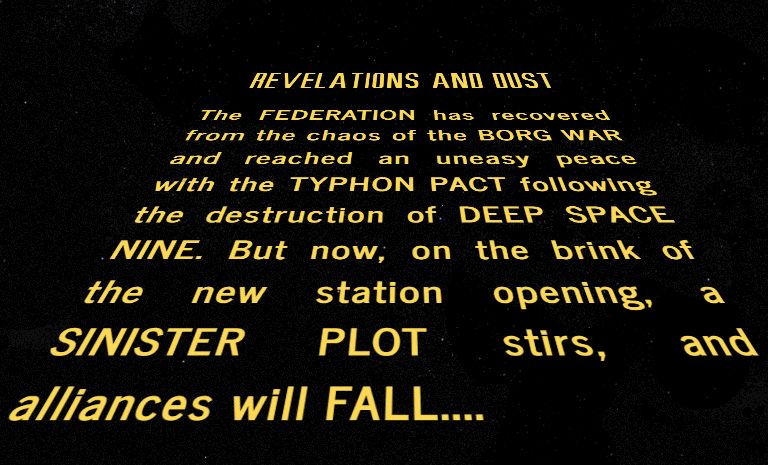
David R. George takes a bullet for the team in The Fall: Revelation and Dust. First in a five-part series with five participating authors, Revelation and Dust largely consists of recap, introduction, and assassination. Well, something had to happen, right? There's four books after this, so something extraordinary had to hook us for the rest. We've had the Borg invasion, we've blown up Deep Space Nine already, the Dominion are SO yesterday, and the hostile takeover of the Federation by the Ferengi Alliance is unlikely. So, gunshots it is.
At the end of George's DS9/Typhon Pact duology, Deep Space Nine was blown up with the lost of most of its hands. Two years later, the station has been rebuilt, this time as a proper deep space installation instead of an ore-processing plant turned command post. Its formal opening coincides with the two year anniversary of the old station's destruction, and now the gang is back together to pay respects to their fallen comrades, and their now-vaporized home. Tensions from the previous Typhon Pact novels -- Sisko's estrangement from his wife Kasidy, Bashir and Dax's falling out over Bashir's determination to destroy Section 31 from the inside -- are buried, making room for new and exciting arguments.The novel largely follows the characters as they make their way to the station and renew old acquaintances, musing over the good times until the speeches and gunfire start. Part of this catching-up is an unfortunate series of chapters that re-uses a plot device from one of the early Relaunch novels: readers are subjected to completely new characters in some quasi-fantasy setting involving a tribe called the 'Bajora'. As with last time this is an extended vision effected by the Prophets, because the mystical goings-on here translate parable-like to something "real" that has happened . The upshot of this thread seems to be that Sisko can have his life back from Prophets. He can have his family and they won't kill him. Yay. In any case, I don't want to read about random fantasy Bajorans, I want to read about President Bacco. She's always fun.
George's previous DS9 novels have all been great reads, but this one is lacking...story. This is essentially a Star Wars scrolling text intro, expanded to 400 pages. See for yourself!
No Star Trek series rivals Deep Space Nine for its moral drama, for its stationary setting meant that characters had to live with the consequences of thir decisions. It told rich stories, and put characters into hard positions. Decisions and their consequences are the theme of The Never Ending Sacrifice, which tells the story of a young boy whose life changed radically when Commander Sisko had to make a hard choice about him, The boy, Rugal, was a Cardassian orphan thought dead by his father, adopted and raised by Bajorans as their own. When the boy's Cardassian father realized his son was still alive and on the station, he successfully petitioned Sisko for custody. The Never Ending Sacrifice explores the consequences of that decision, as Rugal returns to a Cardassia that will -- as DS9's seven year run unfolds -- descend into hell. As Cardassia reels from one government to another, Rugal copes with his homesickness and self-loathing -- lashing out against those who want to love him, and courting disaster by seeking purpose in revolution. Ultimately, as Cardassia falls into tragedy -- the abyss of the Dominion War, and its eight hundred million dead -- a young man surrounded by death finds life to cherish.
My regard for this book see-sawed a bit at first. I was immediately won over by the title, which is that of a Cardassian family epic mentioned in "The Wire". As Rugal uneasily settled into his new Cardassian life, I was disappointed in the easy "Bad Guy Empire" rendering of Cardassian society, as it seemed less like a coherent state and more of a device to complain about contemporary society. However, McCormack skillfully works in connections to the larger Trek verse that lured me into appreciating it more. Rugal takes inspiration from the words of dissident professor Natima Lang, for instance, who fled Cardassia in "Profit and Loss"; Tekeny Ghemor, the sympathetic reformist gul who was the target of a plot in "Second Skin", is a constant source of hope -- and later on, Rugal's connections to Ziyal allow him to elicit the help of one Elim Garak. Ultimately, it was McCormack's ending which fully won me over. Rugal fights the title of the novel by resisting the tendency to pass on old battles to the next generation, and his own decisions to stay or go create a redemptive ending that buried my grumbles. Although this is not quite A Stitch in Time, it's still very good.
Deep Space Nine once made a throwaway reference to the Mike Hammer novels of Mickey Spillane, and featured Constable Odo reading I, the Jury. I, the Constable, plays with that a bit more by having Odo play detective on Ferenginar, searching for a missing person. Odo fills his spare time on the flight writing 'letters' to Kira and reading more detective fiction -- Raymond Chandler and Dashiell Hammett are named -- and arrives on Ferenginar slinging a mix of 20th century detective slang. The trail will lead him to dead bodies and scheming women, and culminate in a local stumbling around in a trench coat and fedora trying to help. If one likes straight mysteries and can tolerate the Ferengi, this is an amusing read. I was hoping the narrative voice would evoke Hammett and Chandler's style more, beyond a little slang. ("Neither of the two people in the room paid any attention to the way I came in, although only one of them was dead.")
"I'm not even supposed to be here! I'm just Crewman #6. I'm the guy in the episode who dies to prove the situation is serious!" ("Guy", GalaxyQuest)
Redshirts is not what you think it is.
To be sure, it's mostly what you think it is, what you've heard it is; a spoof of Star Trek that mixes it in with concepts from The Truman Show and Stranger than Fiction, and comes within a few words of quoting that other great Star Trek spoof, GalaxyQuest. As far as spoofs go, it lives up to its reputation for being hilarious and meta. We have self-aware redshirts who avoid interactions with the bridge crew of a Federation , having realized that those guys go on away missions with crewmen and come back with bodybags. One member of the crew believes that the good ship Intrepid is in fact a TV show, and that when strange things happen, that's the Narrative at work. A lot of the silliness of shows like Star Trek is played with, particularly plot implausibilities, and the ability of battered characters to heal overnight, like the much-abused Miles Edward O'Brien. After a couple of ensigns begin to that they're living in a conspiracy, they go on a mission to put things to rights, and it involves time-travel, doppelgangers, and other such hijinks. If that were everything, I'd put this book up on the shelf having gotten my laugh, and think of it fondly from time to time as I do Night of the Living Trekkies. But that's not the entirety of Redshirts. Buried at the end are three codas, titled "First Person", "Second Person", and "Third Person" respectively. These three codas transform an amusing novel into one which is profoundly moving. I can't say if the conclusion's effect on me is merely a consequence of the author's writing, or if it was Wil Wheaton's delivery. Suffice it to say, I never thought Wil Wheaton could move me, but he did.
What if....Khan won the Eugenics Wars? What if....Earth had succumbed to fear after the Xindi attack, and withdrawn from the Coalition of Planets and exploring the final frontier? And what if -- and this is a big one -- what if Harry Kim was promoted to lieutenant? Such are the stories, the three novellas, comprising ST: Myriad Universes, volume one. Three Treklit veterans have produced here a collection of stories that have old heroes and villains -- Kirk, Dukat, KHAAAAAAAAN! -- playing very different roles. An unexpected discovery for me, I couldn't stop reading it.
William Leisner's "A Less Perfect Union" starts us off with an alternate Babel conference, featuring a xenophobic James Kirk who serves the United Earth ship Enterprise, under the command of an aging Christopher Pike. Although Earth succumbed to xenophobic politics following the conclusion of the Xindi war, withdrawing from the proto-Federation, after a century of isolation some on Earth are interested in restoring relations with the Vulcans and Andorians. Unfortunately, their spokesperson -- T'Pol, who remembers the hopeful days of Archer's Enterprise -- is kidnapped by a Romulan impersonating Ambassador Sarek, with the unwitting help of Jim Kirk. Leiser almost rivals Greg Cox for subtle allusions to parts of the Trek verse, including Trek literature. This was a strong start to the book, with the hilarious sight of Doctor McCoy urging Jim not to be so defensively racist about Vulcans.
In Christopher Bennett's "Places of Exile", we see a Voyager too shattered by its first encounter with Species 8472 to continue pressing on towards the Alpha Quadrant, choosing instead to temporarily settle among the residents and officers of a space station-based civilization. Bennett brings his customary science strengths to the table here, and they serve him and the reader well when he begins exploring fluidic space. Janeway and Chakotay's enthuaism for making a home in the Delta Quadrant vary widely: Janeway's intention of returning to the Federation never wavers, and she is concerned that her crew might lose its identity. But it is Federation ideals that move Janeway and the other to work with refugees of the Borg-8472 war, creating a nascent coalition that works to find a way, martial or scientific, to end the brewing catastrophe. Another interesting aspect of this story is the expansion of the Doctor, who becomes a dispersed intelligence controlling medical droids throughout the Coalition's stations and ships. Although Bennett kills off Tuvok and Paris, Harry Kim finally gets a love life and a promotion. (Was it worth it, Harry?)
"Seeds of Dissent", authored by James Swallow, visits a very different 24th century, one in which Khan Noonien Singh won the Eugenics Wars and created a human empire nearly engulfing the Alpha Quadrant. The discovery of an ancient human freighter -- the Botany Bay -- sparks problems for the Children of Khan, however. The freighter contains the last survivors of unmodified humanity, and their memory banks contain records of the atrocities committed during Khan's rise to power -- and challenging a history of Khan that sees him personally doing everything from being the first to step foot on Mars to breaking the lightspeed barrier. Although this story features an amusingly perverse pairing of Kira and Dukat (rebel lovers), it's mostly a generic rebels vs the Empire story. The augmented humans aren't even interesting: they're big and can survive in space for a few moments, but nothing of their society is revealed beyond a lot of Roman-derived titles. The ending was a little different than expected, however.
Of the three, I regard Bennett's as the strongest. Swallow's had the most interesting premise, but its development wasn't nearly as imaginative as it could have been. This book is first in a trilogy of alt-tales, but the others don't seem particularly interesting -- with one exception, of Soong-type androids becoming pervasive in the Federation. As usual, Bennett posts annotations for his story.