Monday, October 20, 2008

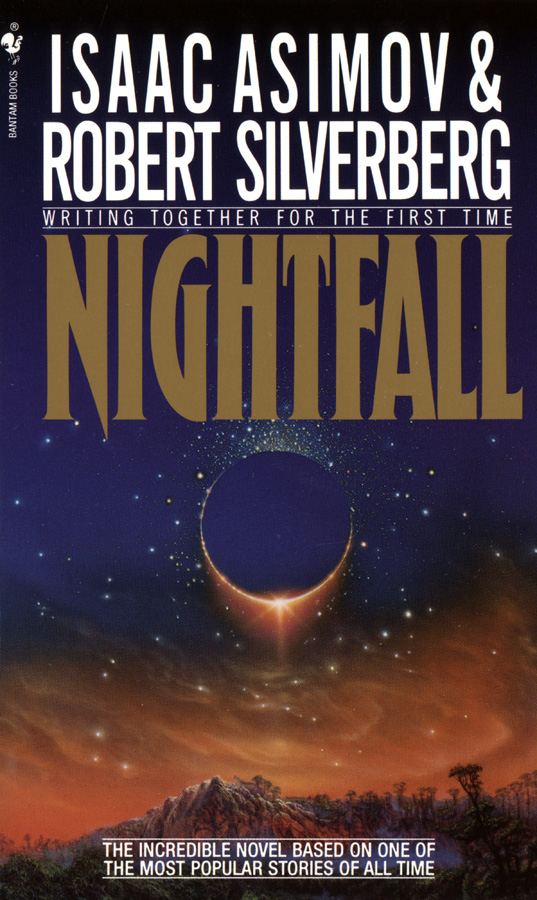
Nightfall

Nightfall
Isaac Asimov and Robert Silverberg, © 1990
Bantam Books, New York
339 pages.

If the stars should appear one night in a thousand years, how would men believe and adore and preserve for many generations the remembrance of the city of God!

A little over a year ago I read my second work of fiction by Isaac Asimov, one that made me a fan and led to the Asimov-binge I enjoyed so thoroughly this summer. Nightfall and Other Stories captivated me. The title story is set in a world occupied by humans, but who have no connection with Earth. A bit like the LOTR series, I suppose -- the humans there live in a completely different but understandable world of their own. The same is true of the humans who live on the planet of Lagesh, whose civilization has never known night -- or has it?

The planet is illuminated constantly by five suns. I'm not quite sure how that works in astronomical terms, but given Asimov's knowledge of astronomy I wouldn't be surprised if he had something in mind. Because of this constant illumination, the humans here have no knowledge of night -- but that will change. The story, apparantly quite well-reviewed, was adapted into a novel in 1990 -- and that is what I have just read.

Although the people of this world have no active memory of ever seeing night, legends of the past state that every 2049 years the Gods examine the people of Lagesh (called Kalgesh in the novel) to see if they are moral or not. When They realize that the people are still sinful, they in their divine fury hide the light of the suns and send the Stars to rain fire down the people to purge them of their wicked ways. These legends are religious in nature, and a powerful group called the Apostles of Flame are more active than ever in the days that begin this novel.

While it is easy to dismiss their rantings about the end of days as nothing more than religious lunacy, those rationalists who the Apostles decry as godless are realizing that something is...off.
  • Sheerin 501, a psychologist who is becoming increasingly aware of the negative psychological effects of even a little darkness on the Kalgeshian psyche.
  • Siferra 89, an archaologist examining the ruins of an ancient city who discovers to her confusion the existence of six other ruined cities built below it -- each displaying evidence of having been destroyed by fire, with the other cities being built above them before subsequently being burned themselves -- with 2049 years existing between each city's rise and fall, indicating the city was periodically burned to the ground, then rebuilt.
  • Beenay 25, a mathmetician who realizes that there's something lacking in his hero and mentor's Theory of Universal Gravitation.

As the novel progresses, Beenay and his mentor realize that Kalgesh has a natural satellite, one that they have never seen before because the light reflected from its surface is washed out by the light from Kalgesh's various suns. This satellite is projected to eclipse one of their suns on a day when that sun is the only one in the sky. The result will be hours of darkness. This eclipse, like those of our Sun, can be predicted using gravitational theory -- and they realize that the eclipse has occured before -- and occurs every 2049 years. The onset of Darkness -- which the Kalgeshians fear instinctively -- would be fought by attempts to make fires whenever they could, they reason, and uncontrolled fires breaking out planet-wide could destroy their civilizations. While they have a few lights in internal rooms, the net effect will be hemisphere-wide darkness.

This, coupled with Siferra's archaeologist data, seems to validate the claims made by the Apostles of Flame, who forcast doom and destruction. This is not easy to accept by the rationalists, but eventually they do. They attempt to warn the population, but their claims are discounted by a cynical journalist named Theremon -- who denounces the scientists as having either lost their heads or become worry-warts. (This could concievably be a gentle poke by Asimov at those who mock global warming proponents, since Asimov was attempting to raise awareness about global warming in the 1980s.) As a result, society is largely unprepared on the day when the only sun in the sky begins to be eclipsed by a dark body -- Kalgesh's moon.

As the sun's light gives way to darkness and the stars appear in all their glory, Asimov ended the short story version of this. I believe the last line was something along the lines of "My god, look at the Stars!". This is interesting, because as we find out, it's not the darkness that strives men mad -- it's the overwhelming and terrifying beauty of the stars, whose existence could never be imagined. Nightfall does not conclude with the arrival of the Stars, though: it continues with "Daybreak", where we see the consequences. Only two groups we know of have prepared in any way for the Darkness: the Apostles of Flame, who intend to impose a theocracy from the ashes of their civilization -- and the scientists, who have prepared a small sanctuary with the knowledge of civilization. We are thus prepared for a battle between the forces of irrationality and rationality -- intriuged?

How the story ends I won't say. I will say, though, that the story remains interesting throughout and I recommend it to those who enjoy a good read. The story provokes many interesting questions, at least for me. For instance, it's highly unlikely that every single civilization was graced with clear skies with the advent of the eclipse. If it was the stars rather than the darkness that drove people made, cloud cover would mitigate the effects greatly. Those civilizations that remained intact could serve as the foundation for a new political order. That would be an interesting sequel -- but Asimov is no longer with us. I suppose Silverberg could write it, but I doubt that would happen.

Sunday, October 19, 2008

The Greatest Benefit to Mankind

(Click title to see the book cover.)
The Greatest Benefit to Mankind
Roy Porter, © 1997
W.W. Norton & Company: New York, London
831 pages

I've been reading The Greatest Benefit to Mankind for the past two weeks. Its full title is "The Greatest Benefit to Mankind: A Medical History of Humanity". I read it on the recommendation of a fellow history of science student, one who was particularly interested in the history of medicine. Happily, my local library had it. The book is quite a read, because it is not limited to western scientific medicine: it also looks at medicine in the ancient world, in India, in China, and among modern foraging societies. The book is divided into twenty-one chapters and an introduction:
  • The Roots of Medicine
  • Antiquity
  • Medicine and Faith
  • The Medieval West
  • Indian Medicine
  • Chinese Medicine
  • Renaissance
  • The New Science
  • Enlightenment
  • Scientific Method in the Nineteenth Century
  • Nineteenth-Century Medical Care
  • Public Medicine
  • From Pasteur to Penicillin
  • Tropical Medicine, World Diseases
  • Psychiatry
  • Medical Research
  • Clinical Science
  • Surgery
  • Medicine, State, and Society
  • Medicine and the People
  • The Past, the Present, and the Future

As you can see, it covers a wide range of topics and so is difficult to summarize. The style is readable, although quite detailed. The author was able to explain the less-familiar ideas behind Indian and Chinese medicine to my satisfaction. The book is arranged topically, and the topics themselves develop chronologically. There is a wealth of information in this book, and much of it was quite interesting personally to me. I learned, for instance, that during the Russian Civil War/October Revolution, the Bolsheviks and White Russians had to contend with an outbreak of typhus as well as their actual physical dispute. "Medicine, the State, and Society" contained a large bit about nationalized health insurance. Germany achieved a form of health insurance in the 1870s (thanks to Chancellor Otto von Bismarck), and England and France followed after the Great War. While the Progressive party promoted national health insurance in the United States, it was decried as being too "German" and being only the concern of overzealous churchmen and hysterical women. A similar drive in the US tried to take off in the late 1940s, but again was seen as too German -- even though England and France also had forms of national insurance. The author writes on the effects of privatized hospital care in the United States. The impression received of the US system is not favorable.

What this book gave me most was an interest in the develop of German universities, since most of the book is focused on the development of medicine in the United States, England, France, and Germany. I've been told by reliable sources that the German university model is the basis for most American university models. The Fount of All Knowledge says that the German model is more focused on research than education, which explains why German universities were able to contribute so much in this book.

Saturday, October 18, 2008

Worldwar: Upsetting the Balance

Worldwar: Upsetting the Balance
Harry Turtledove © 1996
Del Rey/Ballantine Books/Random House; New York
530 p.


I continued in the Worldwar series this week. The front cover is rather interesting, as it depicts Albert Einstein, General Ike Eisenhower, and former Italian dictator Benito Mussolini together. Unlike the past two book covers, this cover actually depicts a scene that happens in the book -- without the jet, however. Upsetting the Balance continues to depict the war between humanity and the lizard-like aliens who call themselves The Race. As you might recall, the Race came to Earth (which they call Tosev-3) thinking they would encounter knights on horseback. This is what they came prepared to fight, although being the cautious kind they brought more supplies than necessary. This is fortunate, because as they neared Earth they realized to their horror that we Tosevites had gained radio already.

The humans the Tosevites find in 1941 are still woefully outclassed by the Race's landcruisers, helicopters, missile-firing fighters, and atomic weapons -- but not nearly as badly as the Race would like. In the past two books, we have witnessed the value of the old adage that 'necessity is the mother of invention'. Tanks improve, and jet fighters displace the old prop-driven ones -- which means the P-51 never becomes widely used, sadly for its fans like myself. Although technology is improving rapidly because the need is so desperate, it is not proceeding nearly as quickly as it would because the Race has made a mess of most industrialized societies. What little gasoline is available is limited to military vehicles, and even it can't be transported to where it needs to go. Consequently, the days of the horse and buggy have returned -- along with an increasing reliance on bicycles. Humans display an ability to adapt that completely frustrates the Race, which is slow, methodical, and fixated on the authority of doctrine. The industrial powers that be -- the United States, Nazi Germany, Japan, and the Soviet Union -- continue to work on their atomic projects. In the last book, the Soviets were able to build a bomb out of material stolen from the Race, and it devastated a large Race force outside of Moscow.

The advent of nuclear weapons is quite bothersome to the Race. They are decades away from Home, their own planet. They have no hope of resupply, and their stores are quickly dwindling. Humanity can build factories and produce arms to replenish their losses, but the Lizards cannot. The "Lizards" is the pejorative term humans use to describe the Race. The Race does try to produce some arms from human-assisted factories, but find that sabotage is rampant. The Race grows increasing more desperate, knowing that eventually they will run out of missiles and ammunition -- and begin to do as during this book. To make matters worse, the British and Germans reintroduce chemical warfare, which the Lizards are utterly unprepared for. As the book passes its midpoint, atomic programs achieve fruition and an uglier stage of the war begins*.

As far as plot goes, I didn't notice anything unrealistic. Turtledove doesn't mentioned what happens to the American presidential race -- Roosevelt is mentioned only once. I would not be surprised if the United States becomes controlled by a lenient version of martial law. I don't know off-hand how much nationalization of industries (state take-over) happened in real life, but if it hasn't happened here in Worldwar's United States, I'd be quite surprised. No other nation in the world (contributing largely to the war effort) has the problem of an elected president with regular, fixed terms. British prime ministers only have to hold an election every five years, and when they hold is is entirely up to the controlling party. What parts of France aren't controlled by Nazi Germany are controlled by Vichy France, and neither the Nazi party in Germany nor the Communist party in Russia have to fret about elections. I mentioned two weeks ago that I wouldn't be surprised if Roosevelt simply continued to lead without an election, but wondered how long he would remain alive. I then speculated on on what kind of president then-vice president Wallace would make. This turns out to be a moot point, as Wallace will be killed by a bomb.

As alternate history and science fiction, it's developing pretty well -- in my opinion. Turtledove likes to work historical situations into his books. In the last book, something I failed to comment on was the Race's attack on Ploiesti to get at Germany's oil refineries. Germany uses the exact same defenses there that they used against the American Eighth bombing group in real life -- with the same effects. Turtledove depicts growing strife -- between ethnic groups, between national leaders, between individual people, between various factions of the Race -- fairly well, I think. I'd like to comment on characterization as well, though. There are three characters I particularly like:
  • Lt. Ludmila Gorbunova, a Russian pilot (female) who Turtledove incessantly tells us is a good student of the October Revolution who has no use for cathedrals.
  • Colonel Henrich Jäger, a German tank commander who turns into a jack-of-all-trades as far as war goes.
  • Sam Yeager, an American baseball player turned foreign liaison. He read Astounding Stories on a regular basis and becomes an expert on communication with the Lizards after he volunteers to guard two Race prisoners.
Gobunova and Jäger become a romantic item in the first book, which rather endears me to them. Jäger is especially likable because he wanted to be an archaeologist before Hitler began rearming Germany and because he displays a strong sense of remorse for what the SS perpetuated in Poland. All three characters are fairly likable, at least for me. Turtledove likes to work in historical figures, some of whom I'd never heard of -- like Otto Skorzeny. Skorzeny comes across as fairly likable in the books, which is a bit odd given that he was an SS man. There are many other characters, and some of them are quite well done. Turtledove does tend to repeat some character descriptions. I mentioned one above -- Turtledove keeps reminding us that Ludmila is a loyal child of the Soviet revolution who has no uses for cathedrals or churches or any kind. Ludmila and I share the same lack of religious beliefs, but I like to admire human architecture*. The Pyramids themselves are religous structures -- that doesn't mean they have no secular value.

Overall, an enjoyable read. I'm looking forward to finishing the Worldwar series -- and perhaps reading the Colonization series.


* I can't say I mourned the destruction of the Vatian City, though. It's excessive, obnoxiously garish, and an offensive reminder of how hypocritical and exploitative the popes have been throughout their long history and continue to be. John Paul II doesn't make up for it.

Wednesday, October 15, 2008

This Week at the Library (15/10)

Books this Update:

I made a decision earlier in the week to change the format of this blog. For over a year now, I have been commenting on my weekly reading once a week or once every three books, depending on the circumstances. Since I take such pleasure in writing, this means that during busy weeks, my bilbiofriends who visit this blog (and with whom I exchange book recommendations) are often presented with a large block of text.

This would have been especially true this week with The Story of the Titanic, as it is really four accounts in one and I had to comment on each individually. I thought, then, that it might be better for me to write about each book as I read it, and then every week if I’ve had a busy week to do a “Week in Review” post, which will be like every single post I’ve done before, only shorter. This will be better, I think, as it will allow my friends to ignore book comments they’re not interested in and skip to the book that they are -- which may be the case when I’m reading a book someone else has recommended to me. On the other hand, if I am visited by someone who only wants to read short summaries of what I’m reading (out of boredom, perhaps) and not anything long, the newly-styled review posts will be more attractive to them.

The first book I read was The Story of the Titanic. I’ve been a Titanic enthusiast since childhood and have read a lot about it. This week was the first time I’ve read direct survivors’ accounts, however, and I must say I thoroughly enjoyed the readings. There were four accounts: one from Lawrence Beesley, a science teacher from England; one from Col. Gracie, an American historian; one from Second Officer Charles Lightoller, and the last from Junior Marconi Operator Harold Bride. Of the four, the one I enjoyed the most was Beesly’s, and you can read it here for free at Project Gutenberg.

Next I read Trial by Error, a Star Trek book set in the DS9 season and authored by Mark Garland The story involves a trade deal of Quark’s gone wrong, leading to a number of aliens vessels arriving at Deep Space Nine and threatening to blow one another up and the station, too. Opening events cause a runabout to drift off into space and into the wormhole -- and the runabout has Jake Sisko in it. The story was pretty interesting as far as I was concerned.

Forward the Foundation by Isaac Asimov was my next read. It concludes the core Foundation series, and was concluded shortly before Asimov’s death. The book ends with the death of his main character and alter-ego, who died while writing. Appropriate for Asimov, a man who said “If I had only five more minutes to live, I wouldn’t worry. I’d type a little faster.” Forward the Foundation is the finishing touch to a literacy masterpiece. If you enjoy science fiction or even just good fiction, you owe it to yourself to try it.

Pick of the Week: Forward the Foundation, Isaac Asimov

Next Week:
  • Robot Dreams, Isaac Asimov
  • Upsetting the Balance, Harry Turtledove
  • The Greatest Benefit to Mankind: a Medical History of Humanity, Roy Porter

Monday, October 13, 2008

Forward the Foundation

Prelude to Foundation
Isaac Asimov © 1993
Doubleday Publishing, New York
341 pages


For nearly fifty years, Isaac Asimov thrilled millions of readers with his internationally bestselling Foundation Series, a spell-binding tale of the future that spans hundreds of years and dozens of world. Here, now, is Forward the Foundation, the seventh and final volume in the series. Completed just before his death, it is the Grand Master's last gift to his legion of admirers.

Here, at last, is the story Asimov fans have been waiting for, an exciting tale of danger, intrigue, and suspense that chronicles the second half of hero Hari Seldon's life has he struggles to perfect h is revolutionary Theory of Psychohistory and establish the means by which the survival of humanity will be ensured: Foundation. For, as Seldon and his loyal band of followers know, the mighty Galactic Empire is crumbling, and its evitable destuction will wreak havoc Galaxy-wide...

A resounding tour de force, Forward the Foundation brings full circle Asimov's renowned Foundation epic. It is the crowning achievement of a great writer's life, and a stunning testament to the creative genius Isaac Asimov.


So begins the conclusion to the Foundation series proper. I'm not quite sure how to express my feelings at this moment. While there are still many more books in the extended series, I've finished the core series of books that Asimov is most famous for. The very first book I read by Isaac Asimov on this blog was Nightfall and Other Stories, on 12 July 2007. It was my Pick of the Week, hardly surprising as the only Asimov book note to dominate my week's reading was Foundation and Empire. It was a collection of science-fiction short stories, and I quite enjoyed it. I began to devour Asimov's short-story collections, including the Black Widower puzzlers. It was not until this summer, however, that I dared to read one of his actual novels. I read The Positronic Man years ago and enjoyed it, but that was in high school. While his short-story collections made me a fan, they also made me wary: what if I didn't enjoy Foundation?

Finally, at the beginning of August, I read Foundation and found that I absolutely loved it. And so, the Foundation books have been part of my weekly reading since. This week, however, I finished the series and I find myself at a loss for what to do next. There are other books in the metaseries -- The Empire series and the Robot series, specifically -- but I don't have access to to them. After a summer of Asimov, I don't want to stop. But what is this final Forward the Foundation?

The Foundation series began with an elderly scholar and mathematician named Hari Seldon approaching the Emperor and telling him that according to psychohistoric analysis, the Empire is in steep decay and approaching a Dark Age. According to him, the only way to mitigate the effects of the fall is to establish an Encyclopedia Foundation to record the sum of human knowledge so that we have something to rebuild the Empire from. This is a farce, of course, and we find out in what the true purpose of the Foundation -- and in Second Foundation, Foundations -- are for. The growth of the Foundations as they strive to realize their purposes dominates Foundation, Foundation and Empire, Second Foundation, Foundation's Edge, and Foundation and Earth. As time passes, the name Hari Seldon achieves near-religious reverence.

In Prelude to Foundation, Asimov introduced us to the young Hari Seldon, one who has just the fainest glimmer of what psychohistory can mean for what he sees as the decay of the Empire. He presents a paper on the subject at a convention and finds that he has caught the eye of many people who perhaps he might have been better off being anonymous to. Prelude follows Hari as he continues fleeing those who want to use him for their own advancement -- along the way forging relationships that will change the future.

In Forward the Foundation, we follow Hari from early middle age until his death, as Psychohistory develops slowly and painstakingly even as the Empire's fall speeds up. Asimov ties the entire series together in a magnificent job. He is a story-teller unparalleled. The book is also a look into Asimov's personal life: through Hari, he expresses his feelings about his own advancing age and the possibility of death -- as well as insights into the complications of human government. I want this book and the entire Foundation series to occupy a shelf in my personal library one day.

I could not have written this book forty -- or thirty, twenty, or even ten -- years ago. That is because, piece by piece, over the years, I have been working back to Foundation's source: Hari Seldon. Today I enjoy the gift given to me by time: Experience (some might call it wisdom, but I will refrain from such bald self-aggrandizement). For it is only now that I am able to give my readers Hari Seldon during the most crucial, creative years of his life...You see, over time, Hari Seldon has evolved into my alter ego...In my earlier books Hari Seldon was the stuff of legend -- with Forward the Foundation I have made him real.


Guess what book is going to be Pick of the Week this week. Any ideas?

Friday, October 10, 2008

Trial By Error

Trial by Error
Mark Garland, © 1997
Pocket Books

Trial by Error is a Star Trek paperback, set in the Deep Space Nine series. The setting is Deep Space Nine, near the planet Bajor and stationed near the Alpha Quadrant wormhole, a tunnel through time and space that allows ships to travel from one end of the galaxy to the other in a relatively short period of time. Trial by Error is set during either seasons four or five: Commander Worf is present (and living in the Defiant, which I could use to narrow down the location further -- but that's not really necessary.), but the Federation is not yet at war with the Dominion, who dominate (har har) the Gamma Quadrant and who try to expand their dominion to include the Alpha quadrant.

The book is written much like an actual episode in that there's a clear A-story and a clear B-story. There's much more to it than that, however, and the author brings the two stories together in a way that's pretty well done, I think. The story itself begin with a trade deal of Quark's gone wrong: Quark is a Ferengi bartender on the station and one who is constantly involved in business deals of one form or another -- shady or otherwise. The book's back cover indicates that the deal goes south and that Deep Space Nine is suddenly the center of attention for three groups of aliens, all of which are accusing the other of thievery, murder, deception, etc -- but that's not the end of it. Klingons and more of Quark's business partners also show up, equally furious. This launches the B-story, which will as the book goes on prove to be more important than originally suspected -- but then again that often happens with DS9 episodes.

So how was the book? The story was interesting and I didn't notice any canon gaffes. My only gripe is that Odo's dialouges with Quark seem a little weak, especially in the beginning. The problem with writing a story set in a setting everyone is familar with and characters everyone is familar with is that when writing about those characters, you have to allow previous authors to dicate what you can write. You can't introduce a polite Klingon, and you can't suddenly reveal that Sisko keeps a large terranium in his quarters. You have to play within the rules that have already been established by the script-writers. Everything else was enjoyable.

My main reason for reading this was that it's been a long time since I read a Star Trek novel for the first time, and all of the Asimovian science fiction I've been consuming recently was giving me a desire to read some Star Trek and Star Wars literature.

The Story of the Titanic

The Story of the Titanic, as Told By Its Survivors
Edited by Jack Winocour; 320 pages.
Dover Publications, Inc. New York
© 1960

The story of the R.M.S. Titanic, of the White Star Line, is one of the most tragically short is is possible to conceive. The world had waited expectantly for its launching and again for its sailing; had read accounts of its tremendous size and its unexampled completeness and luxury; had felt it a matter of the greatest satisfaction that such a comfortable and above all such a safe boat had been designed and built -- the "unsinkable lifeboat" -- and then in a moment to hear that it had gone to the bottom as if it had been the veriest tramp steamer of a few hundred tons; and then with it fifteen hundred passengers, some of them known the world over! The improbability of such a thing ever happening was what staggered humanity. - Lawrence Beesley


The Story of the Titanic is a collection of four survivors' accounts from the loss of the Titanic in April 1912. If you are interested in seeing 1912 video footage of the Titanic's survivors, the ice field where Titanic went to its death, and other related material, click here.

When I was just a child, I owned a pack of "cards" -- I'm not sure if that's the best way to describe them, as it seems they were bigger than 5 by 7 index cards -- that displayed historical events. The front of each card displayed a picture of the event, while the back of it supplied generous information. One particular card that I remember quite vividly depicts the Titanic sinking. Its stern is high in the air, still well-lit, and appears to be quite dramatic set against the background of the stars. Small lifeboats filled with shadowy human forms occupy the foreground. You can see a similar scene if you click here and forward the video t the 8:34 mark.

The picture struck me, and from that moment on the Titanic held fascination for me. I remember drawing pictures in second grade of that scene, with little stick-figures in lifeboats watching the ship go to its death. My interest in the subject has not waned, and as such I've read a lot of literature on the subject -- but until this week, I've never read any primary source material, nothing from the actual survivors. I've read quotations from them in the Walter Lord books, of course, but not their actual accounts. Titanic, the 1997 blockbuster, was on television a few days ago, and I watched it for a few minutes before having to go somewhere. Seeing it reminded me that it's been some time since I read anything on the subject, and I decided to remedy that.

My local library happens to have access to The Story of the Titanic, As Told By Its Passengers. The book is really a collection of four survivor accounts, two of which are full-length books in and of themselves. The accounts are by Lawrence Beesley, a science instructor from England; Colonel Archibald Gracie, a native Alabamian and an amateur historian; Second Officer Charles Lightoller, and Junior Marconi Operator Harold Bride. Since there are four separate accounts, I shall be commenting on each one separately.

Beesley's book The Loss of the S.S. Titanic (1912) is quoted liberally by Walter Lord and other Titanic historians, and with good reason. Beesley wrote it in the month following the sinking, and has an incredible mind for seeing and memorizing details Given his profession as scientist, it comes as no surprise that he comments on the technical aspects of the ship with an idea for details. To add to all of this, he is also a talented writer, at least in my opinion and in the opinion of Colonel Gracie, who will quote him in his own book. Beesley travels as a second-class passenger (I believe) and was on his way to the United States for a bit of sight-seeing. He was the only person in this collection who actually got into a lifeboat before the ship sank: he was offered the chance to go down when there were no more women on his part of the ship, and he took up the opportunity. (The rest were all washed over and managed to swim to overturned lifeboats in the water.) Beesley ends his account with a chapter on "Lessons Learned", and makes suggestions for making the Atlantic safe. (Not that it will matter much longer: commercial avitation will begin to come into its own after the Great War.) You can read his account at Project Gutenberg for free.

Colonel Gracie (who you can spot in the 1997 movie: click here for a list of characters and look at the bottom of it) was an amateur historian with a particular interest in the Civil War, unsurprising given that he's from Alabama. Even today rural whites in the deep south sport Confederate flags and talk of "General Lee" with great veneration. Gracie states in The Truth about the Titanic (1913) that he was on the Titanic to recover from writing his The Truth About Chickamauga. Gracie's account is the largest, as the last two chapters include a gorge of information from the American and British inquiries.

The next account, "Titanic", is by the only senior officer to survive, Charles Lightoller. He dedicates it to "my persistant wife, who made me do it." Lightoller will, incidentally, live to help out at the evacuation of the British army at Dunkirk in 1939. Lightoller's account betrays the period most: he is a career officer of the White Star Line and is quite proud of it. He writes of the differences between the merchant marine -- his fellow commercial sailors -- and the Royal Navy. While the "Bluejackets" of the Royal Navy are trained to obey every order without question, the men of the merchant marine pride themselves on being able to think on their feet and respond to problems out of a commitment to duty. Lightoller also speaks sneeringly of the American Inquiry because of its naval ignorance, and he records his experience of forcing a group of "Dagos" to leave an unattended lifeboat at the point of a gun -- probably the inspiration for the scene in the 1997 blockbuster where Lightoller brandishes a gun on a crowd of passengers and yells “Get back, I say! Or I'll shoot you all like dogs! Keep order here! Keep order, I say!” Before reading Lightoller's account, I had scoffed at the scene, but that's really no better than forcing a few men out of a boat and then sending it down with empty seats. During the final moments, when people are drowning in the ship, Lightoller writes that "It was mostly men, thank God."

The last and shortest account is by Junior Marconi Operator Harold Bride. The "Marconi" was the Titanic's wireless set. It was included mostly as a luxury, much like the elevators, and so the two operators were not really seen as part of the "crew". They were paid separately by the Marconi company. Thre was no rationalized procedure for conveying iceberg warnings directly to the bridge (the merchant marine liked winging it, as we've learned from Cmdr. Lightoller), which is in my opinion one of the causes for the accident. I would like to believe that had Captain Smith received all six messages, he would have put them together and realized that the Titanic was steaming into a massive ice field.

Bride's account is really rather short, and the most memorable incident he mentions is that after the Captain released the men from their duty, Senior Operator Philips stayed at his post. Bride went into their berths in the next room to gather Philips' and his belongings (the water already covering the floor), and when he returned he saw someone trying to remove Philips' life-belt. Philips was oblivious, concentrating on his work. Bride writes that he hit the intruder over the head and left him to die. "I hope I finished him," he said.

There are common threads woven through the three main accounts -- other than "The ship sank. People died." Beesley, Gracie, and Lightoller all speak well of Captain Smith, although Beesley does write that the captain has to take some of the blame: he took a gamble and lost. All three agree that the whole Titanic incident was conducted with dignity and self-control. They all write that the officers and sailors did their duty quickly, quietly, efficiently, and safely -- while the passengers never lost their heads and conducted themselves like proper Britons. Beesley in particular writes about the self-control of the "Teutonic Race", the way the officers did their duty and the way the passengers complied with them completely. Bride doesn't mention this, but he and Philips were in the Marconi cabin the entire time, practically until they were both washed overboard.

Beesley and Gracie also maintain that the ship did not break apart. Beesley states that the accounts in American newspapers of the great ship breaking into two are pure fiction. We know that they're incorrect: the ship currently lies in three pieces. The bow is completely shattered and is scarcely recognizable as being part of the ship, while the stern is relatively intact but rotting quickly. There's a hunk of wreckage near the bow that is unidentifiable, and the physics of the sinking explain all of this. So why did they not witness it?

1. Beesley: in a lifeboat at the time of the breaking. He writes that the night is so dark that he couldn't even see the face of the woman next to him. Consequently, when the lights on the Titanic failed, I imagine all he could make out was a shadowy mass that was constantly moving and impossible to define. Thus, when he heard the boilers crashing through the ship and the ship breaking apart, he thought it was just the sound of the boilers. Who would imagine a ship breaking in two like an twig?

2. Gracie: he would have been in the water swimming as all of this happened -- very near the sounds of screaming people, the roar of the ship's beds and boilers tearing from the floor and falling downward. He's also in darkness and immersed in chaos. He writes that he was under the water for four minutes, and by the time his head emerged the ship was gone. Others have written that the ship seemed to speed up as it sank -- but still, four minutes for half of a ship to sink? That's pretty quick.

Being on a ship as large and grand as the Titanic, I can't blame them for not believing it could be snapped in two. Gracie mentions having visited the Olympic (Titanic's sister ship, built on the same plans) to confirm details of the ship's layout. That trip must have been rather haunting. On a similar note, I read in a Titanic encyclopedia that Lawrence Beesley visited the set of A Night to Remember and tried to stay on the ship as it sank. You can see the trailer here.

Each account was informative. While each of these accounts were written in the nineteen-teens, the language isn't overly stilted. Beesley is rather wordy, but in an eloquent way. To students of the Titanic I would reccommend this, so long as they realize that these are only four perspectives and not necessarily wholly reliable. I would especially recommend Beesley's account, however, because of his way of coming to terms with how and why things happened the way they did.

There seemed to be a sense of loneliness when we were left on the se in a small boat without the Titanic; [...] we waited head on for the wave which we thought might come- - the wave we had heard so much of from the crew and which they said had been known to travel for miles -- and it neer came. But although Titanc left us no such legacy of a wave as she went to the bottom, she left us with something we would willingly forget forever, something which is well not to let the imagination dwell on -- the cries of many hundreds of our fellow-passengers struggling in the ice-cold water.

I would willingly omit any further mention of this part of the disaster from this book, but for two reasons it is not possible -- first, that as a matter of history it should be put on record; and secondly, that these cries were not only an appeal for help in the awfuld conditions of danger in which the drowning found themselves -- an appeal that could never be answered -- but an appeal to the whole world to make such conditions of danger and hopelessness impossible ever again; a cry that called to the heavens for the very injustice of its own existance; a cry that clamored for its own destruction. - Lawrence Beesley