Sunday, February 28, 2010

American Infidel

American Infidel: Robert G. Ingersoll
© Orvin Larson 1962 / republished 1993 by FFRF Inc
316 pages


Robert Green Ingersoll has long been a personal hero of mine, so when during the course of a class on the Gilded Age I was allowed to choose a contemporary of the period to write a biographical article about, I eagerly chose “Colonel Bob”.  I have read most of Ingersoll’s available works and a previous biography, and looked forward to seeing Larson made of him. At the outset, American Infidel is more personal than Robert Ingersoll: while the latter emphasizes his legal work and examines themes in his speeches, Larson’s work is very much about the man who referred to his wife and daughter as his Holy Trinity, who rehearsed his speeches before a bust of Cicero as he engaged in his favorite sport of billiards.

Unlike David Anderson's topical approach, Larson is strictly linear. While his gives the reader a better picture of Ingersoll's life as he lived it, the ever-rushing narrative was a bit distracting at times. The book might have profited from more occasional focus, but overall Larson presents a richer view of Ingersoll's life with particular emphasis on his humanistic worldview and his relationships with the religions and churchmen of the day.

      Although I tend to think of Ingersoll as a man apart from his era-- a colossus whose committment to humanism made the times look poorer by comparison -- Larson's work makes it clear that Ingersoll was a man of his time. He was a principled but profit-conscious lawyer, a frightfully polemic politican, and an ardent lover of the Union whose passion for the American dream was only rivaled by his contempt for those who would render the Union asunder or undermine its foundation.  He seems almost a man of multiple times: his political philosophy is from the 18th century and his morals from the 20th, but he lived in between the two. He emerges from the narrative as an extraordinary man of conviction, fighting fiercely for the causes he sees as just and making sacrifices in order to keep true to his principles.

    Thus, while the book has a few minor weak points, it is an easy reccommendation for those interested in the life of Ingersoll or his works.

Related:


Thursday, February 25, 2010

This Week at the Library (24/2)

This week at the library....


  • Dinner with a Perfect Stranger is a glorified Chick tract, although one with a more promising start. The book's overworked protaganist is invited to dinner with Jesus and accepts, initially providing the reader with an interesting conversation. Alas,  Jesus begins speaking in cliches and the protagonist ceases to exist except as a strawman. 
  • A Year of Living Biblically by A.J. Jacobs was a deliciously interesting , humorous, and challenging read. Jacobs, a secular Jew, decides to follow every rule and suggestion in the bible literally in order to see why religion attracts people. The year-long journy changes him into a "reverent agnostic" and may help readers who do not subscribe to orthodoxy understand the appeal of both of religion and a sense of formal spirituality. 
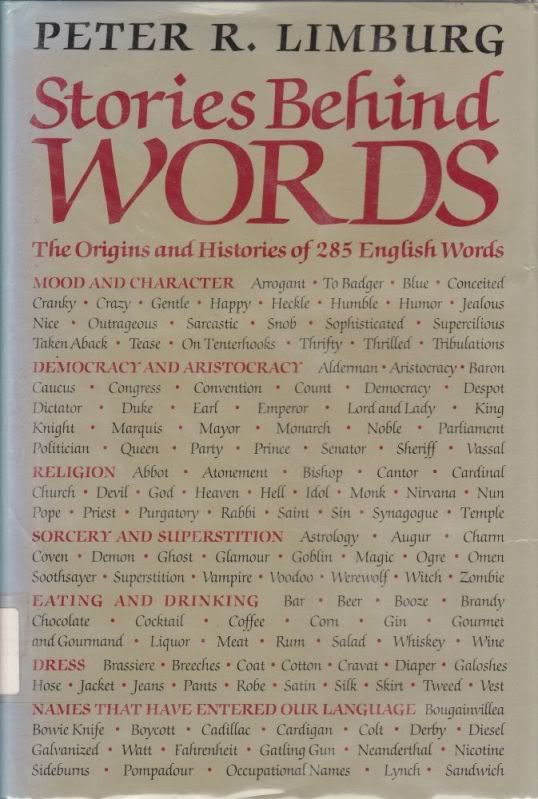
  • Stories Behind Words by Peter Limburg consists of nearly three hundred essays on the meanings, derivations, and histories of as many words. This proved interesting. 
  • The Geography of Nowhere sees author James Howard Kunstler attack surbubran and urban sprawl as wasteful, untenable, and spiritually bankrupt while promoting the ideal of smaller-scale communities emphasizing local economies and planning designed to maximize human happiness.
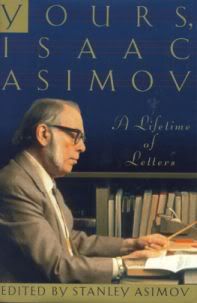
  • Yours, Isaac Asimov: A Life in Letters, editd by Stantley Asimov provides excerpts from several decades of Asimov's letters, organized topically.  The excerpts portray Asimov's personality fairly well, and I enjoyed the read.


Pick of the Week: A Year of Living Biblically, A.J. Jacobs

Quotation of the Week: "It isn't dying I mind. It's the thought of having to stop writing."  - Isaac Asimov, in paraphrase.

Upcoming Reads:

  • American Infidel: Robert Ingersoll.  My first draft of an encylopedic-type article on Robert Ingersoll is due next week, so you'll probably  see this one soon. 
  • The Human Zoo, Desmond Morris. If I'm able to read this one more this week, I look forward to comparing it to The Geography of Nowhere. Both would seem to analyze the impact of urban living upon human biology.


I may find books in the library that command my immediate attention, but given the impending deadline (and midterms), those two will do for now.

Wednesday, February 24, 2010

Yours, Isaac Asimov

Yours, Isaac Asimov: A Lifetime of Letters
© 1996 Isaac Asimov, ed. Stanley Asimov
352 pages


Photobucket


Had you asked me who my favorite author was in 2007, I would’ve looked askance at you, thinking that sort of question a type of sacrilege. Humanity has produced so many varied authors -- how could I dare choose one? That was before I read my first short story collection by Isaac Asimov, featuring little forwards to introduce each story. I loved reading Asimov’s collections -- adored them. Each book was a feast, and a year later I realized: Isaac Asimov was my favorite author. I could say that because of his breadth of approach: he wrote on science, history, religion and literature in addition to his fictional works which were equally varied. Thus, I looked forward to Yours, Asimov: A Lifetime of Letters.

The book is most appealing to fans of Asimov, particularly those who are fond of his personality as displayed in his forwards, memoirs, and the like. Edited by his brother Stanley, the book consists of quotations -- typically short, but with occasional long passages -- lifted from the many letters Asimov wrote throughout his lifetime. The excerpts are arranged topically, the first chapter consisting of his mentions to the joy of letter-writing and the last his reflections on death. In between, he comments on everything in his life, seemingly: science fiction, limericks, science, travel,  Star Trek,  age, funny stories, his fans, his fellow authors,  his health, and his religious views among other subjects.

Although I’ve read a couple of Asimov memoirs (I, Asimov and It’s Been a Good Life), Asimov managed to surprise me there and again. I enjoyed reading about his friendship with Carl Sagan and Gene Roddenberry, and I was amused to see him quoting from the same letter exchange between himself and Leonard Nimoy that Nimoy quoted from in I Am Spock.  The book reflects Asimov’s personality well: informal, witty, self-depreciating and immodest at the same time,  and typically charming. Having been consigned to bedrest with plenty of fluids, I enjoyed cozying up with the good doctor today. For the Asimov fan, this is an easy recommendation.

The Geography of Nowhere

The Geography of Nowhere: the Rise and Decline of America's Man-Made Landscape
© 1993 James Howard Kunstler
303 pages


Little boxes on the hillside, little boxes made of ticky-tacky
Little boxes, little boxes, little boxes all the same
There’s a green one, and a pink one, and a blue one, and a yellow one --
And they’re all made of ticky-tacky, and they all look just the same
(“Little Boxes”, Pete Seeger)


James Kunstler’s A Geography of Nowhere is a scathing rebuke of land-use and development policies of the past hundred years which do nothing but maximize the profit of developers, enslaving the American economy to a need for expansion, while offering humanity nothing but a soulless and miserable expanse of boxes.He promotes an approach to land development that emphasizes human needs and communities that are not only “human sized”, but worth living in and caring about.

After a brief introduction -- recounting a cartoon villain’s mad scheme to make everyone dependent on freeways which he builds and on cars which he sells -- Kunstler begins the book with a history of development patterns since the first European set foot on American soil.  Kunstler sees the overall pattern of American development as being set against the European pattern that emphasizes the integrity of local communities. In his view, American development has been driven by individual greed and the desire to maximize profit through endless subdivision and mass production of living and working spaces. Most American counties and cities are organized along strict grids that give no thought  to the landscape or to the humans that will live in them.

As the book progresses, Kunstler rants against Modernist building styles and launches into a history of suburbanization, beginning with the first (late 19th century)  trolley-dependent communities. The root of the suburban impulse, Kunstler says, is that people want to escape the cities. In addition to the primary desires to get away from the noise and grime, Kunstler believes American suburbanites are attempting to find escape from the spiritual bankruptcy of the commercial-driven city. Ultimately, given the way suburbs will continue to develop, this is a futile goal. The vast expanses of subdivisions are no better, ultimately: they repeat the failures of urban planning and provide nothing in the way of community, isolating people further.

Kunstler contrasts the failings of modern American cities and suburbs to the ideal of a small town community, placing particular emphasis on the importance of a local economy. In his view, there is no community without a local economy. Not only are American development policies unwise and untenable from a long-term perspective (given their dependence on oil), but they are spiritually void. Kunstler returns to this often, writing on the importance of a sense of “place”, of the connections that tie people together and to the land.  He sees building aesthetics as important to maintaining human happiness within communities, as various elements (T-intersections and tree-lined roads, for instance) give us psychological security.  I find this fascinating, and it’s making me itch to read Alain de Botton’s book on the architecture of happiness.

Kunstler thus presents two premises: one, that suburbanization and urban sprawl are in the long term economically disastrous; and two, that these matters contribute to the unhappiness of the people who live within them. Speaking for myself, my own quality of life increased when I moved from a semi-suburban area dependent on automobiles to a small university town with a genuine sense of community, and one in which I can walk anywhere I want to go. I’ve developed a passion for small-scale human communities and am repulsed by the same sprawl that fascinated and excited me as a child. I am thus an ideal audience for Kunstler.

His ideas are worth considering, I believe, and are not his alone. although I am cautious about recommending the book given Kunstler’s tone. Although easily keeping my attention and often inducing me to laughter, he is exceptionally opinionated -- sometimes bitterly so. This may turn off readers who would have otherwise benefited from the deleterious trends that he points out. There may be better books on the same general topic, and if I read them I will point them out. For the moment, though, this is the only one I know of and I cautiously pass it on to you.


Born in 1948, I have lived my entire life in America's high imperial moment. During this epoch of stupendous wealth and power, we have managed to ruin our greatest cities, throw away our small towns, and impose over the countryside a joyless junk habitat which we can no longer support. Indulging in a fetish of commercialized individualism, we did away with the pubic realm, and with nothing left but private life in our private homes and private cars, we wonder what happened to the spirit of community. We created a landscape of scary places and became a nation of scary people. 

From the book, page 273.

Related:

Tuesday, February 23, 2010

Teaser Tuesday (23-2)

It's that time again, from Should be Reading.

Neighborhoods like Georgetown or Beacon Hill are walking neighborhoods. It is not necessary to hop in the car to get an ice cream cone or a bottle of aspirin. You walk to  a store -- enjoying the felicities of the street as you go -- and you are able to see other people along the way. You may even have a conversation with a stranger. This is called meeting people, the quintessential urban pleasure. (Or else it is called a mugging, the quintessential urban calamity.).

- p. 127, The Geography of Nowhere: the Rise and Fall of America's Man-Made Landscape; James Howard Kunstler)

Stories Behind Words

Stories Behind Words: The Origins and Histories of 285 English Words
© 1986 Peter Limburg
288 pages


I have long held an interest in etymology and the history of language, thus this book’s interest to me.  Author Peter Limburg expounds upon the meanings and derivations of hundreds of words in 285 essays sorted into seven general categories. The book’s table of contents -- displayed on the main cover, incidentally, which you may view by clicking the preview image above --  is not quite complete, as Limburg typically discusses similar words that branch off from the topic in the same essay. For instance, the essay “To Badger” gives not only the meaning and history of that phrase, but discusses other words derived from the behavior or perceptions of animals.

The essays tend toward the thorough, with only a few exceptions. Even though I’m a “word nerd” and a student of history, I found here much to inform. I learned why the US legislature is a “Congress” and not a “Parliament” for instance -- and that cathedrals are named after the residing bishop’s throne, the cathedra.  Uncomfortably, there are no citations or references given -- a potential problem for me given that I’ve not heard of some of Limburg’s opinions and would like confirmation. For example, he posits that the medieval church’s chief problem with witchcraft was that it amounted to heresy: only later was the accusation of witchcraft used as a weapon against  people.  Limburg’s tone is conversationally informal: he likes to end the essays with dry humor or a pun, which is appropriate for a book of word-history. My favorite: when Limburg ends the essay on brassieres, he first comments on the changing perception of bras in the modern age and then notes that 'men will be watching future developments with great interest.'

All told, this book of essays on the history of words made for an enjoyable and informing read.  Those interested in the subject -- particularly in the words listed in the table of the contents -- will probably find this book both useful and entertaining.


Monday, February 22, 2010

The Year of Living Biblically

The Year of Living Biblically: One Man's Humble Quest to Follow the Bible As Literally As Possible
© 2007 A.J. Jacobs
388 pages

Photobucket

Day 111. When I'm jotting down tips on how to land a second wife, it's clear that the pendulum has swung too far into the Bible's crazy territory.  (p. 138)


I began this blog in May 2007 with A.J. Jacob’s Know-It-All, in which he records his experience reading the entire Encyclopedia Britannica. I enjoyed the book immensely, and so jumped at the chance to read another work of Jacobs’. In A Year of Living Biblically,  he tasks himself with following every rule and suggestion in the Judeo-Christian bible as literally as possible in an effort to understand what religious beliefs and practices do for people. He intends to honor the various commandments’ literal meaning, rather than their specific expression*, and establishes references to help him along the way. Not only does he convene a panel of religious leaders to help him navigate the maze of translations and cross-interpretations, but he begins to build a library of biblically-focused works for his own research. He also commits to spending time with other biblical literalists (the Amish,  Mormons, and Young-Earthers) and making “pilgrimages” to Jerusalem and the Creationist site in Kentucky.

Jacobs’ initial steps onto this new religious path are bumpy indeed, as he attempts to adjust to a confusing new regimen. Jacobs isn’t content to take the bible’s ethical mandates seriously: not only does he begin living the Golden Rule, but he lets his beard grow out, attaches tassels to his clothing, avoids his wife during her period, and begins each month by blowing a shofar. He thus strives to fulfill its ritualistic laws as well. He also attempts to follow the Bible’s advice for punishing others for their sins, but breaks no laws in the process: he does stone adulterers, but does so with pebbles. As the months pass, Jacobs immerses himself in the life, becoming the sort of person others cross the street to avoid coming near. So intrusive are the biblical laws that Jacobs fears he is being absorbed by a newborn alter-ego -- the long-bearded, staff-toting, moralistic “Jacob”.  Jacobs fights to maintain his sanity, even though he obviously enjoys the journey in part. When the time comes for him to leave the Hebrew scriptures for the Christian, he is reluctant to abandon his beard and horn-blowing.

Although Jacobs intended to follow both the Hebrew and Christian scriptures, his attempts to live a Christian life are stymied by the fact that he can’t accept Jesus as the Messiah: beyond that, all the New Testament contains are a few ethical rules already covered by the Hebrews. Thus, he spends his three Christian months visiting Christian churches. This causes a bit of a stir given his beard and fondness for robes. Humorously, Jacob’s year-long research into the Bible causes him to take issue with the way Christians like Jerry Falwell misuse the Hebrew scriptures, robbing them of their context.  Speaking of Falwell, Jacobs finds out that despite the man’s ability to vomit sound bytes, his actual sermons are dull.

When the year-long journey ends, Jacobs seems conflicted. Although he’s relieved of the burden of following so many rules, he enjoyed the structure they gave his life.  He especially enjoyed the group activities, like dancing with drunken Hasidic Jews on a night designated for revelry. He feels as though he has benefited from the experience overall, having gained a reverence for life while remaining agnostic. I enjoyed watching him grapple with the life, and I recommend the book to both religious and nonreligious audiences. It will allow us -- particularly the nonreligious -- to understand our fellows better. Religious audiences may glean the same, but not so much if Jacobs happened to subscribe to his own life stance. In any case, both audiences are sure to be amused by Jacobs’ constant reacting to what is expected of him. This was an exceptional read, one I'm sure to remember with fondness.

The inside cover includes pictures that track the growth of Jacobs' beard and hair over the course of a year. You may view it here.


*“Those who piss against the wall” could be taken literally to mean hobos and drunken college students, for instance, but its literal meaning would be males. Females would be hard-pressed to pee against a wall.