Showing posts with label CS Forester. Show all posts

Friday, April 6, 2018

Rifleman Dodd and The Gun

The Gun, and Rifleman Dodd
© 1933 C.S. Forester
311 pages

"There was sorrow in Dodd's heart as he looked down on the pitiful scene, but it did not prevent him from turning away and setting himself to survey the next adventurous quarter of a mile of his route. There are many who give up, and many who procrastinate, but there are some who go on."


C.S. Forester is best known for his Horatio Hornblower stories,  naval adventures set in the Napoleonic Wars.   These two short works, The Gun and Rifleman Dodd, are less known but equally entertaining and detailed. Both are set in Napoleonic Iberia, as both a peasant resistance and the shattered remnants of the old Bourbon Army fight for Spain and Portugal's liberty from Napoleon,  with the generous support of English seapower and the Duke of Wellington.

The first story, The Gun,  follows an eighteen pound siege gun which abandoned on the field after a crushing Spanish defeat, but recovered by a priest and a few farmers, The gun passes from hand,  as many realize its incredible potential and attempt to shift it to the best place -- and those who particularly value it seize it by force. It does get put into action, however, fomenting rebellion on the plains and sending the French into retreat for the first time.

Rifleman Dodd pieces together the adventure of the eponymous rifleman after he is cut off from a retreat, and lost behind enemy lines. A hard-worn veteran of five campaigns, Dodd knows how to soldier and stay alive, and so when he encounters a group of Portuguese irregulars, he becomes their leader and becomes a phantom menace to the French, who are haunted by visions of a green Englishmen.  Even as they methodically begin sweeping and scouring the hills to destroy his hiding places, Dodd and a couple of survivors -- and finally, Dodd alone -- endeavor to put flames to Bonaparte's plans.

Although a sketch of their plots gives both of these novels an air of romantic air,  they're not fanciful in the least.  Forester does not shy from the brutal behavior of both parties, French and irregulars, as they fight tooth and claw with one another.  Forester also does not reduce the French to a distant enemy:  in Rifleman Dodd, he tells their story in alternate chapters, and every person Dodd kills is named as he falls.   There's no denying the adventurous drama of the last bit of Rifleman Dodd, however, as he beards the French lion in its den.  Good stuff!

As a bit of trivia, Bernard Cornwell mentions a missing rifleman named Dodd in one of his Sharpe novels, also set in Spain.   This is a deliberate reference to Rifleman Dodd, and one of Cornwell's stories about becoming a writer involves trying to find more stories like Dodd, and then realizing he'd have to write them himself.  Three cheers, then, for Rifleman Dodd, which was not only a great little story by itself, but one that gave us the force of nature that is Sharpe.

Rifleman Dodd was originally known as Death to the French. I speculated that the title was changed after the outbreak of World War 2, but Rifleman Dodd seems to have just been the American title.

Related:
Cornwell's Sharpe books
Forester's Horatio Hornblower sea stories

Saturday, March 24, 2018

The Return of Horatio Hornblower

Hornblower Addendum
Collected 2011 eNet press
79 pages


Has it been eight years since I last sailed with Horatio Hornblower?  The naval adventure series by C.S. Forester, and the A&E movie series based on it were one of the highlights of 2010, and in the years since I’ve subjected many friends to those same movies so I could have the pleasure of watching them again in company.  In hunting for books like Horatio Hornblower, however, I stumbled upon a collection of Hornblower tales I’d missed -- or, mostly missed.  This is not a substantial collection by any means; it’s rather shorter than the shortest Hornblower work, Hornblower and the Hotspur, or Hornblower in the West Indies,  and two of its five stories have been previously collected.   The stories are chiefly of interest to those who know and admire Hornblower already,  as they put him in fascinating or morally demanding situations.  The last story here has him encounter a seeming lunatic who claims to be the emperor Napoleon, for instance, while another has him tasked with securing an Irish deserter and discovering a secret compartment in the man’s trunk filled with gold. In all instances Hornblower proves himself to be a perfectly honorable and charitable fellow.  Perhaps the most interesting story in the one in which Admiral Hornblower is asked to take insane King George III to rendezvous with another ship, but they’re stumbled upon by an American frigate in the latter part of the war of 1812.

Although this collection really only recommends itself to the completists among Hornblower readers, I felt instantly at home as soon as I started reading the first story. Forester and his naval hero were good to experience again.

I'd planned this book to be a Read of England post, but it's more "fun-sized" than a regular read. I am gearing up for that, however -- we're a week away from a solid month of English glory!

Friday, August 20, 2010

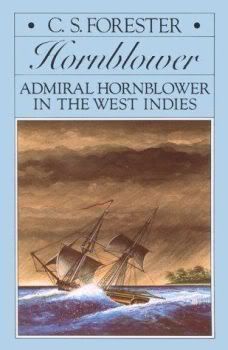
Admiral Hornblower in the West Indies

Admiral Hornblower in the West Indies
© 1957 C.S. Forester
250 pages


Although not the last Hornblower book published -- Hornblower during the Crisis was a work-in-progress when Forester died -- it is the novel set latest in Hornblower's life. The Napoleonic wars are over: after twenty years of tumult, Europe is finally at peace. Owing to his many years of excellent service, Rear Admiral Hornblower has earned a position in the peacetime navy, keeping watch over Britain's forces in the West Indies. Though described as a novel, West Indies is more kin to a book of interrelated short stories. Hornblower has no singular campaign to manage, but the storm-tossed seas of the tropical Atlantic give the admiral little rest. There are pirates and slavers afoot, and the Americas are awash in revolutions as various people attempt to rid themselves of colonial overlords.

West Indies has an altogether different tone from the rest of the books, save Midshipman Hornblower. While its stories offer drama, the consequences of failure are less severe than they would be in wartime. Instead of gathering intelligence and striking blows that will defeat a tyrant, Hornblower is kidnapped, chases pirates and slavers, and contends with a hurricane while settling into a contented old age.  It's cozy, comfortable. For my own part I enjoyed it. Though not the great adventure that other books -- Lord Hornblower, for instance -- were, it's a gentle farewell to the man whose adventures I've enjoyed reading so much through the spring and summer.

Fair winds and clear horizons, captain.

Tuesday, July 20, 2010

Hornblower and the Crisis

Hornblower and the Crisis
© 1967 CS Forester
174 pages


Hornblower and the Crisis is the last of CS Forester's Hornblower books, as Forester died in the midst of writing it. This book collects the first 130 pages of the intended novel, adds a portion from Forester's notes establishing how he intended to develop the book further and end it, and then tacks on two short stories. The first, "Hornblower's Temptation", is set during Hornblower's lieutenancy aboard the HMS Renoun, where he makes a potentially lucrative discovery when overseeing the execution of an Irish deserter-turned-insurrectionist. "The Last Encounter" takes place in 1848, where an elderly Hornblower receives a late-night visitor -- a man claiming to be the Emperor Napoleon Bonaparte.

The death of Forester in the middle of the Crisis is truly a loss for his readers, for the book was shaping up to be one of the better additions to the series. Newly-minted Captain Hornblower is returning to England from his blockade duties as a passenger aboard the Princess, a small utility vessel, when the book begins. His former ship, the Hotspur, is still at sea under a new captain, but Hornblower has been ordered to return to Liverpool for new orders.  After a French brig harasses the lowly Princess, Hornblower urges his fellow passengers -- also royal officers -- to ambush Boney's boat. Although they are too few men to take the ship as a prize of war in total, Hornblower fights his way to the brig's command office and steals the French captain's orders. They are fixed with the seal of Emperor Bonaparte, and contain orders from the Corsican himself.  When Hornblower dutifully takes them to the Admiralty, they and he contrive a plan of espionage that will draw the French navy into a decisive battle -- the monumental battle of Trafalgar.

I tend to enjoy Forester's books more when they center on diplomatic intrigue, shore adventures, and espionage, so the plot of this naturally drew me in. Although the notes included are short, they do more than relate the rest of the plot.  The two short stories are both far shorter than those in Mr. Midshipman Hornblower, and each was a treat. "The Temptation" shows Hornblower's humane side, one we don't often get to see in a series dominated by war, and "The Last Encounter" is both amusing and almost serves as an afternote to the Hornblower series:  1848 is a year beset by revolution, where rail lines and naval steam engines have brought modernity, supplanting Hornblower's old, familiar world.

Although I read this when I did for its setting (French Revolution and Napoleon), it more than made up for Hornblower and the Hotspur.  While the novel's opening chapters and the short stories are enjoyable in their own rights, I suspect newcomers to the series would enjoy a more complete work. Still, for Hornblower readers this is certainly worthy.

This is not my last Hornblower read: I still have Admiral Hornblower and the West Indies to read, and there's one Hornblower-related book I intend to read following that. It's ah....going to be a bit different.

Tuesday, June 22, 2010

Hornblower and the Hotspur

Hornblower and the Hotspur
© 1962 CS Forester
344 pages


Young Horatio Hornblower flourished as an officer in the King's service during the general European war against the fledgling French republic, the war having given an ambitious and intelligent officer like himself plenty of opportunities for promotion. Hornblower rose swiftly through the ranks owing chiefly to his keen mind and penchant for taking risks, but he is able to call upon neither strength in civilian life: struggling to survive on a commander's half-pay, Hornblower is roped into marrying a young woman whom he does not love. He has sprinted across mast-heads without a net and bearded French lions in their dens innumerable times, but he does not have the courage to break a young woman's heart.  News that France is now ruled by a swaggering little man from Corsica who fancies himself an emperor comes as a great relief to him, and the newlywed commander is all-too-happy to accept his first real command, the sloop Hotspur. At his side is the implacable Mr. Bush. What's more, he will once again be serving under his beloved captain from his midshipman days, Commodore Edward Pellew.  Although my own experiences watching the television series have undoubtedly influenced my judgment, I  was just as happy as Hornblower to see Bush and Pellew again.

France's First Republic is steadily replaced by its First Empire as Napoleon gathers more power around himself, and Hornblower is ordered to troll the French coast for fisherman to bribe, seeking news of the French fleet. These initial orders become more aggressive as Napoleon readies for war with Europe: Hornblower and the fleet his Hotspur is part of blockade certain port cities and are eventually told to sack the annual Spanish delivery of gold from the New World: Spain intends to use the money to assist France in a newborn alliance. Hornblower and the Hotspur contains many of the legends told about Hornblower in his later years -- how he discreetly showed mercy on a man by allowing him to escape to the USS Constitution, or how he picked up a not-yet exploded shell and threw it back into the water,  saving his ship. Despite this, I struggled through the book, forcing myself to march ahead:  this book more than any other is dominated by the act of sailing the ship. It's hard to enjoy details when there are so many of them.

For Hornblower, the book is a coming-of-age: he begins the book as a young man just about to be married, and looks on Captain Pellew almost as son. By the end of the book, Pellew has been promoted to the admiralty,  removing him from Hornblower's service life for the most part -- although he did appear in the last book of the series, Lord Hornblower.  Hornblower receives his own promotion to post-captain, and begins the next phase of his life as the master of his own series of ships throughout the Napoleonic wars.

Of the Hornblower books I've read, I enjoyed this the least, although my own reception of the book seems to differ from other Hornblower fans. I would not recommend first-time readers to the series to start with this one.


Ioan Gruffuld as Horatio Hornblower, Robert Lindsay as Edward Pellew

Tuesday, May 25, 2010

Lord Hornblower

Lord Hornblower
© 1946 C.S. Forester
318 pages


      The year is 1814, and Sir Horatio Hornblower, commodore in his Britannic Majesty’s Royal Navy, has been sent to the coast of France on a secret mission. The crew of the gunship Flame have rebelled against their abusive captain and are offering their ship to Napoleon in return for amnesty and a new start. This cannot be tolerated: mutiny is intolerable even when justified, but treason?  Hornblower must somehow capture a ship of men who know they are damned if they surrender to him, and so before they make good on their threat to humiliate Britain by delivering Flame to France.

One thing leads to another, and a book about mutiny becomes the story of French political intrigue during the last months of the Napoleonic wars: a captured French noble approaches Hornblower and suggests that if the two of them work together to capture one of France’s nearby port city, they may be able to liberate northern France from Napoleon’s rule and do their part to send the naughty Corsican back to the hell that spawned him. This potential rebellion, unlike the similar Anglo-French Royalist effort in “Frogs and Lobsters”, stands a good chance of succeeding: Napoleon’s armies are pressed from all directions by the Austrians, Prussians, and Anglo-Spanish forces in Iberia.

And so Hornblower is thrust into the land war in France, participating in Napoleon’s defeat. While his wife Barbara helps host the Congress of Vienna, he travels to the interior of France to drink with old friends to the honor of other friends who did not survive the great conflict. When Napoleon escapes from Elba and makes France his once more, Hornblower -- who has had a long-standing price on his head by Napoleon’s men -- must flee for his life through the countryside, facing mounting peril.

Lord Hornblower is easily one of Forester’s better Hornblower works for me:  the adventure took me completely, and the many plot twists kept my on my heels, wondering where Forester would take me next -- and what he might do, for the gloves were off in this book.  I half-expected the book to end with Hornblower facing a firing squad. Lord Hornblower would be a fitting end to the series if Forester had written them in chronological order, given that it finally ends the long war with France that began with the Revolution in Midshipman Hornblower and ties up loose ends with various characters. The book was also published in 1946, and I can't help but wonder if the characters' manifest joy at the end of the war -- and their horror when Napoleon escapes to begin it anew -- are the result of Forester's own relief that the destruction during his own day in Europe had finally ended.

Photobucket

Inside cover art: click for full-sized image.

I have two more Hornblower books to enjoy, but I suspect compared to this they're going to feel anticlimactic.

Sunday, May 2, 2010

Commodore Hornblower

Commodore Hornblower
© 1945 C.S. Forester
384 pages


My previous reads in the Hornblower series have been through collections of the shorter works, but Commodore Hornblower is a standard novel set shortly after Captain Hornblower. Hornblower has by now distinguished himself as one of the most capable and celebrated officers in the Royal Navy through a life of service punctuated by imaginative and bold approaches to problems. Fittingly, he is promoted to commodore and given a flotilla to take into the dangerous waters of the Baltic Sea -- dangerous not just for  the French ships and pirates prowling about, but for Hornblower's nebulous mission that will certainty involve diplomacy. Napoleon Bonaparte is nearly emperor of Europe, having composed a Grand Army filled with soldiers from subject nations. Only Britain's navy and Spain's guerrillas oppose the Corsican's ambitions, and he is now moving that army in the direction of Russia to effect its coercion. The loyalty of the Baltic nations may shift suddenly as Napoleon presses on, and Hornblower is tasked with responding to potentially changing diplomatic conditions on behalf of the British empire.

While he isn't attempting to prevent Britain from becoming wholly diplomatically isolated, Hornblower must still fight the French along the coasts. When Napoleon makes good his threat and invades Russia, Hornblower and his men must lend succor to the besieged city of Riga and do all they can to bolster resistance against the continent's would-be master. I didn't enjoy this book quite as much as I have previous Hornblower novels, with the exception of the novel's beginning and its diplomatic intrigue. Being a history student, I enjoyed seeing Forester's foreshadowing. He also alludes to the world of 1945, using characters' backstories relating to Napoleon's rise to hint to readers that history is repeating itself.

Saturday, April 17, 2010

Young Hornblower

Young Hornblower
© 1948, 1951, 1953 C.S. Forester
672 pages
(My library's copy has long lost its dustcover, but this would certainly be eye-catching...)

A few weeks ago I began reading and was immediately taken by the adventures of Captain Horatio Hornblower, an officer in the Royal Navy during the Napoleonic wars. I knew I would be reading further, and here I am. Young Hornblower collects three sets of stories set during Hornblower's early career, beginning with his induction into the Royal Navy and first assignment as a midshipman at the start of the French Revolution.  Midshipman Hornblower consists of ten standalone stories that mark Hornblower's service aboard the HMS Indefagtible, where his resourcefulness and audacity serve him, his captain, and the British empire well as it wars against 'red France', a nation that has dared to kill its king.  Hornblower rises steadily through the ranks, becoming his captain's protege and favorite prizemaster. Lieutnant Hornblower sees Hornblower transfer to the Renown, under the command of an increasingly paranoid and violently insane captain whose mental instability puts their mission at risk. Hornblower and his new friend Lieutnant Bush (his first officer in Captain Horatio Hornblower), along with the other senior officers, must find some way of restoring good order on the Renown or they are doomed. Hornblower and the Atropos, in an odd turn, is set ten years following Lieutnant Hornblower: Hornblower is not so young, nor inexperienced, for he is the captain of a ship sent to the Mediterranean on a secret mission.

Hornblower's stories are fast-paced adventure. Technical language abounds, but as general background: it can be blithly ignored in the same way viewers of Star Trek might ignore 'technobabble'. On occasions when naval mechanics influence the story, Hornblower's thoughts or his subordinates' words tell the reader what the consequences might be. Interestingly, Forester doesn't stick to the typical rise-climax-conclusion format of novels. The books' opening and ending sections may be largely unrelated to the conflict that most of the book addressed. Forester seems to find a good 'stopping place', and then ends the novel there. I don't consider this a fault of the book: indeed, the chapters that ended Lieutnant Hornblower seemed like 'extra content', content that you can enjoy but aren't necessarily recquired for the novel's plot. I shall be continuing this series.

Related:
A&E did a series of eight movies based on Midshipman Hornblower and Lieutnant Hornblower. The movies take liberties with the original source, but those liberties add to the novels rather than take away from them. They add whole subplots and allow the viewers to become familar with a set of characters rather than just one or two. You can find all of the movies on Youtube, or on Amazon here. I watched them all in a single weekend. Riveting, for me.


Friday, April 2, 2010

Captain Horatio Hornblower

Captain Horatio Hornblower
© 1937 C.S. Forester
504 pages


Captain Picard: Just imagine what it was like. No engines, no computers... Just the wind...and the sea... and the stars to guide you.
Commander Riker: Bad food, brutal discipline... no women. (Star Trek: Generations)


I've been itching for a read involving adventure, so when in the course of reading an interview with Sir Patrick Stewart wherein Stewart recounted Gene Roddenberry giving him a set of books about the seafaring adventures of Horatio Hornblower of the Royal Navy in the hopes that Stewart would find Hornblower's character of use in maturing Jean-Luc Picard, my interest was piqued and I decided to give the books a try.

Captain Horatio Hornblower is a collection of three novellas following the service of the titular character in the first decade of the 19th century. Post-revolutionary France is now ruled by Napoleon Bonaparte, who will soon attempt to turn all of Europe into his private domain. Great Britain stands nearly alone against his ambition. Lacking land forces on the scale of La Grande Armée , Britain must rely on its most powerful resource -- the Royal Navy. Beat to Quarters, known outside America as The Happy Return, begins with Captain Hornblower's arrival in South America to undertake a secret mission that may change the balance of power in Europe: plot twists abound.  In A Ship of the Line and Flying Colours, Hornblower and his men return to Europe to fight France directly. Although Hornblower serves as captains, the novellas are not entirely naval:  The Happy Return combines a sea story with political intrigue, while in Flying Colours Hornblower spends most of his time on land, save a daring river ride wherein he must flee those who would see him hang. I did not expected to be as gripped by Hornblower as I was: I hardly left the book while in the course of reading, as Forester constantly kept me thinking -- "What will the captain do now?"

Horatio Hornblower is certainty the star of the books, and in him Forester has created an interesting character. As a captain, Hornblower must maintain the respect and loyalty of his crew at all times. Though imperiled or frequently cast into difficult circumstances impossible to anticipate,  Hornblower must maintain a steely sense of calm and make decisions to face every crisis of command. This is especially evidence in The Happy Return, as Hornblower is forced to make possibly life- and career-ending decisions that will effect Europe's political scheme on his own, as he is separated from England by oceans that would take months to cross. Behind the facade of the perfect captain lies a flawed man who hides his blemishes as best he can, but who is haunted constantly by the idea that he isn't all he should be. Most endearing for me was his unrequited love for a certain nobleborn lady, which develops in the first novella and ripens throughout the latter two.

I have seldom been as enthralled as I have been in reading Captain Horatio Hornblower. I am presently engrossed in the eight-movie series about his early career, and will certainly be reading the rest of the series as I am able.

"What are we do?" he asked feebly.
"Do?" she replied. "We are lovers, and the world is ours. We do as we will." (p. 161, Beat to Quarters/The Happy Return)