Showing posts with label Albuquerque. Show all posts

Tuesday, November 22, 2016

The Motel in America

The Motel in America
© 1996 Jefferson S. Rogers, John A Jakle, and Keith A. Sculle
408 pages


At some point in high school I pulled out a dictionary to find out what, exactly, was the difference between a motel and a hotel. They seemed much the same to me: "A place to sleep when traveling".  A motel, the dictionary informed me, was typified by guests' easy access to their cars.  It was cars that built motels, or rather motorists: The Motel in America is a history of how the first "auto camps" came into being, in a fairly organic fashion, which follows their maturation from mom and pop shops to national franchises. Also included are special sections on the evolution of the motel room, and a case study of motels and their impact on urban form, using Albuquerque as a case-study.  It's thus a mix of topics with some popular appeal (social history) interspersed with more academic sections, like the comparative brand distribution of various chains.

The story of motels begins decades before the auto-oriented boom of the 1950s,   Americans began touring by car almost as soon as there were roads fit to drive on -- sometimes before --  but downtown hotels didn't lend themselves towards motoring hospitality. They were enmeshed in an urban fabric, after all;  their travelers disembarked from downtown passenger rail stations and got where they needed via trolley or on foot. That 'urban fabric' meant a lot of buildings in a small space, with precious  little to spare for parked automobiles. So people began improvising and camping out on the outskirts, and through the magic of free enterprise, a new business was created to cater to them. One woman who allowed travelers to camp in a grassy area near her gas station put up small cottages for rent -- followed by more cottages, until the cabin rentals were better earners than the gasoline. 'Campgrounds', initially roped-off areas created by cities to keep motor-gypsies from running amok,  attracted food-and-service vendors and quickly became a commercial form in their own right. The first 'motels' were essentially campgrounds with little cottages or cabins that motorists rented for the night; the owner-operators, typically a family, often served meals on the premises. Kentucky Fried Chicken actually began its life as the lunch option of the Sanders Motor Court.

 These auto camps, motor courts, or 'motels' flourished in the Great Depression even as the downtown hotels struggled under the burden of the economy and urban reformers out to destroy them. World War 2 put expansion on pause, but after that -- and especially given the free range of the in-progress interstate system --  the business quickly grew into the network of massive chains  that now fill the continent.  The strings of cabins largely gave way to more space-efficient barracks, though they were organized around pools and prettied up in pastel.While the loss of mom and pop shops can easily be mourned, the chains came into being largely because it was more beneficial for motels to exist as part of a network. That network could be built from the ground up (in the manner of Best Western) or organized from the top down, if  one motel was owned by an especially ambitious and savvy man as in the case of the Alamo line.  Networks of motels could refer travelers along a route to one another,  present a united front against other motels by maintaining uniform standards, and lower their prices through bulk purchases.(They might even purchase the same 'room sets', as furnishings were standardized.)  The authors also cover the franchise approach, used as effectively in motels as in fast food restaurants.

The Motel in America proved itself an interesting little bit of history, demonstrating another facet of the genuinely revolutionary impact automobiles have had on American urbanism. The case study of Albuquerque -- a city which was known primarily as a train layover until it began expanding rapidly through Route 66 and the interstates, with gobs and gobs of motels to service them -- was a welcome surprise.

Related:


Wednesday, October 26, 2016

Week of Enchantment: The Garden of Eden is Missing its Critters


From here  I moved to the attached Gardens, one of the most beautiful, romantic, and sometimes weirdest spots in New Mexico.  Beauty first:  Moorish gardens open the area,  ending in a tree-lined walkway that is utterly  peaceful


This goes around a park with a lagoon, and following the arbor-laden path took me to several greenhouses. The greenhouses are massive, multiple-story places.


  Another area of the gardens is done up in Japanese style, including round stones buried in the water used as a stepping bridge. The strangest part of the gardens, though, is the multi-acre farm in the middle.


"Farm"? Yes, farm. In the middle of Albuquerque,  there are apple orchards, vineyards, and rows of other crops.  Despite the abundance of rusting old farm equipment and the penned-in steer and horses, this isn't a museum. There's a barn on the premise that actually makes cider.  The irrigation used, at least in part, is traditional, as the farm is maintained here to remember how agriculture on the Rio Grande used to be.


Downtown Albuquerque, everyone!


One exceptional and enclosed area houses butterflies, who flit by constantly. I made it my mission to take a picture of one of the blue ones in flight, although the young woman on station warned me it was impossible.

A nearby building housed bugs, which were far less photogenic. I deleted several pictures of leaves before I remembered those were shots of LEAF INSECTS. D'oh.


The gardens took an enormous amount of time to enjoy, and that cypress walk was just as lovely going back. If I lived in ABQ, it would be an obvious place to go on a date.

After this, I headed for the zoo. Not that I hadn't seen enough animals this week, but it was two miles away; how could I resist?  I didn't realize how late in the day it was, and in fact I very nearly got kicked out of the zoo at closing.   There were three kinds of exhibits: the ones where the animals were not there for explained reasons, the ones where the animals were not there for unexplained reasons, and the ones with actual animals.  The polar bears were no-shows, and I arrived just in time to see the chimpanzees disappearing into a wall like hairy Oompa-Loompas.   Bear in mind this wasn't at closing, but starting around 4 a lot of the animals were being wheeled in,  so I wound up doing a lot of trekking and not seeing much at all.   After an hour and a half of wandering, booming voices warned me the zoo was closing in fifteen minutes, at which point I started scurrying.

In total, waste of energy, time, and $8.  I did see a few things, though:

Breathing steam! ...or mist.


Is it five o'clock yet?


Zoom issues again, hence the blurriness. 

I came back to admire this fella after being disappointed by another exhibit, and was just in time to see him turn his back on a group of people.  Heh.


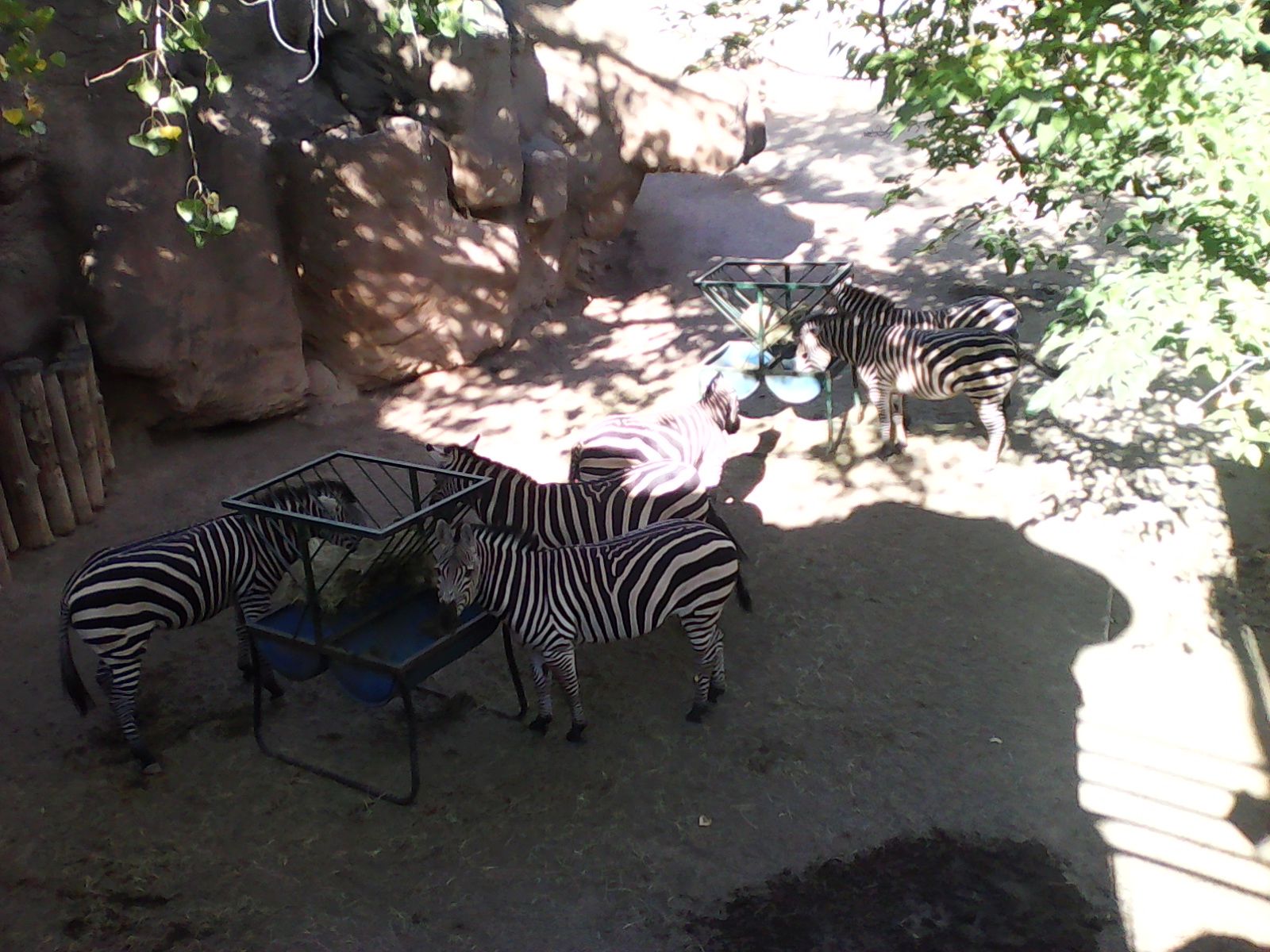
Grant's Zebra. I'd like to know who this Grant fellow was. Every zoo I go to, he's donated zebras. 


A hippo! 


The only primate I managed to see before closing, and at this point I was frantically trying to find a way out so men in carts didn't come after me. 

Although I'd planned to go downtown and look at a piece of 'pueblo deco' architecture, at this point I was so tired of walking the only thing I wanted to do was return back to my room.

And so, back up Central I went, passing under something claiming to be Rt. 66, home to rest up for Santa Fe and my last day in New Mexico. 


Week of Enchantment: Tourists, Sharks, and Gardens, oh my!


Emerging from the natural history hours later, and returning to old town, I discovered that everyone else had woken up and joined me.  Cars poured in and filled the once-empty plaza, but with them came pleasant music and even pleasanter sounds. Those bronze figures shared earlier were planted outside a museum of history and art, but from what I could tell the art was modern.  My attempt in Las Cruces to find a southwestern art museum had resulted only in a large Japanese pottery exhibit, so I wasn't  excited about the prospect of paying $12 and being dismayed again.  I could see all the art I wanted on the streets!

Entering the outdoors 'mall', I drifted until I spotted a restaurant.  This was the first and only time anyone asked me "Red or green". I'd been waiting all week to be asked, and I knew the answer.  "May I have it Christmas?"  I'd like to report on the experience of having red-green chile sauce, but the dish I had it on (a chimichanga) was so large that I didn't taste much of it.   The only unqualified dining sucess I had all week was on Friday, since after a long day of driving I tended to either look for fast food I didn't recognize, or better  yet grabbed a chicken and Hatch green chile burrito from Allsups gas stations.  Those were quais-regional AND cheap.

Entrance to the 'mall'


Plaza central to the left

I saw this guy go by four times -- looking for a parking place, I'll warrant


Inset: I SAW THAT CAR IN ROSWELL, TOO! 


As much as I enjoyed the sights and sounds of the plaza,  one place downtown I wanted to visit was the Aquarium, Zoo, and Biopark.  It turns out that the entrances of the Aquarium-Biopark and the Zoo are two miles apart, although on my map they were parked in a continuous blob of green.  The aquarium-biopark was amazing, the zoo was an amazing disappointment.  But first, the amazing.


The 'underwater tunnel' won me over immediately to the Aquarium, as I've been longing to see the one in Atlanta, but that place is an interstate spaghetti bowl. After a few minutes enjoying the sight of fish over my head,  I next encountered a large tube of jellyfish, and a shallow pool of manta rays. One of the rays would 'surf' the side of the tank, flashing his underbelly, but they're so fast I never caught him in the act.  The big attraction, of course, is a floor-to-ceiling tank that features hundreds of fish, including several sharks.


The basement of the aquarium included several model ships, and I spied an actual boat in the back of the place. It may have access to the nearby Rio Grande.


On to the Gardens!


Monday, October 17, 2016

Week of Enchantment: Epic? Nay, MAMMOTH!


The natural history museum in downtown Albuquerque is monstrously big, and after arriving at its service doors I made my way around the campus ("building" does not suffice), admiring the way the landscape was sculpted and filled with plants to deliberately portray different areas of New Mexico.  I was very nearly the first person in, and decided to do only the museum tour. There's a planetarium, but I was just at the VLA yesterday and had seen massive photos of galaxies, not just stars, there.  The museum is so incredibly HUGE that simulated stargazing wasn't missed. (And...the last time I visited a planetarium, it turned out to be a light show and I fell asleep.)


Where to begin with this place?   Its heart and soul is natural history, with an extensive and winding tour through time that involves dinosaurs, the ice age, and early American man.   The museum tells the story through massive skeleton reproductions, murals, 'real-life' models, and flat pictures.  Just as Carlsbad gave the definition 'cavernous' real weight, here too the megafauna gave 'mammoth' a new meaning.   They were imposing even as frames, and people used to summon the courage to attack them for meat!

Note the the man in the foreground for scale.


A computer science wing attracted my interest going in, though I found it too noisy; television monitors are everywhere,  with interviews of various people like Bill Gates talking about New Mexico's role in turning computers from warehouses into pocket conveniences.  They had all manner of interesting gadgets there: early portable radios, an array of vacuum tubes and transistors; teletype machines, even a UNIVAC.

The plate said UNIVAC, and I've realized now that UNIVAC is a brand name and not a particular machine. 


 The noise moved me out, though, and into the space science hall. There I played with a Mars rover, rotating its camera around with a joystick. It's not as easy as it sounds, because the rover's eyeball isn't obvious.  Massive models of the planets ("and Pluto") line the wall, and a small theater offered a depressing film on environmental destruction, ozone depletion, that sort of thing.  Natural history is king here, from the the T. Rex models to the enormous rock collection. There's even a reproduction of a cave, and live animal exhibits.  In another area, Actual Science is done -- there's a closed off area visible by glass where people were peering into dishes and studying their computers.  Perhaps they were an exhibit: "Science At Work".   The museum also has live animals, at least fish and reptiles.

Week of Enchantment: Takin' that Left Turn at Albuquerque


Ever since I arrived in Albuequerque, I'd be haunted by the constant din of traffic. I entered town in the middle of it, and remained surrounded by it. It never ceased -- even at three am in the morning, I'd awake and hear the steady roar of the interstate and Coors Boulevard.   Here in Old Town, though, long before tourists and shopkeepers had arrived, I was free from the storm of steel.


I beelined for the church, of course, it being the largest and most attractive building. Called San Felipes, it was closed for the moment, but early visitors like myself could still wander the courtyard.  After getting my bearings, I noticed the doors being opened and entered.

Sanctuary of San Felipes. Notice statue of Mary on left, posed above an entombed Jesus.  


San Felipes later in the day

San Felipes was the only church I visited whose aura hadn't been trampled under by throngs of fellow tourists, and I enjoyed five minutes of peaceful silence before anyone else came in. They came armed, with cameras, so I took my own shots and departed.  From here I would wander in and out of streets admiring the architecture.  I decided to see if I could find the science museum, but on the way encountered art.

Does that say 'Christmas Shop'? Yes. Does it refer to red and green chile? No.


Monument to Spanish colonists


To the left of our intrepid explorers lays the rear of the science museum. Onward!