Showing posts with label civil liberties. Show all posts

Thursday, December 22, 2016

You Have the Right to Remain Innocent

You Have the Right to Remain Innocent
© 2016 James Duane
152 pages

"One of the Fifth amendment's basic functions is to protect innocent men who otherwise might be ensared by ambigous circumstances." (Ohio v. Reiner)

"People are inherently honest, and that's their biggest downfall." - Officer George Bruch


It is perfectly possible for good and innocent people to lose decades of their lives languishing in prison because a stray word ensnared them in the criminal justice machine.  Like clothes and hair in a factory setting, both of which  must be securely fastened to avoid a nasty accident, words must be guarded in the presence of a police officer or a federal agent -- especially the latter.  In You Have the Right to Remain Innocent, legal professor and defense attorney  James Duane expands a captivating lecture he gave some years ago into a case for keeping mum.

Long gone are the days when an individual's conscience was a good rule-of-thumb guide to ward one away from criminal behavior.  Assaulting people,  invading their homes destroying or stealing goods -- all these are moral norms that everyone  is aware of and can avoid transgressing.  Today, though, writes Duane, the US criminal code expands with such rapidity that not even defense attorneys who are paid to stay conversant with it can keep pace -- in part because not all criminal infractions are contained within the criminal code. Many are the spawn of regulatory agencies, who instead of merely fining citizens for  running afoul of a policy they had no idea even existed,  tar them with the same brush as a rapist or bank robber: criminal.     (Hence the title of a book edited in 2004 by Gene Healy: Go Directly to Jail: the Criminalization of Everything)

Innocent people can be hooked and booked for legitimate offenses they had no association with, only because they were too eager to share information with investigating officials who use every tidbit they can to try and fill in the blanks of a crime.   Duane cites many examples: , but  in one instance a man who was brought in denied being on a given street at a specified time. Of course, he added, he had a girlfriend on that street previously, but he wasn't OVER there.  That little detail, unsolicited and useless for him to share with the police, was used as part of case to damn him.  If a person attempting to remember facts makes a mistake,  innocent hiccoughs of memory will be spun as willful deceit.  Police interviewers may also unknowingly manipulate innocent people into confessing by strongly implying that they're doomed anyway, but a confession will ease the consequences. Detectives and judges can be perfectly conscientious -- utterly moral, veritable knights in shining Armani suits. -- and still make mistakes.  Even if a case is appealed, someone who is drawn into the system will lose years of their lives and considerable money.

Unfortunately, minimizing one's profile isn't as simple as pleading the Fifth, because the Gang of Nine, in its infinite wisdom, has decreed that overtly invoking the Fifth Amendment can be used as evidence of guilt.  (Another marvelous bit of judicial wisdom: recently a court decreed that cops breaking and entering to execute a warrant can shoot the house dog if it 'barks or moves'.)  In response, Duane advises readers rely on other parts of the Bill of Rights: by all means, don't volunteer information and decline to answer questions beyond one's name -- but employing the Sixth amendment, the right to an attorney, is a more reliable shield against a black-robed inquisition.

This briefing in avoiding justice jihads is short, to the point, amply referenced, and.well organized   I watched his lecture in 2010 and have since viewed it several times, along with its companion talk by a seasoned detective, who shares the various ways well-meaning cops can elicit confessions from even the innocent. (One of his favorite tricks: bringing in a recorder into an interview room, and then visibly 'turning it off' to coax the suspect into being more forthcoming -- not knowing that there is no off the record, because the room has other recording equipment!)

A must-read for any American -- there's more to the Bill of Rights than the first two!

Related:

Saturday, February 6, 2016

Unstoppable

Unstoppable: the Emerging Left-Right Alliance to Dismantle the Corporate State
© 2014 Ralph Nader
224 pages


George Carlin groused that when he heard the word bipartisanship, he knew a larger than usual deception was in the works. Ralph Nader's Unstoppable offers a different kind of bipartisanship -- cooperation, not conspiracy. Written primarily to a progressive audience, Nader draws on his reading of Russell Kirk and F.A. Hayek to share the good news:  there are people who share the similar values in both political wings, and plenty of room to work together against a common enemy. What common enemy? The crony-capitalist state, the nemesis of both progressives who fear the power of modern-day robber barons, and of libertarians and conservatives who value free markets, the rule of law, and civic order.

Nader opens Unstoppable with a victory several decades old: the termination of a particular nuclear project based on a alliance between progressive environmentalists and fiscal conservatives.  Although joining forces with conservatives was initially a pragmatic move, in the decades that followed, Nader familiarized himself with both conservative and libertarian literature.  Nader deserves kudos, for while it's not unusual for those passionate about politics to learn their opponents' arguments merely to demonstrate to them while they are wrong, Nader seems to have gained a genuine sense of empathy for those on the other side. Humanistic concern runs through each political camp considered here, a commonality that can be the basis of cooperative action.  What most progressives think of as conservatism, Nader writes, is a new thing, the product of decades of slow corporate corruption of the political state.  Its subsidies to multinationals, the benefaction rendered by regulations that smother competition, conserve nothing -- and nor do they promote liberty. Nader may still disagree those on the right, but underneath the ideology, he writes, we are still human beings who, when confronted with abuses, want to help one another.

The alliances that can be created vary. Progressivism's opponents may agree on opposing the State's growing activity in everyday life, but they don't agree with one another.  Take the environment: some of the United States' most sweeping conservationist legislation was enacted by presidents like Theodore Roosevelt and Richard Nixon, and environmentalism lends itself well to the language of conservatism; think 'stewardship'.  Progressive horror at the inroads consumerism is making in the lives of children can find kindred spirits in the ranks of social conservatives, especially the religious who fear their children becoming selfish and materialistic.  Libertarians who swear more by the market than moral order may object to progressive-conservatives limiting choice by barring certain kinds of advertising, for instance, but when it comes to forswearing money given to corporations they're stalwart allies. Another area of progressive-libertarian camaraderie is ending the drug war, which even Old Right types could be convinced to join if shown how the war has completely destroyed civil law enforcement in favor of pseudo-military police enforcement.  Free trade is a particularly thorny issue: libertarians may be for it, and paleo-conservatives against it, but there's a fuzzy thin line between protectionism (which progressives might  back) and cronyism.

In the latter half of his book, Nader puts forth a list of twenty-five issues that progressives can work with either libertarians or paleo- and populist conservatives on, or both. Some of them involve the federal government doing more, which I don't think will sell well in allying with groups who view federal overreach as the entire point of opposition. It's a let's-get-the-Wehrmacht-out-of-Paris-before-we-strengthen-it-against-Stalin situation.  Others involve a heart dose of localism. like promoting 'community self reliance', and distributive electrical grids. At one point Nader quoted Who Owns America?, the classic agrarian-distributist critique of the then- nascent plutocracy, and I may have swooned.  Considering that two of the major contenders for the presidency have nebulous connections to their respective parties -- the independent socialist Sanders and the populist Trump --  Americans' frustration with the reigning RepubliCrat scheme seems ripe for this kind of cooperation. I only wish Nader had put more emphasis on local cooperation, which is further removed from ideology, and more motivated by  having to work with the facts at hand. Non-progressives will find Nader's repeated assertion that progressives have less interest in ideology than facts to be  dubious, and  for the record I think that comes a little too close to holding that the ends are more important than the means.  It's not enough to take steps to take care of what ails us:  we should have some idea of where we are going. If we allow power to accrete in the name of "doing something", then we'll simply pave the way for future abuses.

Quarrels withstanding I found Unstoppable to be an immensely heartening book, a reassuring dose of civility and cooperation. I think if more Americans read it -- progressives, liberals, conservatives, and even those power-enabling rascals in the middle, the liberals and neocons, we might see each other more as people with genuine convictions, and not merely wrongheaded enemies who need to be defeated and driven from the field.   When the talking heads on TV, both the announcers and the candidates, drive one to despair, consider Nader's humane rebuttal. Genuine hope for America may not be forlorn.

(And where else are you going to find a book with a Green party progressive hailing decentralism and lamenting over the problems of regulatory capture and bureaucratic quagmire?)

Related:
Crunchy Cons, Rob Dreher
Citizen Power, Mike Gravel
What's Wrong with the World?, G.K. Chesterton
We Who Dared Say no to War, ed. Murray Polner and Tom Woods. (Men of the left and right, respectively.)

Friday, May 29, 2015

Rise of the Warrior Cop

Rise of the Warrior Cop: the Militarization of America's Police Forces
© 2013 Radney Balko
400 pages


A man's home is his castle...but now the cops have bettering rams.. Among the sins of George the III, according to the Declaration, was his practice of keeping a standing army.  Militias might be raised to defend against outside invasion, but they dispersed upon peacetime; standing peacetime armies were regarded always the weapons of tyrants. In Warrior Cop,  author argues that the nation’s civil police forces have been turned into a standing army, beginning in the 1970s after the Watts Riots but even more quickly in the 9/11 era.    Police violence has been especially notorious in the last year, but the recent spate of deaths is not an anamoly. As Warrior Cops indicates, not only have police forces assumed a more militaristic attitude in recent decades, but they now come armed with the army’s weapons.

In setting up his argument, Balko gives a brief history of law enforcement in the United States which expands in the mid-20th century, during a rising crime wave that put stress on the government to “do something”.  Law and order rose to become a mainstay, with liberals arguing for social programs that would combat poverty and reform criminals, and conservatives advocating  stern enforcement and prison expansion.  The latter approach met with more popular support, but few could predict what Nixon’s approach would result in. Balko details several problems that would arise in the decades to follow: first, the excessive formation and use of SWAT teams, initially devise to deal with extraordinary situations beyond the means of beat cops.   This initially meant high-powered rifles, but it wasn’t long before SWAT officers were lobbing grenades into private homes.  At the same time as they were using more brutal weapons, they were deployed for mundane ends, like serving arrest warrants. This stemmed from a use-it-or-lose-it mentality: if cities couldn’t point to any recent uses of  the team’s training and equipment, how could it justify further expenses to the public?  

Fortunately for them, that problem soon fell away when D.C. initiated programs that would funnel money to purchase arms, and equipment itself, to the cities.  This made it easier for local law enforcement agencies to purchase military  surplus, from the practical to the insane: one California city attempted to requisition a submarine.  Even as the wall keeping civil and military uses of force crumbled, the legal walls protecting citizens from illicit police force vanished together: warrantless raids and arrests skyrocketed after 9/11, leading to tragedy after tragedy.  Although advocates for “no-knock raids” maintained that they prevented intended arrests from destroying evidence and scampering away, the sudden and violent invasion of homes by  masked men screaming obscenities was time and again met with alarm, confusion, and legitimate attempts at defense that led to slaughter, especially tragic given how many times SWAT teams invaded the wrong house. Still worse, in the modern age new Federal programs helping military officers transition into the police force, or programs training police for anti-terrorist programs, mold the law enforcement mind in the pattern of  search-and-destroy soldiers.
Despite all of this, Balko sees some meager grounds for hope.  Legal objections to no-knock raids and police employed military equipment have for the most part fallen away, but in the light of widespread videography by citizens,   abuses are much more publicized -- and some parts of the war on drugs are finally losing support.  By way of offering grounds of hope, Balko looks at efforts at reintroducing community policing, in which police officers build relationships with the communities they patrol (preferably on foot) and create solutions that don't involve ramming down doors and rushing in with MP-5s at the ready. This is a profoundly disturbing book, but worth any American's attention, especially in light of the recent deaths at the hands of policemen in Balitmore and New York.


Friday, February 6, 2015

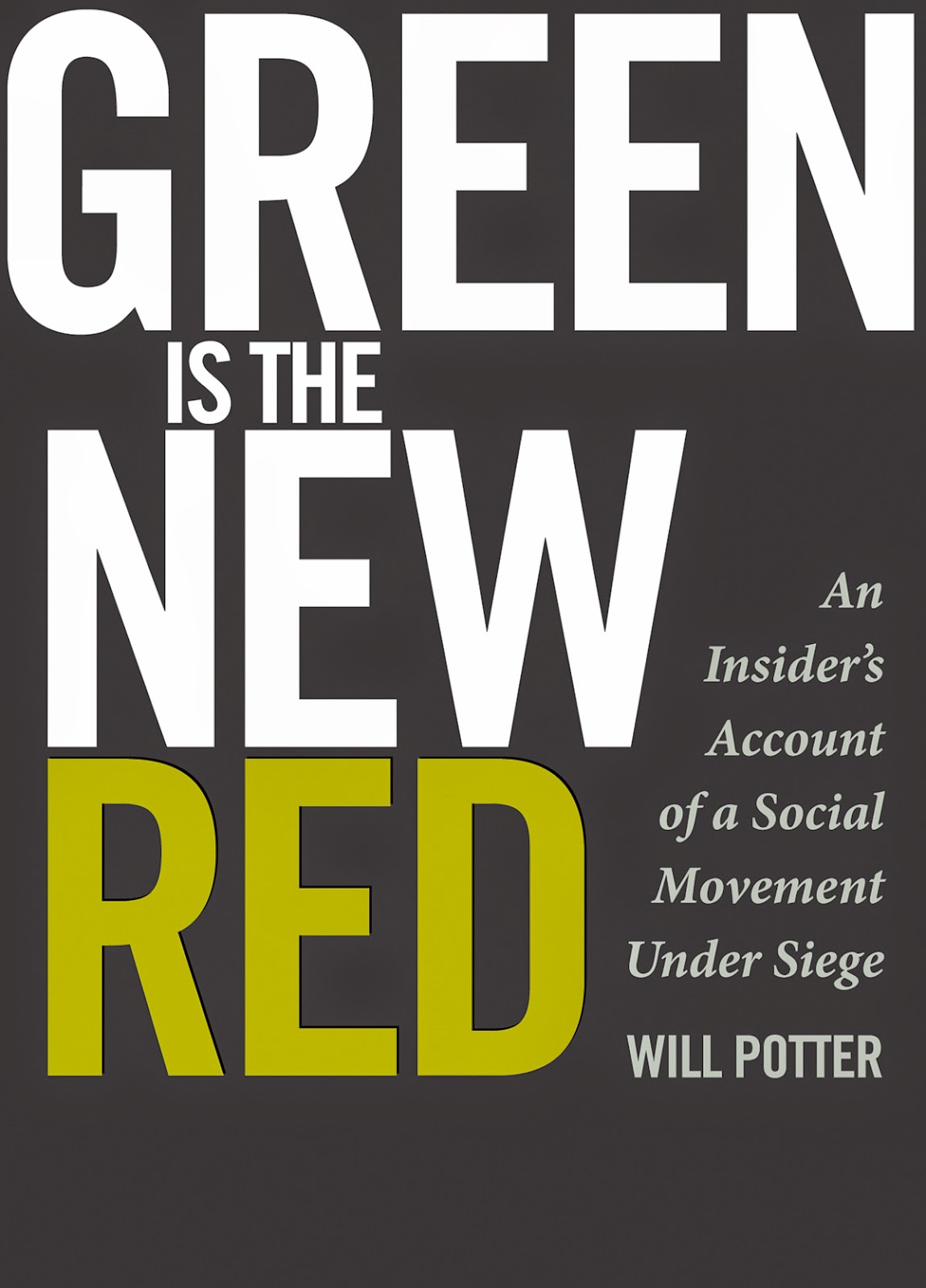
Green is the New Red

Green is the New Red: An Insider's Account of a Social Movement Under Siege
© 2011 Will Potter
256 pages


Is passing out flyers the moral equivalent of flying a plane into a skyscraper and killing thousands of people?  Well, in some legal circles, yes. Will Potter found out how eager Uncle Sam is to take down 'disruptive elements' when he passed out flyers as part of an animal rights campaign after years of writing about the activism of others and feeling guilty for not changing the world himself.  Federal agents showed up at his door and forcefully suggested he tell them everything he knew about the organization, or else he might find himself on a terrorist watch list.  Shaken by their visit, and disgusted at his fear, Potter decided to dig into  how and why the government had become so interested in consumer activism. Green is the New Red, the story of a group of young people called the SHAC-7 arrested and jailed for political crimes, is the result.

Although its title may indicate that environmentalism itself is under siege by the government,the focus here is animal rights activism. The SHAC 7 were associated with a movement called Stop Huntington Animal Cruelty, a campaign aimed against an animal-testing lab in the US and the UK. While SHAC itself was not a formal organization that carried out actions, it collected  and published information that could be used in campaigns -- information like the names and addresses of the lab's employees, executives, and shareholders.  Organizations like the Animal Liberation Front used that information to carry out actual attacks, which ranged from the benign (leaftlet campaigns) to the dangerous (arson). This collated information was also of service to demented individuals who broke into one woman's home, stole her dirty underwear, and used it to threaten rape. An aspirational activist, Potter does not shy away from the fact that some of the information-sharing was irresponsible. His concern here is not necessarily to exonerate the group, but to but to reveal and criticize the ferocious Federal response against them.  The seven, and other animal rights activists, are being treated as not only violent criminals, but capital-T Terrorists on the level of Al-Quaeda.  The SHAC-coordinated attacks on HLS were a triumph, reducing the company's stock so swiftly that lenders abandoned it as a credit risk, but no one was hurt. Property was damaged during the numerous lab-torchings, but no blood was shed. Potter compares the severe handling of the seven to groups that actually threaten and visit violence on others, like militia groups, the odd anarchist, and a few misguided pro-lifers. Whereas ordinary criminal laws applied to these acts of aggression, those associated with SHAC were interned in the same maximum-security sites as jihadists, and their names uttered in the same breath. Potter believes that the state's ferocity is provoked by its economic ties to the corporations whose bottom line is being disrupted.

That the State exists to protect and advance the interests of property is undisputed. Indeed, most attracted to a book of this kind about political activism will probably hold it as the truth. More to the point is the problem Potter identifies of the government's modern ability to freely label activists as enemies of the state. The problem lies in the many and nebulous definitions of terrorism, and the fact that once someone is declared a terrorist that normal rights, procedures, and the like go out the window. Although ALF did seek to use the threat of violence to force HLS to alter or stop the most abusive of its practices, its intent was not to incite terror in a population, and especially not through hurting innocents.  The PATRIOT Act's definition of terrorism is so vague that most acts of civil disobedience, including those practiced by Martin Luther King, qualify.  Modern presidents have an actrocious track record where civil liberties are concerned, and any threat to them must be checked. While Potter is somewhat hopeful that government persecution will create a larger problem than it solves -- he points out that the trial only caused an upsurge in activist attacks on HLS --  a more recent round of arrests has effectively ended the SHAC campaign.   The specter of federal agents arresting anyone who makes a fuss is arguably more daunting than the thought of a company losing equipment to arson:  civil liberties are much harder to restore than buildings.


Related:
The Ethical Assassin, David Liss. Said fellow is an animal rights warrior.