Unstoppable: the Emerging Left-Right Alliance to Dismantle the Corporate State
© 2014 Ralph Nader
224 pages
George Carlin groused that when he heard the word bipartisanship, he knew a larger than usual deception was in the works. Ralph Nader's Unstoppable offers a different kind of bipartisanship -- cooperation, not conspiracy. Written primarily to a progressive audience, Nader draws on his reading of Russell Kirk and F.A. Hayek to share the good news: there are people who share the similar values in both political wings, and plenty of room to work together against a common enemy. What common enemy? The crony-capitalist state, the nemesis of both progressives who fear the power of modern-day robber barons, and of libertarians and conservatives who value free markets, the rule of law, and civic order.
Nader opens Unstoppable with a victory several decades old: the termination of a particular nuclear project based on a alliance between progressive environmentalists and fiscal conservatives. Although joining forces with conservatives was initially a pragmatic move, in the decades that followed, Nader familiarized himself with both conservative and libertarian literature. Nader deserves kudos, for while it's not unusual for those passionate about politics to learn their opponents' arguments merely to demonstrate to them while they are wrong, Nader seems to have gained a genuine sense of empathy for those on the other side. Humanistic concern runs through each political camp considered here, a commonality that can be the basis of cooperative action. What most progressives think of as conservatism, Nader writes, is a new thing, the product of decades of slow corporate corruption of the political state. Its subsidies to multinationals, the benefaction rendered by regulations that smother competition, conserve nothing -- and nor do they promote liberty. Nader may still disagree those on the right, but underneath the ideology, he writes, we are still human beings who, when confronted with abuses, want to help one another.
The alliances that can be created vary. Progressivism's opponents may agree on opposing the State's growing activity in everyday life, but they don't agree with one another. Take the environment: some of the United States' most sweeping conservationist legislation was enacted by presidents like Theodore Roosevelt and Richard Nixon, and environmentalism lends itself well to the language of conservatism; think 'stewardship'. Progressive horror at the inroads consumerism is making in the lives of children can find kindred spirits in the ranks of social conservatives, especially the religious who fear their children becoming selfish and materialistic. Libertarians who swear more by the market than moral order may object to progressive-conservatives limiting choice by barring certain kinds of advertising, for instance, but when it comes to forswearing money given to corporations they're stalwart allies. Another area of progressive-libertarian camaraderie is ending the drug war, which even Old Right types could be convinced to join if shown how the war has completely destroyed civil law enforcement in favor of pseudo-military police enforcement. Free trade is a particularly thorny issue: libertarians may be for it, and paleo-conservatives against it, but there's a fuzzy thin line between protectionism (which progressives might back) and cronyism.
In the latter half of his book, Nader puts forth a list of twenty-five issues that progressives can work with either libertarians or paleo- and populist conservatives on, or both. Some of them involve the federal government doing more, which I don't think will sell well in allying with groups who view federal overreach as the entire point of opposition. It's a let's-get-the-Wehrmacht-out-of-Paris-before-we-strengthen-it-against-Stalin situation. Others involve a heart dose of localism. like promoting 'community self reliance', and distributive electrical grids. At one point Nader quoted Who Owns America?, the classic agrarian-distributist critique of the then- nascent plutocracy, and I may have swooned. Considering that two of the major contenders for the presidency have nebulous connections to their respective parties -- the independent socialist Sanders and the populist Trump -- Americans' frustration with the reigning RepubliCrat scheme seems ripe for this kind of cooperation. I only wish Nader had put more emphasis on local cooperation, which is further removed from ideology, and more motivated by having to work with the facts at hand. Non-progressives will find Nader's repeated assertion that progressives have less interest in ideology than facts to be dubious, and for the record I think that comes a little too close to holding that the ends are more important than the means. It's not enough to take steps to take care of what ails us: we should have some idea of where we are going. If we allow power to accrete in the name of "doing something", then we'll simply pave the way for future abuses.
Quarrels withstanding I found Unstoppable to be an immensely heartening book, a reassuring dose of civility and cooperation. I think if more Americans read it -- progressives, liberals, conservatives, and even those power-enabling rascals in the middle, the liberals and neocons, we might see each other more as people with genuine convictions, and not merely wrongheaded enemies who need to be defeated and driven from the field. When the talking heads on TV, both the announcers and the candidates, drive one to despair, consider Nader's humane rebuttal. Genuine hope for America may not be forlorn.
(And where else are you going to find a book with a Green party progressive hailing decentralism and lamenting over the problems of regulatory capture and bureaucratic quagmire?)
Related:
Crunchy Cons, Rob Dreher
Citizen Power, Mike Gravel
What's Wrong with the World?, G.K. Chesterton
We Who Dared Say no to War, ed. Murray Polner and Tom Woods. (Men of the left and right, respectively.)
Pursuing the flourishing life and human liberty through literature.
"Once you learn to read, you will be forever free." - Frederick Douglass
Showing posts with label liberal-progressive. Show all posts
Saturday, February 6, 2016
Friday, February 6, 2015
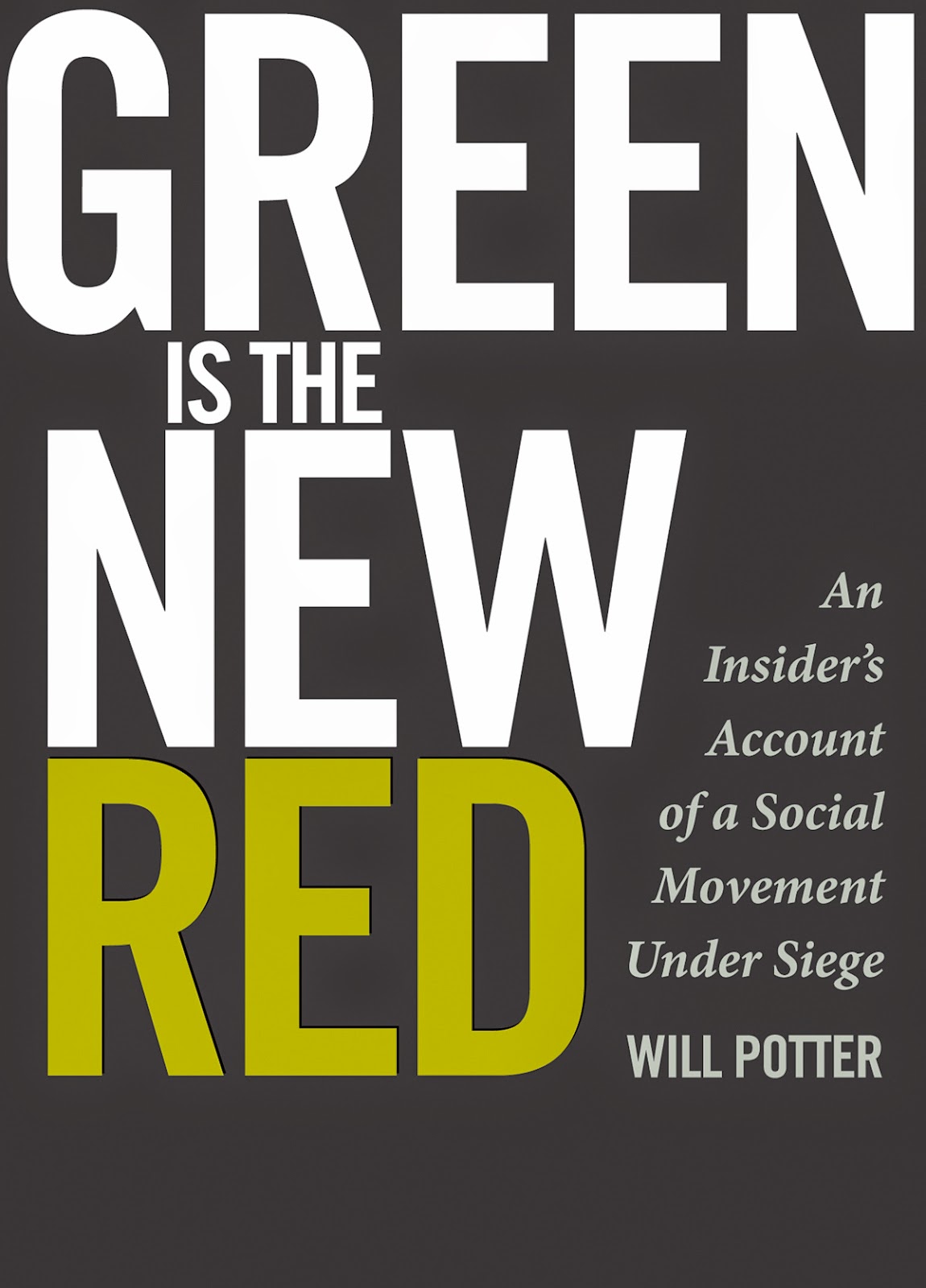
Green is the New Red
Green is the New Red: An Insider's Account of a Social Movement Under Siege
© 2011 Will Potter
256 pages
Is passing out flyers the moral equivalent of flying a plane into a skyscraper and killing thousands of people? Well, in some legal circles, yes. Will Potter found out how eager Uncle Sam is to take down 'disruptive elements' when he passed out flyers as part of an animal rights campaign after years of writing about the activism of others and feeling guilty for not changing the world himself. Federal agents showed up at his door and forcefully suggested he tell them everything he knew about the organization, or else he might find himself on a terrorist watch list. Shaken by their visit, and disgusted at his fear, Potter decided to dig into how and why the government had become so interested in consumer activism. Green is the New Red, the story of a group of young people called the SHAC-7 arrested and jailed for political crimes, is the result.
Although its title may indicate that environmentalism itself is under siege by the government,the focus here is animal rights activism. The SHAC 7 were associated with a movement called Stop Huntington Animal Cruelty, a campaign aimed against an animal-testing lab in the US and the UK. While SHAC itself was not a formal organization that carried out actions, it collected and published information that could be used in campaigns -- information like the names and addresses of the lab's employees, executives, and shareholders. Organizations like the Animal Liberation Front used that information to carry out actual attacks, which ranged from the benign (leaftlet campaigns) to the dangerous (arson). This collated information was also of service to demented individuals who broke into one woman's home, stole her dirty underwear, and used it to threaten rape. An aspirational activist, Potter does not shy away from the fact that some of the information-sharing was irresponsible. His concern here is not necessarily to exonerate the group, but to but to reveal and criticize the ferocious Federal response against them. The seven, and other animal rights activists, are being treated as not only violent criminals, but capital-T Terrorists on the level of Al-Quaeda. The SHAC-coordinated attacks on HLS were a triumph, reducing the company's stock so swiftly that lenders abandoned it as a credit risk, but no one was hurt. Property was damaged during the numerous lab-torchings, but no blood was shed. Potter compares the severe handling of the seven to groups that actually threaten and visit violence on others, like militia groups, the odd anarchist, and a few misguided pro-lifers. Whereas ordinary criminal laws applied to these acts of aggression, those associated with SHAC were interned in the same maximum-security sites as jihadists, and their names uttered in the same breath. Potter believes that the state's ferocity is provoked by its economic ties to the corporations whose bottom line is being disrupted.
That the State exists to protect and advance the interests of property is undisputed. Indeed, most attracted to a book of this kind about political activism will probably hold it as the truth. More to the point is the problem Potter identifies of the government's modern ability to freely label activists as enemies of the state. The problem lies in the many and nebulous definitions of terrorism, and the fact that once someone is declared a terrorist that normal rights, procedures, and the like go out the window. Although ALF did seek to use the threat of violence to force HLS to alter or stop the most abusive of its practices, its intent was not to incite terror in a population, and especially not through hurting innocents. The PATRIOT Act's definition of terrorism is so vague that most acts of civil disobedience, including those practiced by Martin Luther King, qualify. Modern presidents have an actrocious track record where civil liberties are concerned, and any threat to them must be checked. While Potter is somewhat hopeful that government persecution will create a larger problem than it solves -- he points out that the trial only caused an upsurge in activist attacks on HLS -- a more recent round of arrests has effectively ended the SHAC campaign. The specter of federal agents arresting anyone who makes a fuss is arguably more daunting than the thought of a company losing equipment to arson: civil liberties are much harder to restore than buildings.
Related:
The Ethical Assassin, David Liss. Said fellow is an animal rights warrior.
Wednesday, June 18, 2014
Power, Inc
Power, Inc: the Epic Rivalry between Government and Big Business
© 2013 David Rothkopf
448 pages
Historians of western civilization are used to viewing its late medieval and early modern period through the lens of a church versus state battle; the reformation owes as much to the desire for German princes to be free of the Roman pontiff’s command as it does belief in theological purity. Concurrent with the battle between Crown and cathedral, however, was another war; one between the crown and commerce. In Power, Inc, Alexander Rothkopft gives a history of the modern world, of the economic tides that eventually created polities greater than many states: corporations. The history, which covers economic entanglement in wars of the period as well as the evolution of Law, doubles as a plea for sharper control of corporations by the government.
Although Rothkopf draws on a variety of examples throughout the work, his anchor is the Stora corporation. Granted a charter in 1347, what began as a copper-mining operation turned Sweden into a power to be reckoned with during the Thirty Years War, but outlived its beneficiary by continuing to adapt to the modern world long after Sweden had been overshadowed once again by Germany, France, and England. Although the economic forces unlocked by the scientific and industrial revolutions were initially used primarily for the benefit of the king, governments soon lost control; the developing rule of law in modernizing country soon triumphed over the king's will, but instead of protecting all parties the law in America eventually became the faithful servant of corporations. Granted fictional personhood, and all the rights (but none of the responsibilities) thereof, corporations became 'super citizens' whose globetrotting power now rivals the majority of nations. Loyal to none and increasing free of legal restraints (courtesy of globalization), their might has prompted nation-states to adopt their methods But countries are not businesses, and if maximizing economic profitability becomes the standard for good governance we will be in a bad way, riven even more by inequality and utterly beholden to economic titans.
Power is organized smartly, linking a breadth of information; this is a lesson in the rise of the rule of law from military might and kings as well as the tale of the global economy's transition from medieval marketplaces to fiendishly complex financial markets. The golem-like creation of corporations delivers appropriate horror, but Rothkopf sees the battle between states and corporations as one sided, with corporations cast as the villains and governments diminished victims. Although he mentions the revolving door that sees corporate executives occupying seats within the government 'overseeing' the businesses they once worked for, and will again when they are out of office, the way government is used to increase the power of corporations -- through subsidies, or through legislation that smothers smaller businesses but leaves the big-business beasts intact -- are absent altogether. Sterner regulation, even when applied through global bodies, will only lead to more of the same.
Power, Inc doesn't quite live up to its name in giving an account of people being pawns between government and business, but it does offer a look as to how corporations are becoming utterly lawless in the global era.
Related:
No Logo and The Shock Doctrine, better anti-corporate books by Naomi Klein
Saturday, November 21, 2009
The Zinn Reader
The Zinn Reader
© 1997 Howard Zinn
668 pages
When I pulled this book from the shelf, I did so with the intention of checking it out and reading it over the Thanksgiving holiday. I did not anticipate the book monopolizing my interest from the moment I peeked inside on my way downstairs to the circulation desk to check it out until the minute I finished it. That a book of nearly seven hundred pages, often about politics, never lost my interest is impressive indeed.
Last week I watched a biographical documentary about the life of author Howard Zinn, a historian whom I read in the early spring. His People’s History of America and People’s History of American Empire were historical narratives with political messages, wholly interesting to me. The man who emerged from the documentary and from this book is fascinating: he grew up poor, in the slums of New York, back when the United States had its own labor and socialist movements. He was part of a B-17 crew during the Second World War, and afterwards became a historian and political activist, a combination of roles he sees only as natural. By chance he was sent to the South just as the Civil Rights movement began in earnest, and has written commentary on seemingly every major social and political event of the sixties, seventies, and eighties. This book contains a large sampling of articles, essays, newspaper columns, book introductions, and other literature he produced during the period, and it is a staggeringly communicative book. Zinn is easily the most captivating political author I’ve ever read, communicating not just history, but the emotional effect of history. Zinn’s indignation, sadness, and anger are obvious, but never overwhelming.
The Zinn Reader is one man’s commentary on his and the United States’ history and development. Zinn is a character in a larger story, responding to the historical events that unfold around him. Zinn is very much involved with history: for him, the idea that the historian is and must be neutral is wrong, fallacious even. Historians, and scholars in general, have the right and duty as human beings to respond to what is happening in their world -- to champion the causes they see as righteous and to attack with fervency what injustice and lies they can. He doesn’t write simply on the major events of his life -- World War 2, the Civil Rights movement, Vietnam -- but on the minor parts as well (Boston University’s “battleground” role during the rise of the student left) - -and on the whole scope of American history, from Columbus to the Gilded Age and beyond.
The highest praise I can give to any book is that it added depth to my life in making me think: Zinn addresses questions of mine in regards to civil disobedience (when is it “right”, namely), and makes me examine old ideas and new ones alike. The book swept me away, and I imagine it will be holding sway over my mind for a good long while, in the manner of Neil Postman. I don’t know if I’ll read anything more memorable this year -- I doubt I could. I recommend this to you utterly.
Saturday, August 22, 2009
The Audacity of Hope
The Audacity of Hope: Thoughts on Reclaiming the American Dream
© 2006 Barack Obama
375 pages
Knowing my interest in political speeches, a friend of mine asked me in 2005 if I'd ever heard of Barack Obama, who spoke at the 2004 DNC. I hadn't, of course, but American Rhetoric had a copy of said speech and gave it a listen. I don't recall my political views at the time: I know I was shifting from a fundamentalist Pentecostal and rabid Republican to questioning the former and not caring about the other. Whatever they were, I enjoyed listening to the speech, and I began watching him. In 2006, I was happy when he announced his decision to run for the office of President: I expected him to be a long-shot candidate, and planned on voting for him. I was surprised by his popularity, and bewildered by the fact that people were singing songs about him on YouTube. Wow. I grew tired of politics last summer, and was uncomfortable with some of his decisions, but I continued to watch his campaign -- and when it was announced that he was the winner, I was elated. I stayed up long after my usual bedtime watching speeches and shivering in anticipation the way I used to on Christmas morning. Despite my political cynicism, Obama has a hold on me. He makes me question my jaded assumptions -- he tempts me to believing in "America".
That's what The Audacity of Hope is principally about, although I expressed the above thoughts to myself weeks ago when writing in my journal, attempting to give voice to the thoughts swirling around in my brain. Its very title appeals to the idealist I once was -- and still am, judging by my susceptibility to the president's message. The book is less about idealism and more about common sense, for the most part. What dominates this book is not his urging the reader to believe in America -- although he does -- but his attempt to reintroduce common sense and empathy to politics, something that has been missing since ideology began driving political discussion in the late seventies or early eighties. Obama begins the book with a chapter on how things got to the point that they are today, going over political changes from the fifties to the present day. He brings up common sense and empathy, and applies them in following chapters to discussions of values, the Constitution, economic matters, religion, race, political campaigning, foreign affairs, and family matters.
Although the book is classified as a biography, I think this is erroneous. With the exception of "Family", the chapters are dominated by his discussion of what is -- not the story of his life. He does use personal anecdotes to introduce chapters and as occasional illustration, but they aren't the bulk of the book. The epilogue gives the book its title, as Obama reflects on a sermon he once heard using the phrase 'Audacity of Hope':
"The audacity of hope. That was the best of the American spirit, I thought -- having the audacity to believe despite all the evidence to the contrary that we could restore a sense of community to a nation torn by conflict; the gall to believe that despite personal setbacks, the loss of a job or an illness in the family or a childhood mired in poverty, we had some control -- and therefore responsibility -- over our own fate. It was that audacity, I thought, that joined us as one people. It was that pervasive spirit of hope that tied my own family's story to the larger American story, and my own story to those of the voters I sought to represent."
When I see that phase "despite all the evidence to the contrary", I'm given pause. It's certainly idealistic, and therein lies my uncertainty. I believe in idealism -- it motivates me. At the same time, I don't want to be deceived by it. This is an honest book, I think: it may get the biographical label because the author is so present in the book, plainly agonizing over difficult decisions that aren't so easy to make when the standard is reason and empathy. I can appreciate that -- I dislike books written with that sense of moral satisfaction, books like Bush Country and Rush Limbaugh is a Big Fat Idiot. I think people who read this book -- who sit down with its author and think about these things as he's thinking about them -- will get a lot out of it. You'd have to approach this book with hostility in mind to come away from it poorly. It is at its heart an honest discussion and I recommend it. At the very least, it will allow the reader to get into the mind of the US President.
Monday, August 6, 2007
This Week at the Library (6/8)
It didn't take me long to zip through this week's reading for whatever reason; the gods directed me to a select some very readable books, I suppose. The first book I read was Al Franken's Lies and the Lying Liars Who Tell Them. I had wanted to read something by Franken, but the main reason I picked this one up was because it featured Bill O'Reilly and Ann Coulter on the front cover. Bill is pointing his finger and shouting, presumably "SHUT UP!". I used to listen to W-MRK, this local AM station that plays fifties/sixties rock and features a lot of conservative talk radio hosts. I sometimes listened to O'Reilly, but I thought he was an abusive ass and only listened when I wanted to be amused by his antics. I can't even laugh about Ann Coulter, though; listening to her is like walking in a graveyard and seeing the grave of a child who died in a fire. It's sad, you know?
When I picked up the book, I wanted to read about those two being taken to task, and Franken does it quite well. Franken and I are both liberal idealists, so I don't think we'd have much to argue about. The book does put President Clinton a bit of a pedestal, though. I generally like Clinton, but I'm wary of a book that doesn't mention any failings of his. Then again, Clinton wasn't the subject of this book and he's mentioned only when Franken is addressing lies about him. This book was written before the '04 election, and so references Bush's "Not Really Elected" status more than a few times. I found the book to be informative and hilarious. One similar book I want to read is Soulless. You can probably guess who that one is about.
After the book on Franken, I read Kurt Vonnegut's A Man Without a Country. The initial few chapters don't seem to have a common theme, but the latter half of the book drifts toward idealism and sticks there. I have to say that the hour I spend reading this book was one of the most enjoyable hours I ever spent alive. The title of the book comes from Vonnegut's conviction that the America he loves has started to pass away in recent years. He does say this, though:
You might notice in that quoted section that Vonnegut uses commas a lot. I don't know if that's his literary style or if it's common of writers in his generation, but I noticed it throughout the book. He never uses semicolons as a matter of principle, which I find to be an interesting quirk. I enjoyed reading Vonnegut's words so much that I copied down a number of his quotations into my journal. You can browse his WikiQuote page to see others. I also have some of my favorites in my blog for those of you in the know. Vonnegut has been described this century's Mark Twain, which is funny considering that he asks where this century's Mark Twains and Abraham Lincolns are. I like reading this book, will look for other nonfiction works by him, and may even give his fiction another try.
Rickles' Book was the third I read this week. I said last week that the most memorable part of Don Rickles' appearance on Letterman was the fact that he kept insulting Dave throughout the course of the interview. As I read the book, I learned that insult humor is Rickles' shtick. That's how he makes a living; people pay him to come to their hotel or show, and he insults the audience and host. The main reason I checked this book out was to read anecdotes about Frank Sinatra. They were there as promised; in fact, Rickles opens and closes with stories about Frank. Anyone who knows me well knows that I am a passionate fan of Frank Sinatra; his music, his movies, the man himself. There are plenty of stories about Frank in this book, and I hadn't heard any of them. Rickles describes Frank's voice as "the best voice in the history of music", which of course I agree with. I had personally never heard of Rickles before I saw him on Letterman, but I found this book to be enjoyable because the stories about the Ratpack and Johnny Carson alone.
Next up, I read President Carter's Our Endangered Values. In it, Carson addresses contemporary issues and explains his stance on them as it is informed by his faith and such. I've been meaning to read some of his books, and when he mentioned this one in an interview I decided to go with this one. President Carter explores issues like science (evolution, Big Bang), fundamentalism, the death penalty, abortion, environmentalism, and nuclear disarmament. I must admit that I used to harbor sort of a grudge against Carter for beating President Ford in the '76 election. It was a rather silly reason. I am a fan of Carter because of his activities in his post-presidential years; for a while my computer wallpaper included a picture of him working with Habitat for Humanity. Some of Carter's stances, as explained in the book:
"Although we often had discussions about the meaning of weekly lesson texts (divided equally between the New Testament and the Hebrew Scriptures), there was no thought of questioning the standard theology that characterized our devotion."
Notice what he does there? It's subtle; he refers to the Hebrew scriptures -- the Torah and Prophets and such -- as the Hebrew scriptures. He doesn't call them "The Old Testament". Why? Because oddly enough, Jews are mildly insulted when Christians refer to their Torah as "old", like it's "outdated" or "defunct". I discovered this a year or so ago when I began to research Judaism out of curiosity, although it should have been common sense. Another example: in a chapter on subservience of women in Christianity, President Carter uses a translation of the Bible that says "humankind" instead of "mankind". That's less subtle given the context, but still nice. He did amuse me when he mentioned "The War Between the States". I can almost hear him saying "Well, you know, there was nothing really civil about it."
The last book I read was The Plains of Passage. This describes Ayla and Jondolar's journey from the summer camp of the Mamutoi to the camps of the Zelandonii, who are Jondolar's people. It reminded me a lot of The Valley of Horses. Ayla spent most of Valley sitting in her cave learning to be self-sufficient, but Jondolar went on a journey with his brother and half the book was devoted to exploring his and his brother's travels as they walked across the landscape and met various people. That's what this book is about; Ayla and Jondolar walking from Asia Minor to France, meeting various people along the way. (The books my local library has feature maps that allow the reader to track what's going on.)
This book actually introduces the closest thing I've seen to villains since Broud. The first and most interesting is a psychotic feminazi named Attaroa. She murders the leader of the camp she lives in (her husband) and shoves all of the males into a caveman concentration camp. She's doing this because she thinks if only female spirits "mix", then only females will be born. She manages to capture Jondolar and tie him to a wooden stake used for target practice. Ayla shows up just in time, although to my disappointment she hails from the Jean-Luc Picard school of confrontation. (That is, talk the villain to death until their own character flaws do them in. It's poetic justice and that makes for nice literature, but in real life Ayla probably would've greeted Attaroa by killing her.)
The author, Jean M. Auel, often takes time while writing the books to describe what the landscape is like, what the animals are like, and how exactly humans are altering their environment to suit their needs. Sometimes this approach is interesting; sometimes it isn't. I enjoy learning about the mammoths and aurochs and onagers, but I couldn't stay interested in flint knapping. (Although I did pick up the word "knapping".) I think this is the reason some people (judging by reviews on Amazon and iRead) lose interest in this book. We're already familiar with most of the people Ayla and Jondolar encounter, so things can get a little bit tedious.
The most interesting part of the book for me came near the very end, when Jondolar and Ayla rescue a man and woman of the Clan who are being attacked by a band of thugs. I was very glad to see the Clan again; I like them. The Others aren't all that interesting, because there's no real difference between Cro-Magnons and modern humanity except that Cro-Magnons were a bit bigger. That makes sense considering that they live during the Ice Age and needed to be made of sterner stuff. I suppose we've atrophied since.
What I didn’t like about the book (and the series) is that things fit together too well. Ayla is almost a Mary Sue character; she's too perfect. She was raised by two people who were considered the best in the fields; one of them is a legendary figure who people across the continent know about. Her moral integrity is beyond reproach. She's wonder woman: she's the Ice Age version of Benjamin Franklin. Horseback riding, dogs, sewing needles...you name it, Ayla of the Mamutoi invented it.
Plains of Passage ended my reading for this week. I'm going to guess in the next book that her new family throws a fuss over her being raised by the Clan, and Jondolar will have to choose between the Family He Returned For and the Woman He Loves.
Pick of the Week: I'm going to go with Vonnegut's A Man Without a Country.
So that ends last week. This week, I wanted to get a book on turtles, as I've always liked turtles and frogs. Turtle biology in particular has always intrigued me. What's with the shells? I did some background reading in case whatever book I pick up is technical, and it seems that the shell is essentially the turtle's ribcage, but has been fused together. The book I want (which covers turtles, frogs, and lizards) is checked out, so I go with Turtles and Tortoises For Dummies. It's focused more at people who want to keep turtles as pets (something I've considered in the past), but I think I will learn from it anyway. I trust the for Dummies books.
In fiction, I plan to read Jeff Shaara's The Rising Tide. Back 2002 or 2003, my folks and I went to Kentucky. At my behest, we went to a Abraham Lincoln museum there. I thought ol' Abe was overrated (and still do, as far as civil rights is concerned*), but was nonetheless interested. While there, I saw a book called The Killer Angels by Michael Shaara and a movie called Gettysburg. I realized while watching the movie that the movie was based largely on the book, and follows it almost word for word. Gettysburg is one of my favorite movies, and I can still quote large portions of it from memory -- especially scenes with General Pickett. While Gettysburg was being filmed, someone told Jeff Shaara -- Michael's son -- that he should write a sequel to his father's book. So he did; he wrote Gods and Generals, which is a prequel. He then wrote The Last Full Measure, which is a sequel. He must've found this line of work to be most interesting, because he continued writing books that take place during American wars. I've read all of them but his last one, which was based on World War 2. It's called The Rising Tide.
On a similar note -- the second World War -- I plan on reading Kurt Vonnegut's "Slaughterhouse-5". I say "on a similar note" because Vonnegut says it is an account of his experiences as a POW held by the Germans during the Dresden bombing. Brief history lesson: the British had to bomb cities at night because the RAF was so small and Nazi Germany's air defenses so stellar. Since precision bombing at night was impossible back then, the British adopted the strategy of carpet-bombing whole cities to ensure that damage was done. Fire-bombing was introduced to make even more of an impact, and Dresden was one city targeted in that fashion. The United States also indulged in firebombing. The USAAF's most well known experience with that is the Tokyo firebombing. I'm looking forward to encountering more of Mr. Vonnegut's personality. I share some of my favorite quotations from the book here.
In keeping with my studies, I plan to check out another book on German history -- Blood & Iron. The secondary title is "From Bismarck to Hitler, the von Moltke Family's Impact on German History". That makes three books this week that are somehow tied to Nazis, so I think next week I'll check out something cheery and light.
Against my better judgment and good taste -- and solely at the behest of numerous friends -- I am planning to read the first Harry Potter novel. I'm not into magic and fantasy, but my friends keep asking me to read these. One of those friends is likewise disinterested in magic, and he described the first book as "charming". We'll see. I'll read the book with an open mind and a straight face; if I could read all sixteen Left Behind books, I can surely read one Harry Potter novel. This way, if I read the first book and don't like it, I'll have a legitimate reason to not have read the series. I think I'll probably like it, but not enough to become a "Potterhead". (I have another friend who refuses to read the Potter books, and that's the way he referred to Potter fans when he threatened my life in the event I became a fan. )
That gives me five books, and I check them out with no problems. While in the library, I see a book written against James Dobson. I'm very much interested in reading, but I don't know how long it will take me to read the Shaara novel. I'll save it for next week. I'm also saving the final Earth's Children novel for next week. I'll miss Wonder Woman, but Auel is working on a sixth and final book.
So, this week:
[*] I've read a lot of Lincoln's own words, and firmly believe Lincoln's "civil rights" achievements were inspired by political strategy. He was firmly in the "necessary evil" camp until the Civil War, then realized he could use slavery against the South as a strategic advantage. That doesn't detract from what he accomplished, but I tire of people making him out to be a saint.
When I picked up the book, I wanted to read about those two being taken to task, and Franken does it quite well. Franken and I are both liberal idealists, so I don't think we'd have much to argue about. The book does put President Clinton a bit of a pedestal, though. I generally like Clinton, but I'm wary of a book that doesn't mention any failings of his. Then again, Clinton wasn't the subject of this book and he's mentioned only when Franken is addressing lies about him. This book was written before the '04 election, and so references Bush's "Not Really Elected" status more than a few times. I found the book to be informative and hilarious. One similar book I want to read is Soulless. You can probably guess who that one is about.
After the book on Franken, I read Kurt Vonnegut's A Man Without a Country. The initial few chapters don't seem to have a common theme, but the latter half of the book drifts toward idealism and sticks there. I have to say that the hour I spend reading this book was one of the most enjoyable hours I ever spent alive. The title of the book comes from Vonnegut's conviction that the America he loves has started to pass away in recent years. He does say this, though:
"While on the subject of burning books, I want to congratulate librarians, not famous for their physical strength, their powerful political connections or great wealth, who have staunchly resisted anti-democratic bullies who have tried to remove certain books from their shelves, and destroyed records rather than to reveal to thought police the names of persons who have checked out those titles.So the America I loved still exists, if not in the White House, the Supreme Court, the Senate, the House of Representatives, or the media. The America I love still exists at the front desk of our public libraries."
You might notice in that quoted section that Vonnegut uses commas a lot. I don't know if that's his literary style or if it's common of writers in his generation, but I noticed it throughout the book. He never uses semicolons as a matter of principle, which I find to be an interesting quirk. I enjoyed reading Vonnegut's words so much that I copied down a number of his quotations into my journal. You can browse his WikiQuote page to see others. I also have some of my favorites in my blog for those of you in the know. Vonnegut has been described this century's Mark Twain, which is funny considering that he asks where this century's Mark Twains and Abraham Lincolns are. I like reading this book, will look for other nonfiction works by him, and may even give his fiction another try.
Rickles' Book was the third I read this week. I said last week that the most memorable part of Don Rickles' appearance on Letterman was the fact that he kept insulting Dave throughout the course of the interview. As I read the book, I learned that insult humor is Rickles' shtick. That's how he makes a living; people pay him to come to their hotel or show, and he insults the audience and host. The main reason I checked this book out was to read anecdotes about Frank Sinatra. They were there as promised; in fact, Rickles opens and closes with stories about Frank. Anyone who knows me well knows that I am a passionate fan of Frank Sinatra; his music, his movies, the man himself. There are plenty of stories about Frank in this book, and I hadn't heard any of them. Rickles describes Frank's voice as "the best voice in the history of music", which of course I agree with. I had personally never heard of Rickles before I saw him on Letterman, but I found this book to be enjoyable because the stories about the Ratpack and Johnny Carson alone.
Next up, I read President Carter's Our Endangered Values. In it, Carson addresses contemporary issues and explains his stance on them as it is informed by his faith and such. I've been meaning to read some of his books, and when he mentioned this one in an interview I decided to go with this one. President Carter explores issues like science (evolution, Big Bang), fundamentalism, the death penalty, abortion, environmentalism, and nuclear disarmament. I must admit that I used to harbor sort of a grudge against Carter for beating President Ford in the '76 election. It was a rather silly reason. I am a fan of Carter because of his activities in his post-presidential years; for a while my computer wallpaper included a picture of him working with Habitat for Humanity. Some of Carter's stances, as explained in the book:
- Evolution & Big Bang, science in general: No problem. He says biblical authors didn't know what we know. He doesn't explain how Original Sin factors in to this. I think maybe he doesn't believe in Original Sin. I googled around to see if I could find out, but I didn't turn up anything conclusive.
- Homosexuality: Considers it a sin based on Paul's writings, but also supports civil unions.
- Death Penalty: Inhuman. He doesn't even argue against it, really; he quotes some statistics, mentions that the penalty is still on the book and still used, and expresses the thought that there needs to be a better effort to get rid of it. He discusses it in the same tone as you or I would anti-miscegenation laws.
- Abortion: Against it; he said he supported Roe v. Wade because it was his duty as the chief executive, and he couldn't allow his religious convictions to interfere with his job as a secular leader. He believes that all babies should be wanted babies. Because of this…
- Birth Control: Very supportive.
- Stem Cell Research: Supportive; based on Carter's seemingly contradictory stances on abortion and stem cell research, It would seem that he doesn't believe fertilized eggs are really human yet. That would also make sense given his stance on birth control, as some methods of that are abortive anyway. Stem cell research may not be an issue in the future; I heard that we may have found a way of using skin cells to supply the same benefits as stem cells.
- Fundamentalism: Opposed; claims it's against Christian ideals.
- Church/State Separation: Very supportive.
- Left Behind: Bizarre.
- Pretty much policy decision made by George W. Bush: Wrong.
"Although we often had discussions about the meaning of weekly lesson texts (divided equally between the New Testament and the Hebrew Scriptures), there was no thought of questioning the standard theology that characterized our devotion."
Notice what he does there? It's subtle; he refers to the Hebrew scriptures -- the Torah and Prophets and such -- as the Hebrew scriptures. He doesn't call them "The Old Testament". Why? Because oddly enough, Jews are mildly insulted when Christians refer to their Torah as "old", like it's "outdated" or "defunct". I discovered this a year or so ago when I began to research Judaism out of curiosity, although it should have been common sense. Another example: in a chapter on subservience of women in Christianity, President Carter uses a translation of the Bible that says "humankind" instead of "mankind". That's less subtle given the context, but still nice. He did amuse me when he mentioned "The War Between the States". I can almost hear him saying "Well, you know, there was nothing really civil about it."
The last book I read was The Plains of Passage. This describes Ayla and Jondolar's journey from the summer camp of the Mamutoi to the camps of the Zelandonii, who are Jondolar's people. It reminded me a lot of The Valley of Horses. Ayla spent most of Valley sitting in her cave learning to be self-sufficient, but Jondolar went on a journey with his brother and half the book was devoted to exploring his and his brother's travels as they walked across the landscape and met various people. That's what this book is about; Ayla and Jondolar walking from Asia Minor to France, meeting various people along the way. (The books my local library has feature maps that allow the reader to track what's going on.)
This book actually introduces the closest thing I've seen to villains since Broud. The first and most interesting is a psychotic feminazi named Attaroa. She murders the leader of the camp she lives in (her husband) and shoves all of the males into a caveman concentration camp. She's doing this because she thinks if only female spirits "mix", then only females will be born. She manages to capture Jondolar and tie him to a wooden stake used for target practice. Ayla shows up just in time, although to my disappointment she hails from the Jean-Luc Picard school of confrontation. (That is, talk the villain to death until their own character flaws do them in. It's poetic justice and that makes for nice literature, but in real life Ayla probably would've greeted Attaroa by killing her.)
The author, Jean M. Auel, often takes time while writing the books to describe what the landscape is like, what the animals are like, and how exactly humans are altering their environment to suit their needs. Sometimes this approach is interesting; sometimes it isn't. I enjoy learning about the mammoths and aurochs and onagers, but I couldn't stay interested in flint knapping. (Although I did pick up the word "knapping".) I think this is the reason some people (judging by reviews on Amazon and iRead) lose interest in this book. We're already familiar with most of the people Ayla and Jondolar encounter, so things can get a little bit tedious.
The most interesting part of the book for me came near the very end, when Jondolar and Ayla rescue a man and woman of the Clan who are being attacked by a band of thugs. I was very glad to see the Clan again; I like them. The Others aren't all that interesting, because there's no real difference between Cro-Magnons and modern humanity except that Cro-Magnons were a bit bigger. That makes sense considering that they live during the Ice Age and needed to be made of sterner stuff. I suppose we've atrophied since.
What I didn’t like about the book (and the series) is that things fit together too well. Ayla is almost a Mary Sue character; she's too perfect. She was raised by two people who were considered the best in the fields; one of them is a legendary figure who people across the continent know about. Her moral integrity is beyond reproach. She's wonder woman: she's the Ice Age version of Benjamin Franklin. Horseback riding, dogs, sewing needles...you name it, Ayla of the Mamutoi invented it.
Plains of Passage ended my reading for this week. I'm going to guess in the next book that her new family throws a fuss over her being raised by the Clan, and Jondolar will have to choose between the Family He Returned For and the Woman He Loves.
Pick of the Week: I'm going to go with Vonnegut's A Man Without a Country.
So that ends last week. This week, I wanted to get a book on turtles, as I've always liked turtles and frogs. Turtle biology in particular has always intrigued me. What's with the shells? I did some background reading in case whatever book I pick up is technical, and it seems that the shell is essentially the turtle's ribcage, but has been fused together. The book I want (which covers turtles, frogs, and lizards) is checked out, so I go with Turtles and Tortoises For Dummies. It's focused more at people who want to keep turtles as pets (something I've considered in the past), but I think I will learn from it anyway. I trust the for Dummies books.
In fiction, I plan to read Jeff Shaara's The Rising Tide. Back 2002 or 2003, my folks and I went to Kentucky. At my behest, we went to a Abraham Lincoln museum there. I thought ol' Abe was overrated (and still do, as far as civil rights is concerned*), but was nonetheless interested. While there, I saw a book called The Killer Angels by Michael Shaara and a movie called Gettysburg. I realized while watching the movie that the movie was based largely on the book, and follows it almost word for word. Gettysburg is one of my favorite movies, and I can still quote large portions of it from memory -- especially scenes with General Pickett. While Gettysburg was being filmed, someone told Jeff Shaara -- Michael's son -- that he should write a sequel to his father's book. So he did; he wrote Gods and Generals, which is a prequel. He then wrote The Last Full Measure, which is a sequel. He must've found this line of work to be most interesting, because he continued writing books that take place during American wars. I've read all of them but his last one, which was based on World War 2. It's called The Rising Tide.
On a similar note -- the second World War -- I plan on reading Kurt Vonnegut's "Slaughterhouse-5". I say "on a similar note" because Vonnegut says it is an account of his experiences as a POW held by the Germans during the Dresden bombing. Brief history lesson: the British had to bomb cities at night because the RAF was so small and Nazi Germany's air defenses so stellar. Since precision bombing at night was impossible back then, the British adopted the strategy of carpet-bombing whole cities to ensure that damage was done. Fire-bombing was introduced to make even more of an impact, and Dresden was one city targeted in that fashion. The United States also indulged in firebombing. The USAAF's most well known experience with that is the Tokyo firebombing. I'm looking forward to encountering more of Mr. Vonnegut's personality. I share some of my favorite quotations from the book here.
In keeping with my studies, I plan to check out another book on German history -- Blood & Iron. The secondary title is "From Bismarck to Hitler, the von Moltke Family's Impact on German History". That makes three books this week that are somehow tied to Nazis, so I think next week I'll check out something cheery and light.
Against my better judgment and good taste -- and solely at the behest of numerous friends -- I am planning to read the first Harry Potter novel. I'm not into magic and fantasy, but my friends keep asking me to read these. One of those friends is likewise disinterested in magic, and he described the first book as "charming". We'll see. I'll read the book with an open mind and a straight face; if I could read all sixteen Left Behind books, I can surely read one Harry Potter novel. This way, if I read the first book and don't like it, I'll have a legitimate reason to not have read the series. I think I'll probably like it, but not enough to become a "Potterhead". (I have another friend who refuses to read the Potter books, and that's the way he referred to Potter fans when he threatened my life in the event I became a fan. )
That gives me five books, and I check them out with no problems. While in the library, I see a book written against James Dobson. I'm very much interested in reading, but I don't know how long it will take me to read the Shaara novel. I'll save it for next week. I'm also saving the final Earth's Children novel for next week. I'll miss Wonder Woman, but Auel is working on a sixth and final book.
So, this week:
- Turtles and Tortoises for Dummies by Liz Palika.
- Harry Potter and the Sorcerer's Stone by J. K. Rowling
- Blood & Iron by Otto Friedrich.
- The Rising Tide by Jeff Shaara.
- Slaughterhouse-5 by Kurt Vonnegut.
[*] I've read a lot of Lincoln's own words, and firmly believe Lincoln's "civil rights" achievements were inspired by political strategy. He was firmly in the "necessary evil" camp until the Civil War, then realized he could use slavery against the South as a strategic advantage. That doesn't detract from what he accomplished, but I tire of people making him out to be a saint.
Subscribe to:
Posts (Atom)