Showing posts with label Greg Cox. Show all posts

Monday, May 1, 2017

Captain to Captain

Captain to Captain
© 2016 Greg Cox
368 pages


Captain Kirk is surprised to be hailed by the formidable former first officer of the Enterprise, a woman so accomplished she still retains the nickname "Number One", enroute to a little shore leave. Her stated goal is to visit the Enterprise, where she was once such a commanding presence that her voice is still the model for the shipboard computer's audio output.  Her unstated goal is to remove something from a secret vault on the ship that only the captain and his first officer -- and only the captains and first officers  before him -- know about. She has unfinished business with the device,  born of a tragedy incurred while she was a young lieutenant on the Enterprise, and before it's too late she wants to make whatever amends she can.

Captain to Captain is the first in a trilogy of books by different authors, celebrating Star Trek's fiftieth anniversary, and should entice Trekkies immediately with the promise of exploring the mysterious character of Number One.  Appearingly only in Trek's pilot episode, she played the logical and unemotional first officer, alongside a...well, not quite unemotional Mister Spock.  According to Gene Roddenberry, he was told by network officials that he must get rid of the woman and the alien, so he 'married the woman and kept the alien, not being able to do it the other way around'. Of course, the woman wasn't so hard to get rid of: Majel Roddenberry would return quickly as Nurse Chapel, the voice of the computer in every series but Enterprise,  and Lwaxana Troi. But that was later. Number One was the original.


We learn quickly that she is from a planet which is not Earth, and which has given her a name unpronounceable to most Federation Standard ears:  she simply uses the monicker "Una", a nickname from her Academy years, as her given name. Following her cat burglary aboard the Enterprise,  the book switches to her original mission, under Captain Robert April. Here she is cool and confident, but not impersonal; she has a strong attachment to several of her crewmembers, even indulging one in many jokes despite his being directly under her command.  Perhaps she embraced more reserve after the tragedy that befell her assignment, which started after the Enterprise discovered a formerly-visited planet had suddenly been invaded by a mysterious citadel of obvious alien origin, which was busy destroying rain-forests, enslaving the locals, and being very poor neighbors altogether. 

Captain to Captain begins as a mystery before quickly developing into an action novel, one which peaked a bit early (4/5ths in) and then threw in the Klingons to keep things exciting. I only bought it for Number One and Cox, and got my money's worth, but could see pursuing the rest of the trilogy later. The second book is by David Mack, for pete's sake. 


Sunday, September 25, 2016

Loose Ends

Roswell: Loose Ends
© 2001 Greg Cox
288 pages


The last person Liz expected to bump into in the depths of Carlsbad Caverns was the man who nearly killed her -- would have killed her, had her lab-buddy/secret admirer not been nearby to save her life. He didn't throw himself in front of a bullet or give her CPR, though, he merely dissolved the bullet and forced her molecules to speed-heal themselves. You can do that sort of thing when you're an exiled alien king.  Bumping into Grumpy Murderman is a problem, not just because it brings to earth the mental-emotional turmoil that Liz has kept suppressed in the two years since she fell to the kitchen floor, bleeding from the gun -- Murderman remembers her, too. He remembers accidentally shooting a girl, even if the papers covered it up, and now that he's laid eyes on her again he's determined to find out the truth. But first, he's gotta blackmail an army test pilot into selling him a briefcase of UFO parts.  Priorities!

The first time I read Loose Ends, when it was released, it confused me -- utterly. I'd read Roswell High, of course, multiple times. I'd memorized parts of it -- and this Roswell, while featuring a lot of the same characters, was completely different. Who were the "Skins"? Why did Maria keep talking about Czechoslovakians?   I managed to get through the novel, questions aside, and put it in my Star Trek bookcase, there to be forgotten about for well over a decade.  Now I've read it again, and -- having watched the television show on which this is based -- it makes a lot more sense.   One of the reasons I've kept the book is because its author, Greg Cox, is more familiarly known to me as an author of Trek books. The language is odd -- sort of self-censoring and clunky, as if the publishers didn't want to be as earthy as the show. "Flying saucer" is used where another F-word might appear in the real world, and sounds really silly in the mouths of teenagers. Similarly awkward is Murderman, whose lines are so wooden they're petrified. (That's not really his name, but he's a scruffy potbelly who shoots people.)

A book like this has limited appeal, I suppose, being written for a teen drama that's since been forgotten by probably everyone, but if you're  a fan of the show it has its moments.


Comments welcome, but I'm lost in the desert until October!

Wednesday, August 3, 2016

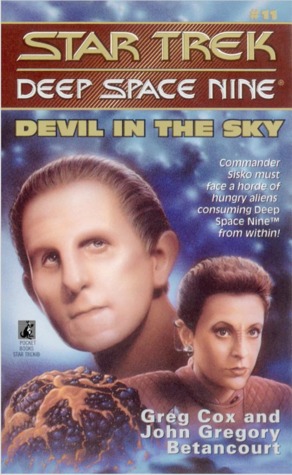
Devil in the Sky

ST DS9: Devil in the Sky
© 1995 Greg Cox and John Gregory Betancourt
280 pages


In the classic TOS episode, "Devil in the Dark",  Kirk and the Enterprise were dispatched to a mining colony to discover and put an end to the monster that had been killing the colonists. The 'monster' turned out to be a silicon being, a Horta, who was waging a war of self-defense against colonists unwittingly destroying her eggs.   Now a Federation outpost is again imperiled by the Horta, after a mother Horta is kidnapped and her eggs arrive on a freighter to Deep Space Nine as hungry orphans. The Horta had been invited to Bajor to jump-start a dormant mining industry, but she was kidnapped by Cardassians enroute. As Kira, Dax, Bashir are dispatched on a rescue mission into Cardassian territory,  Sisko and the others labor to keep the hungry rock-slugs from literally eating them out of house and home.

The only high point here, really, is Kira and Bashir's maturing 'friendship'. Bashir begins as a caricture of himself. His youthful arrogance and total confidence in himself are taken up to eleven, and made all the more obnoxious by Bashir swaggering around like a lady-killer.  Kira, with an established disdain for Bashir's patronizing view of Bajor, only likes him slightly more than the Cardassians.  Forced to work together to free the Horta from a death camp filled with Bajorans, however,  Bashir matures and Kira starts to find him tolerable. It's the Bashir-Kira version of that Bashir-O'Brien episode: evidently the key to liking the doctor is facing death with him.

The rest is fairly average: Odo is grumpy and doesn't like Quark, Quark is scheming, Jake and Nog get into trouble, that sort of thing. There's at least one nice call back to the original episode, in which the Mother Horta is forced to communicate by writing letters in acid on the floor -- not "NO KILL I", but "FOLLOW ME".  Sisko takes entirely too long to remember that Bajor has  deserted moons that he can stick the Horta babies on without angering the Bajoran government who have suddenly decided that nope, Horta have no place in Bajor's delicate ecosystem.

If the first one hundred pages -- of Bashir being utterly obnoxious, far more so than he was in the show -- can be survived, it's an enjoyable enough action tale.

Friday, August 15, 2014

To Reign in Hell (Rise and Fall of KHAAAAAAAAAAN #3)

To Reign in Hell: the Exile of Khan Noonien Singh
©  2006 Greg Cox
384 pages


"No! This is not the end!  Khan Noonien Singh will never surrender, not to this accursed planet and not to the treacherous vagaries of fate. Hear me now! I shall show you that the superior man never bends before the cruelties of fate, no matter how hopeless the odds. Let this entire planet die a slow and miserable death. Let Kirk and Starfleet forget us entirely. I will keep you and the rest of my people alive -- this I swear upon my sacred honor."
He shook his fist at the dust-shrouded sky.
"Do you hear me, Kirk? I will survive!"   p. 269


Khan Noonien Singh is the most outstanding individual villain in all of Trek lore, a man who took from Kirk his dearest blood. An escaped superman from Earth's violent past, Khan failed in attempts to take over the world and then the USS Enterprise before Kirk exiled him to a harsh planet in the Mutara Sector to build his own civilization. Such a dream wasn't to be, however, as only months into exile astronomical phenomena destroyed the planet's chances of sustaining life for very long.   His last hope wrecked, his people dying,  a man bred to be an emperor was left to preside over nothing more than the apocalypse. To Reign in Hell is an exceptional tie-in to "Space Seed" and The Wrath of Khan,  and an expert conclusion to the Khan trilogy, depicting the demise of a dream and the descent of a man into madness.

The story picks up a year after the events of The Wrath of Khan.  Kirk and his comrades have decided to pay a visit to the hellhole that was Khan's world in order to find out what went wrong;  what happened to make the colony fail so catastrophically, and why did Khan blame a man who had been a  model of mercy towards him?  Soon after landing, Kirk and company discover the underground shelters that Khan and his people fled to when the surface was exposed to the blistering sun and fierce winds that turned grasslands into desert. Within the caverns are historical records, provided by the Starfleet historian who was seduced by Khan and joined him in exile -- Marla McGivers. The novel unfolds as Kirk delves in, and the story that Cox builds works wonderfully to iron out "Space Seed" and TWOK's wrinkles.

To Reign in Hell performs admirably in every aspect; as piece connecting two different Trek stories, as a thriller in its own right, and as the finale of Khan. Khan has never been as human, nor as remotely sympathetic, as he is here. He has no one to villainize, he has only his hopes and ambition, those dreams of creating a world for his people, and it is the environment that renders him a victim. He is doubly human in proving to genuinely love the historian who he took as a wife, Marla; perhaps because the story is told in her voice,  readers are given a more tender appreciation of his character. Certainly the warlord is still there -- he is called the Tyrant by some on the planet -- but here we see aspects of him, like that of a loving spouse, that make him even more fascinating.  It's even possible to feel sorry for him, left to a world washed over in violent storms, with starvation constantly haunting him.  Ultimately the book closes in hope, at least for Kirk -- who discovers in the ruins one last chance to do good by Khan's people.


Tuesday, July 29, 2014

The Rise and Fall of KHAAAAAAAN! Volume II

The Eugenics Wars: the Rise and Fall of Khan Noonien Singh, Volume II
© Greg Cox 2001
434 pages


 Having seized power in India and cultivated a network of spies and yes-men who will do his bidding throughout Asia, genetically engineered and predestined ruler of the world Khan Noonien Singh is ready for expansion. Having experienced his first difficulty in politics (people), Khan hopes that joining forces with his fellow augments will expedite his dreams of world domination. Enter sibling rivalry…with biogenic weapons.  The second volume of The Eugenics Wars tries to fit the wars themselves into the geopolitical events of the early 1990s,  rather like stuffing a gorilla into a tuxedo. It doesn’t work out too well, but it’s still entertaining to witness.

As with the first volume, this is a Gary Seven story. Seven,   for whom thwarting Khan has turned into a full-time job,  will be remembered as the Secret Agent Man from Space in “Assignment: Earth”.  Having saved the child Khan from the explosion of his insane mother’s underground base, Seven feels some responsibility for having turned him loose onto the world. Their perennial feud is first marked by professional respect for the others’ skills, but later grows personal when Khan learns that Seven blew up mommy.  Also personal is the grudgemath between Khan and his kin, who really don’t like one another.  None of them are quite powerful enough to  war openly, however, so they resort to terrorist attacks on the people their counterparts wish they were ruling. Two manage to buy submarines and they have a little torpedo tête-à-tête in the east Med, but ‘real’ warfare is nonexistent.

Unfortunately for the plot, there aren’t enough real-world dead people in the small window of time canon allows for the coexistence of the Eugenics Wars with our own history, at least not if the Wars are to be given their “bad-as-WW3” feel experienced in “Space Seed”.   That these events could have happened is believable, but why would Kirk and company be fussed about it several centuries from now?    But explanations can be found;  considering that genetic engineering reared its head several more times, perhaps the historians of Kirk’s time have come to believe a more legendary version of Eugenics history, that Khan’s escape marked the end of the beginning, but not the end altogether. At any rate, the established character-based portions are terrific as usual, as are the little connections and allusions to greater Trek. Even Star Trek Voyager gets a nod, unavoidable given that it had an episode set in the 1990s.  The supermen themselves aren’t an asset to the book, consisting of caricatures (a Marxist revolutionary and a man-hating chieftess with an army of ‘amazons’, for starters) who don’t help general believability.  While the sequel isn’t quite as terrific as the first novel promised it might be,  the third – To Reign in Hell – will – will be freed of having to conform to real world history, so I imagine the series will end on a strong note.

Related:

  • From History's Shadow, Dayton Ward. Another impressive and fun  integration of ST canon and real-world history
  • Assignment: Eternity, possibly my first ST novel, and another Gary Seven tale by Greg Cox. 


Sunday, July 20, 2014

Rise and Fall of KHAAAAAAAAAN! Volume I

Star Trek Eugenic Wars: the Rise and Fall of Khan Noonien Singh, Volume I
© 2001 Greg Cox
520 pages

Ah, how well I remember the 1990s -- neon colored plastic pants, frizzy hair, and that gang of genetically engineered supermen starting World War III in a bid to gain total command over Earth and institute order out of chaos...

..no?  Star Trek's canon ran into a bit of a problem as it aged, as in the 1960s it predicted things that not only never happened, but bear no semblance to what happened. Not only did Earth not send a manned mission to Saturn in the 1990s,  but by the end of the 20th century it had confined space exploration to robotic probes sent to planets. Still, not all the failed predictions were losses for humankind; we gave the civilization-destroying Eugenics Wars a total miss. Or did we? In The Eugenics Wars: the Rise and Fall of Khan Noonien Singh,  veteran Trek author Greg Cox attempted to reconcile the events of "Space Seed" with our own history,  grounding Khan in the real-life events of the 20th century.   Framed by Captain Kirk consulting the historical records in preparation for an encounter with a planet of genetically engineered humans (rather like TNG's 'Masterpiece Society', complete with a domed colony),  the principle characters are of course Khan, and the mysterious Gary Seven.   When Seven realizes there's a group of mad scientists with an underground base in the middle of nowhere hatching a plot to create a tribe of supermen, he decides that such a thing definitely falls under his job description of preventing humanity from destroying itself.  It takes more than a team of cosmic secret agent men to take down Khan, however, and in the end Seven finds more than he bargained for.   Since this first novel primarily concerns Khan growing up and deciding to pursue evil mastermindedness as a career,  the real artwork is yet to come -- however will Cox create a war that kills millions out of the 1990s?  Even so,  the big events of the novel,  like the use of a nuclear power plant contained within the mad scientists' lair, are tied into real-world events smartly.   There's a lot to like about this novel; the dead-on use of Seven and Khan, the subtle connections to the Trek canon (including appearances by Ralph Offenhouse, Grumpy Robber Baron Extraordinaire), and the utterly fun historical shenanigans. Frenzied action scenes take place across the globe, from New York to India and even Lenin's tomb.   For Trek fans, this is a must-read.

Volume II should be quite a treat.

Related:
From History's Shadow, Dayton Ward. Another impressive and fun  integration of ST canon and real-world history.

Tuesday, June 24, 2014

No Time Like the Past

No Time Like the Past
© 2014 Greg Cox
400 pages


Question: why is the heroic, resolute-looking face of James T. Kirk carved Rushmore-like into a mountainside in the middle of the Delta Quadrant?  In search of an answer, Seven of Nine is thrown across space and time into the middle of a firefight, whereupon she rescues Kirk and company from Orion pirates and enlists his and the Enterprise's help in returning home  Her quest for home won't be easy, and is made even more difficult by a bureaucrat's big mouth; after the pirates learn there's a woman from the future among them, they badger the Enterprise relentlessly, turning a mystery novel into a running battle. No Time Like the Past is a TOS novel with a Voyager twist, a fantastic adventure novel rendered by veteran author Greg Cox.


In the course of sorting out the mystery, Seven and the TOS crew will revisit the battlegrounds of some of the original series’ odder episodes, including “The Apple”.  Although some premises stretch plausibility (the planet riven by race war between people who are black on the right side, and white on the left, or the reverse),  Cox succeeds in fleshing them out enough for readers to take seriously. Cox has an easier job handling the characters; a veteran Trek author,  his Spock/McCoy salvos are right on the mark.  The Voyager crew are in character as well.  The story is one of a mystery-turned-scavenger hunt punctuated by frequent battle scenes and an explosive finale as the frustrated Orions try to  board and seize the Enterprise itself.  All this makes for a story that moves speedily along, with plenty of action and time spent with beloved and familiar characters.  Their interactions with Seven provide even more to enjoyed.  As they have no idea of her backstory, her cybernetic modifications horrify the doctor, but her rational personality and strength impress Kirk and Spock.  The big TOS three and Seven have a lot of fun together, the many scenes of peril aside, and so too will the reader.