Showing posts with label seasonal. Show all posts

Saturday, December 24, 2016

LaForge Reads "The Night Before Christmas"


LeVar Burton, better known as Geordi LaForge of Star Trek TNG, reads The Night before Christmas.  Burton used to host a program called Reading Rainbow for children.  Here he reads a favorite in excellent style.

Merry Christmas, one and all!

And if you're celebrating the first night of Hanukkah, then...that, too!


And the great Menorah, for eight days it kept on burning
What a celebration -- a great return to Torah learning


And for extra laughs, check out "All bout that Neis". Yep, it's a Hanukkah song set to the tune of "All 'bout that Bass". 


Tuesday, December 9, 2014

This week: Christmasish


It's been a quiet week for me, most of my time being spent in bed -- stomach viruses are no fun at all! I've been too weak and bedridden to do any real reading, though I did finish two short Christmas-related works. The first was The Forgotten Man of Christmas, ostensibly about Joseph, but more about the spiritual import of his dreams. Relatedly, The Handmaid and the Carpenter is a novel based on the relationship between Joseph and Mary, which I found little of interest in. The characters are neither true to tradition nor to life, as Mary acts like a 21st century teenager -- sensual and flighty.  Joseph, for his part, is no more likable, being an overly strict scold and a pious fraud, revealing on his deathbed that he never believed that bit about Mary and the Holy Spirit. "It was a Roman soldier, wasn't it?" he asks. I suppose it's nice that he raised Jesus as a son despite believing he was cuckholded, but there's little inspirational about it. The prevailing spirit of the book is one of resignation; Mary resigning herself to being married,  Joseph resigning himself to being the dutiful partner to a ditzy harlot. Rather disappointing for a Christmas read.  

Now recalled to life, covered from that little bug, I'm within a hairsbreadth of finishing The Personal Recollections of Joan of Arc;  when I broke away to go to work, she was just about to be fixed to the stake.  After that will be Sailing from Byzantium, and I'll be investigating Kent Haruf's Plainsong, per WordsandPeace's recommendation.  I should be thinking about seriously digging into Galileo's Finger, at least if I want to wrap up that TBR list before the year's end.

Tuesday, December 31, 2013

Sharpe's Christmas

Sharpe's Christmas
© 2003 Bernard Cornwell
104 pages


Sharpe's Christmas collects two stories which do the seemingly impossible, in honoring the Christmas spirit while simultaneously being action-adventure tales starring Richard Sharpe. Sharpe doesn't lend himself easily to Christmas stories; he is not lovely or kind. He is a soldier whose battle-scarred face has frightened women, and whose rifle and cavalry sword have frightened men, from Indian to France.  He is a wonder as a soldier, grimly effective, but dismally unlucky outside the killing fields.  His attempts at love have met in disaster as his beloved ones die or vanish, along with whatever fortune he entrusted to them.  And yet the Daily Mail asked Bernard Cornwell to write two Sharpe-related Christmas stories for them, and so he did.

 The stories are not unusual in their Christmastime setting;  the series has seen battles set around the Christmas season before.  But while there Christmas was the background, here it is the abiding theme.In the first story, "Sharpe's Christmas",  Sharpe is participating in the invasion of France, and caught between two forces of Imperial troops in a narrow mountain pass, some of them commanded by an old friend. In "Sharpe's Ransom", disgruntled Hussars break into Sharpe's postwar home in Normandy and hold his wife and child hostage unless he produces the gold  the evil masterspy Ducos framed him for stealing in Sharpe's Revenge.  After outwitting the dopes guarding him, Sharpe must effect a rescue of his family.  Readers are treated to the usual elements of a Sharpe novel -- desperate battles between riflemen and massed columns of French troops, small-scale action by Sharpe himself, plenty of humor (especially between Sharpe and his usual compatriot, Patrick) but with a Christmas twist. Sharpe creates a miraculous victory out of disaster out of nothing but cleverness, skill, and cutting remarks, but the discovery of an old friend allows him to act as an agent of mercy; in "Ransom", he doesn't take out the entire band of Hussars singlehandedly, but turns the crisis into an opportunity to win the trust and acceptance of the local villagers, who -- being French -- resent an English war hero taking up residence among them and taking as his mate a once-noble widow.  Sharpe's Christmas is as exciting, historically grounded, and funny as any Sharpe novel -- but it's also heartwarming. It's positively touching.  I thought it quite appropriate.

Tuesday, December 13, 2011

Santa and Pete

Santa and Pete: A Novel of Christmas Present and Past
© 1998 Christopher Moore and Pamela Johnson
176 pages


Seven year-old Terrence has no interest in spending his Saturdays keeping his elderly grandfather company while the older man runs his bus route.Who wants to be cooped up on a bus listening to an old man's stories when he could be outside playing? And the stories don't even make sense; they're about a place called New Amsterdam, a place grandpa seems to see when he looks out the window and sees New York. Instead of skyscrapers and apartment complexes, Terrence's grandfather acts as though he lives in a 17th century harbor town, where immigrants throughout Europe and Africa lived together and tried to make a world for themselves. Terrence can't help but notice the way passengers respond to the stories, though -- they lean forward, eyes bright, minds captivated by the way their driver can connect them with the past. And one snowy Christmas eve, when the bus breaks down in a blizzard, they are forced to wait -- but in the meantime, break out snacks from their shopping and hunker down while they're told the story of a man named St. Nicholas and his good friend Pete.

The story is set in a Christmas long ago, when Nicholas and his friend Peter traveled from the Netherlands to the New World, after hearing that the children there were in distress. They find the town  (New Amsterdam) enduring a poor harvest, a harsh winter, and on the verge of war with the natives. This being a Christmas story, Nicholas and Pete bring hope, peace, and friendship to the town and its perceived foes. Author Christopher Moore (not of Lamb fame) has produced a story that is a fascinating mix of fantasy, legend, and mythic history. I doubt many Americans are familar with the Dutch Christmas mythos, in which St. Nicholas arrives in town accompanied not by elves, but by a black man of Moorish descent named Piet -- or multiple black men. David Sedaris wrote about Christmas in Holland in the sketch, "Six to Eight Black Men". Although Sedaris revels in the absurdest aspects of the legend, here Moore presents the story of the two men in all seriousness. Their close friendship in a time of ethnic conflict should speak to American audiences, and despite playing fast and loose with both history and convention myth, the story itself is a charmer.

Friday, December 24, 2010

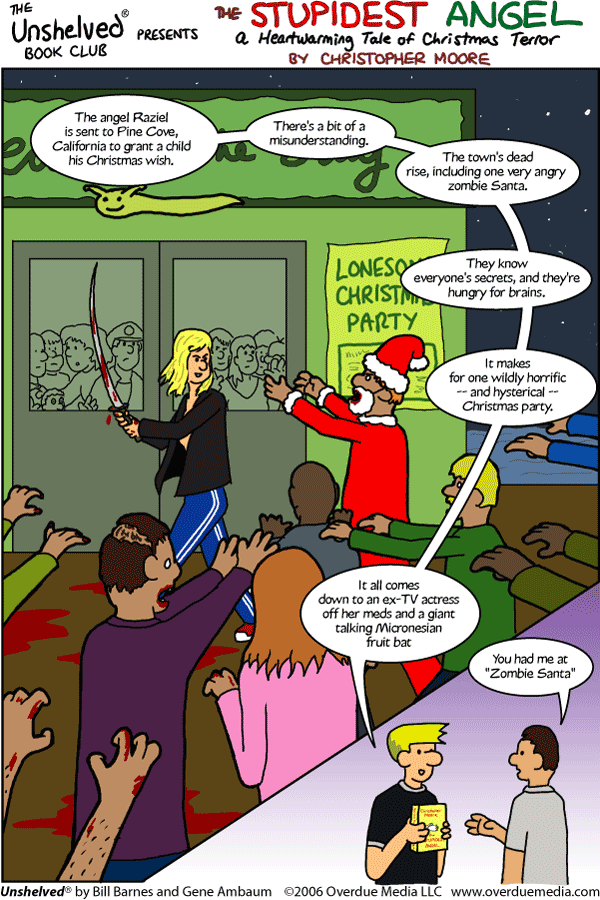
The Stupidest Angel

The Stupidest Angel: A Heartwarming Tale of Christmas Terror
© 2004 Christopher Moore
288 pages

In another Christmas story, Dale Pearson, evil developer, self-absorbed woman hater, and seemingly unredeemable curmudgeon, might by visited in the night by a series of ghosts who, by showing him bleak visions of Christmas future, past, and present, would bring about in him a change to generosity, kindness, and a general warmth toward his fellow man. But this is not that kind of Christmas story, so here, in not too many pages, someone is going to dispatch the miserable son of a bitch with a shovel. That's the spirit yet to come in these parts. Ho, ho, ho.

It's Christmas in quiet Pine Grove, California: the Salvation Army bell-ringers are being walloped by sacks of ice, husbands and wives are at each other's throats, and someone just buried Santa Claus in the woods. Looks like this town needs a Christmas miracle to get back into the spirit of things.  Good thing Heaven always sends an angel to Earth to perform exactly one miracle at the behest of a child every Christmas week. Unfortunately, the angel this year is Raziel, a celestial servant as bright as a bag of rocks. His attempt at restoring Christmas goes wrong -- terribly wrong. Hilariously wrong.

Christopher Moore digs into his back of goodies and bestows upon the reader heaping amounts of absurdism. This starts with the characters, two of whom are a married couple consisting of a hippie constable and a legendary if retired porn actress known as the Warrior Woman, who's just schizophrenic enough to chop down the world's tallest pine tree with her own broadsword in the name of the Worm God. Everyone in this town acts as though they're in a Monty Python sketch. The narrator   is just as eccentric as the lives it details: halfway through the book, it pauses to look at the Christmas photos of the main characters, and some chapters consist of nothing but the local community of decaying corpses in the church cemetery talking to themselves -- gossiping, mostly. I manage to avoid any spoilers, and when I realized just how the angel's miracle had gone wrong, I hit the floor in mirth.

Short and sweet, a laugh-out-loud treat for Christmas time.

Related:

Tuesday, November 23, 2010

Top Ten Holiday Books

Ten books to read for the holidays? Well! I don't know ten Christmas-themed books, so I'll also tack on a few books I may read during the next month.

1. A Christmas Carol, Charles Dickens
RUN, WESLEY!


This story is one of my very favorites. I watch the Patrick Stewart version every year (several times) and last year read the novella for the first time. I plan to do so this year and every year hereafter.

2. Skipping Christmas, John Grisham

Luther Krank is starting to believe this whole Christmas thing is one big racket. Why on earth should he spent thousands of dollars on banal gifts and parties, or put himself through hours of stress decorating and throwing said parties, for the sake of a single day? Shouldn't he enjoy the season? And so Luther Krank blows seasonal madness a raspberry,  arranges to go on a cruise, and happily spends November and December working on his tan and preparing himself to look good in a speedo while his neighbors fume. And it almost works...until the phone rings.

3. The Stupidest Angel: A Heartwarming Tale of Christmas Terror,  Christopher Moore.

Moore wrote Lamb and A Dirty Job, both of which were riots, so I'm expecting good things.

4.  Santa & Pete: A Novel of Christmas Present and Past, Christopher Moore.

Didn't know this was even in the library. Maybe I'll read it. I have no idea what it is about, but as mentioned prior I like Moore.

5. Dress Your Family in Corduroy and Denim, David Sedaris

Sedaris' essay collections are always good for a laugh, but this book contains a section ("Six to Eight Black Men") about Christmas in the Netherlands which is seasonally appropriate and hilarious of course. Listen to him read it here. ("Wait, St. Nicholas would kick you?")

6. Holidays on Ice, David Sedaris

Home of the SantaLand diaries!

7. The Grand Design, Stephen Hawkings

Science is awesome.


8. The Kobayashi Maru and The Romulan War: Beneath Raptor's Wings by Martin & Mangels

I've had these for going on a month now, but I'm still waiting on another before starting in.

9. The Age of Faith, Will Durant

I have fallen right off the Story of Civilization treadmill, but I aim to get back on.

10. Typhon Pact: Zero Sum Game, David Mack

I did it! I said I'd catch up with the Relaunch books this year, and here I am planning to read a book released just in October.

Honorable mentions: Isaac Asimov's Christmas and his Twelve Frights of Christmas. These are not by him, but edited. I've never read them, but I found their book covers when googling for a picture of him dressed as Santa Claus.

(I was, alas! Unsuccessful.)

Friday, December 25, 2009

Skipping Christmas

Skipping Christmas
© 2001 John Grisham
227 pages

One of my own personal Christmas traditions is to read John Grisham's Skipping Christmas. It's a tradition I've maintained every year since owning the book, although part of the tradition is not reading all of it. Skipping Christmas was one of the first books Grisham wrote outside of the legal thriller genre, and makes for a light, fun, seasonal read.

Skipping Christmas is the story of Luther Krank, who -- after a particularly grating trip downtown to buy pistachios and an expensive brand of white chocolate for one of his wife's many holiday projects -- wonders just  how much Christmas costs him. After calculating his total expenditures -- the tree, gifts, cards, massive party -- and arriving at the respectable sum of $6100, he has a mad idea: why not skip Christmas? His daughter Blair just started a two-year hitch with the Peace Corps, so why not take himself and the wife on a ten-day Caribbean cruise for half the price of Christmas -- blowing off all of the trappings of the season? Why not say "no" to buying meaningless and often useless gifts, to parties with lechers and gossips, to the turmoil of shopping for supplies downtown?

And so, while his neighbors spend thousands of dollars on turkeys and cashmere sweaters, the Kranks work on their tans and diet to make their bodies swimsuit fit. While their neighbors invest hours of work in decorating their homes, the Kranks dance around in their living room to reggae music, knowing that on Christmas day they will be headed for warm sunshine and tropic islands -- and when they return, utterly relaxed, they will have no bills to pay, no decorations to take down, and can enjoy knowing that this year, they said "no" to being overwhelmed by the holidays: they did it their way.

The reason I typically stop reading the book 5/6s of the way through is because on Christmas Eve, Luther's beautiful plan goes awry and he must begin biting bullets. I suppose it's a story about the futility of trying to resist such entrenched traditions, but so help me if I don't root for Luther every single time. As I said, it's a fun little read -- worth reading in the next couple of weeks while Christmas songs still echo, or next year when the frenzy begins again.

Sunday, November 30, 2008

A Christmas Carol

A Christmas Carol
Charles Dickens

For a number of years now, I have made a tradition of watching A Christmas Carol with Patrick Stewart. I do not recall the first time I watched the movie, but it became an instant favorite. I will go so far as to say that the movie changed my life for the better in that through it I was able to gain the will to redeem my own self. I watched it during a troubled time in my life where I needed it. It is to me a powerful story about the ability of human beings to change themselves for the better. Although I have watched movie numberless times -- through several Christmases and during the year, even when Christmas was far away -- I have never read the story that inspired it. I decided to amend that this year.

The story is a familiar one: I would wager most people in the west have heard of it. They have at least heard the name Scrooge, and many people might remember that he was visited by ghosts and realized the "true meaning" of Christmas (as if there's only one). I remember as a child that Dickens "A Christmas Ghost Story" did spook me as a ghost story -- what with its doorknobs changing into the howling faces of dead people and spirits wandering about. During this past Thanksgiving break, I sat down and read the story -- and oh, what a story!


Old Marley was as dead a doornail. Mind! I don't mean to say that I know, of my own knowledge, what there is particularly dead about a doornail. I might have been inclined, myself, to regard a coffin-nail as the deadest piece of ironmongery in the trade. But the wisdom of our ancestors is in the simile, and my unhallowed hands shall not disturb it, or the country's done for.

A Christmas Carol is the story of one Ebeneezer Scrooge, the partner of the late Jacob Marley and something of a miser. Dickens writes that his heart was so cold that the winter wind did not bother him and the summer sun didn't warm him up -- so cold that everyone around him avoided his company. John Irving introduced the story in the copy I had, and he writes that although we see Scrooge as a caricature that Dickens was attempting to convey an accurate depiction of Dickensian England's heartless "robber barons". Scrooge likes profit -- so much that he doesn't bother repainting his firm's sign after the death of Marley, and snaps at his clerk (Bob Crachit) for attempting to burn coal.

Having introduced Scrooge as a selfish, spiteful old miser, Dickens begins his "Christmas ghost story" with peculiar things happening to him. A spectre of a hearse goes before him; his door-knob changes into the face of his late partner, howling at him; the portraits on his fireplace change into portraits of Marley. Finally a ghost appears -- the image of Marley, transparent and clothed in his funeral apparel -- but with additional elements, that of cash-boxes and money registers trained to him. Scrooge is at first skeptical, maintaining that he could be seeing things -- his senses could be fooled by undercooked food -- "A blot of mustard, a bit of moldy cheese...there's more of gravy than grave about you, friend".

Marley (after convincing Scrooge of his existence) warns Scrooge that unless his heart changes, he is in for a fate like Marley's -- to roam the Earth without rest as punishment for his selfishness. "It is required of every man," the ghost returned, "that the spirit within him should walk abroad among his fellow-men, and travel far and wide; and, if that spirit goes not forth in life, it is condemned to do so after death." Scoorge is perplexed that Marley is being punished -- he was a good businessman. Marley replies (in one of my favorite lines) "Business! Mankind was my business! The common welfare was my business; charity, mercy, forbearance, and benevolence were all my business!"

Marley informs Scrooge that he will be visited by three ghosts as part of his reclamation. The next three parts of the story concern the visits of the three ghosts -- the Ghost of Christmas Past, the Ghost of Christmas Present, and the Ghost of Christmas Yet-to-Come. Each ghost takes Scrooge places and forces him to examine his life and the consequences of the decisions he has made. The Ghost of Christmas Past particularly upsets Scrooge. Bit by bit, we see Scrooge being slowly changed -- his heart slowly thawing. By the time he is visited by the Ghost of Christmas Yet-to-Come, he is determined to not let certain things happen.

"Men's courses will foreshadow certain ends, to which, if persevered in, they must lead," said Scrooge, "But if the courses be departed from, the ends will change. Say it is thus with what you show me!" cries Scrooge as he and the Ghost of Christmas Yet-to-Come approach a grave. Upon seeing his own name, Scrooge insists that he is not the man he once was -- "I will honor Christmas in my heart, and try to keep it all the year. I will live in the Past, the Present, and the Future. The Spirits of all Three shall shrive within me! I will not shut out the lessons that they teach! Oh, tell me that I may sponge away the writing on this stone!"

With those words, Scrooge finds himself in his bed -- alive -- on Christmas day, and begins to live with the spirit of Christmas for the first time, making amends to his fellow human beings. It is to be a wonderful story of human redemption -- of the power of the human will to change one's self for the better, to rise above that selfishness that comes to easily and to reach out to one another. Dickens' prose is marvelous, as is his use of symbolism. I highly recommend the story to you -- it's only a little over a hundred pages -- and declare it this week's Pick of the Week.

One quotation -- this from Scrooge's nephew Fred in response to Scrooge calling Christmas a humbug.

"There are many things from which I might have derived good, by which I have not profited, I dare say, " returned the nephew [of Scrooge]: "Christmas, among the rest. But I am sure I have always thought of Christmas time, when it has come round [...] as a good time; a kind, forgiving, charitable, pleasant time: the only time I know of, in the long calendar of the year, when men and women seem by one consent to open up their shut-up hearts freely and to think of people below them as if they really were fellow-passengers to the grave, and not another race of creatures bound on other journeys. And therefore, uncle, though it has never put a scrap of gold or silver in my pocket, I believe it has done me good and will do me good, and I say God bless it!"