Showing posts with label Warp Speed Discard Challenge. Show all posts

Tuesday, September 13, 2016

Bloodletter

Bloodletter
© 1993 K.W. Jeter
276 pages


Constable Odo has noticed something very strange about the Cardassian freighter docked with Deep Space Nine. Despite its identification as an utterly harmless freighter, dangerous only to the subspace version of bugs splattered on the windshield, there are subtle tells that the ship was created for exclusively military purposes. In fact, the Cardassians mean to establish an outpost on the far end of the Wormhole connecting the Alpha and Gamma Quadrants, compromising Bajor's own control of the etheral tunnel. While Commander Sisko has expected this kind of move, he's using it to force Starfleet to ...er, increase funding to Deep Space Nine. A quick mission to establish Starfleet's own permanent outpost on the Gamma side will also get Kira out of his hair, because (1) this is season one and he hasn't adopted the awesome-bald look, and (2) Major Kira is a Major Pain. No sooner did she let a bunch of Bajoran Wahhabis onto the station than did people start mysteriously dying, and she's so stubborn that he's been forced to assume every aspect of station management.

Most of Bloodletter's oddities are the result of being written in the show's infancy, back when writers were still relying on the rough-outline series bible to give them general ideas. ("Kira used to be a terrorist, and now she's an authority figure. Discuss.") Consequently, to use Kira as an example, her relations with Sisko are a lot more rough than they ever were in the show: she actually interupts and argues with him during staff briefings, which is probably why he's willing to send her into the gamma quadrant on her lonesome to establish an official Bajoran presence there. She's not the only one acting not just out of character, but grossly unprofessional: Bashir actually asks Kira out on a date while IN HER QUARTERS. She walks in, ready for a night of listening to fundamentalist Bajoran preachers threatening to purge Bajor of foreigners and red-headed majors, and there's the doc waiting for her and poking through her bookcases. Other aspects of the book are simply weird: Odo catches wind of the Cardies' plan because they've stopped at DS9 to have 'impulse buffers' installed. Starfleet demands that every ship passing through the Wormhole have these buffers installed, because otherwise the ships might kill the beings who live inside the portal. To borrow from Kirk, "Why do the gods need protection from starships?" I'm guessing that was a bit of  series-development speculation that went the way of TNG's 55 mph warp speed limit.

Jeter used plot elements later employed in the show "Past Prologue", in which Bajoran jihadists test Kira's loyalty and their plot involves rudely exploding things near the wormhole. Frankly, I found the odd character-and-plot elements more enjoyable than the actual plot, since obviously Odo would get his man. Bashir receive a bit of odd character background here: he's a 24th century hipster, rebuilding an old audio system because the sound is sooooooo much better than digital, man. Really intense. It's not just a quirk, of course; his experience playing with audio helps him with the plot later on.

Monday, September 12, 2016

War Drums

ST TNG: War Drums
© 1992 John Vornholt
276 pages


Imagine Lord of the Flies with Klingons, and set the pack of nigh-feral boys against a small community of settlers who only just arrived themselves.  Such is the set up of War Drums, the story of a besieged human colony which solicits the Enterprise's help. When the people of New Reykjavík broke ground at a stable spot on the strange planet Selva, they didn't realize it already had residents -- a group of Klingon adolescents, marooned as children when their refugee ship crashed here. Now, after months of raids by the Klingons, the humans are lead by a bitter and xenophobic man who prefers the Enterprise's sensors and phasers to her crew's diplomatic savvy.   Created by John Vornholt, War Drums is Ro Laren's first appearance in Treklit, and an interesting predictor of several TNG and DS9 episodes. The main plot -- desperate settlers increasingly held in the grips of a fear taking racial overtones, Worf struggling to make contact with the raiders and teach them - -has much human interest, but the obligatory B thread involves imminent geologic catastrophe that is uncovered by Ro and a twelve-year-old colonial girl, Myra.  Truth to be told, I tend to skip through the B-scenes in older Trek books, because they tend to be  engineering problems rendered in complete technobabble. ("The tech is going to go teching tech! We need to tech the tech, quickly! We did it! Now the A plot is safe!) This one features a science investigation with Earth-relatable terms, so it actually merited paying attention to.

 TNG later featured an episode in which Worf tries to connect long-abandoned Klingon youths to their glorious heritage ("Birthright"), and a DS9 episode involved a mostly-human colony with Klingon neighbors ("Children of Time").  Kudos to Vornholt for predicting that.   He also uses the same exact quote that Picard quotes later on in the episode "Drumhead" -- 'when drums beat, the law is silent'.  (Speaking of:  what with the violent boys, their worship of the Chief, and their obsession with drums and encircling trials, Vornholt had to be drawing on Lord of the Flies!)   I probably wouldn't have tried this novel but for two things: Ro Laren was on the cover, and John Vornholt penned it.  He's not a particularly well-known author, but I'm familiar with him from his TNG Dominion War duology, which were the first TNG books I ever read. I read them multiple times, actually, and considering the heavy use of Ro Laren there he's probably to blame for her being such a favorite character of mine.  She comes off well here, both as action hero and Starfleet scientist; Worf, too, gets some depth beyond "Grrr! Honor! WORF SMASH!"

Unfortunately, I think this is my last TNG novel with Ro Laren on the cover.  All good things...

BONUS POINTS: At one point, Worf literally turns his phaser up to 11.

Sunday, September 11, 2016

The Better Man

ST: The Better Man
© 1994 Howard Weinstein
294 pages


McCoy: "I should have told you about this in my quarters, not yours."
Kirk: "Why? Some kind of weird protocol?"
McCoy: "No, I've got a better liquor selection."

Fresh from a refit, the Enterprise has been summoned to the planet Empyrea. Or rather, Dr. McCoy has. In his days as a young officer, he and his captain-buddy Mark Rousseau discovered there an isolationist colony of human beings, dedicated to perfecting their own gene pool. Though the Emyreans were stridently against outside contamination, Rousseau did manage to win permission for Starfleet to set up a science station on the planet to monitor unusual star activity. Shortly after their ship, the Feynman, left Empyrea,  McCoy sought transfer away from both it and his now ex-best friend, Rousseau. Whatever happened? And why have McCoy and Rousseau been asked back?  (Was it a woman? Of course it was a woman. Discover new life and go to bed with it, that's the StarFleet way!)

The Better Man is a rare TOS book in that McCoy is the primary character, with Kirk stuck on the Enterprise.  Though it takes place two years after The Motion Picture, the plot could have easily fit within the five-year mission:  two main threads quickly emerge, with a third crisis tying them together. When McCoy visited the planet eighteen years ago, he worked with a local scientist, and now -- almost  eighteen years later -- she has a daughter, just about eighteen years old.  And that's a problem, because when the child is given her customary bioscan at eighteen to make sure she's worthy breeding potential, the government is going to realize her daddy is Not of This World. She'll be sterilized, or worse yet, killed, because that's the sort of thing that happens when people start controlling others to make things...Perfect.  You get mass killings or reavers,  and so in the fashion of Captain Mal,  people here are aiming to misbehave. Specifically, McCoy manages to get himself kidnapped by the Empyrean Liberation Front, which is even more embarrassing than it sounds: the ELF is one teenager who wants to start a revolution and use McCoy as leverage. 

I found A  Better Man a fun, quick read. Weinstein gets the subtleties of McCoy's language fairly well, and there's several fun lines:
===============================================================
McCoy: "Y'know, that day Spock threw that bowl of soup at Christine Chapel will always be one of the highlights of my life."
Kirk: "I suppose that says something about your life."

Kirk: "I thought you wanted to have as little to do with them as possible."
Scott: "I do, sir, I just want it to be my idea -- not theirs!"

Scott: "Looks like so-called genetic perfection has doesn't away with the occasional horse's ass."
Spock: "A correct observation, Mr. Scott, if I understand the reference.
Scott: "That y'do, sir."


Wednesday, August 3, 2016

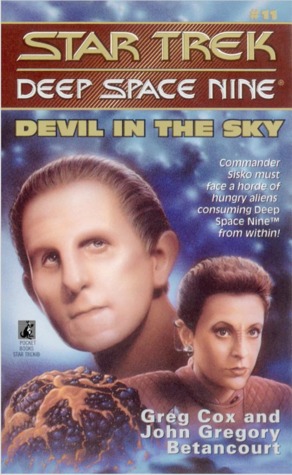
Devil in the Sky

ST DS9: Devil in the Sky
© 1995 Greg Cox and John Gregory Betancourt
280 pages


In the classic TOS episode, "Devil in the Dark",  Kirk and the Enterprise were dispatched to a mining colony to discover and put an end to the monster that had been killing the colonists. The 'monster' turned out to be a silicon being, a Horta, who was waging a war of self-defense against colonists unwittingly destroying her eggs.   Now a Federation outpost is again imperiled by the Horta, after a mother Horta is kidnapped and her eggs arrive on a freighter to Deep Space Nine as hungry orphans. The Horta had been invited to Bajor to jump-start a dormant mining industry, but she was kidnapped by Cardassians enroute. As Kira, Dax, Bashir are dispatched on a rescue mission into Cardassian territory,  Sisko and the others labor to keep the hungry rock-slugs from literally eating them out of house and home.

The only high point here, really, is Kira and Bashir's maturing 'friendship'. Bashir begins as a caricture of himself. His youthful arrogance and total confidence in himself are taken up to eleven, and made all the more obnoxious by Bashir swaggering around like a lady-killer.  Kira, with an established disdain for Bashir's patronizing view of Bajor, only likes him slightly more than the Cardassians.  Forced to work together to free the Horta from a death camp filled with Bajorans, however,  Bashir matures and Kira starts to find him tolerable. It's the Bashir-Kira version of that Bashir-O'Brien episode: evidently the key to liking the doctor is facing death with him.

The rest is fairly average: Odo is grumpy and doesn't like Quark, Quark is scheming, Jake and Nog get into trouble, that sort of thing. There's at least one nice call back to the original episode, in which the Mother Horta is forced to communicate by writing letters in acid on the floor -- not "NO KILL I", but "FOLLOW ME".  Sisko takes entirely too long to remember that Bajor has  deserted moons that he can stick the Horta babies on without angering the Bajoran government who have suddenly decided that nope, Horta have no place in Bajor's delicate ecosystem.

If the first one hundred pages -- of Bashir being utterly obnoxious, far more so than he was in the show -- can be survived, it's an enjoyable enough action tale.

Monday, July 11, 2016

Requiem

ST TNG #32: Requiem
© 1994 Michael Jan Friedman,  Kevin Ryan
277 pages

dun-dun DA DA DA DA DA DA dun-dun DA da!

One hundred years ago, James Kirk of the USS Enterprise arrived at Cestus III to find a Federation colony in flames,  virtually all of its residents destroyed by mysterious attackers.  Kirk soon found himself in direct physical conflict with the attackers, a race of dinosaur-like creatures called the Gorn.    Kirk was able to find a way to conclude the Cestus affair without further bloodshed, and diplomatic overtures followed many decades later. Now, as the Federation and the Gorn try to keep the peace, the Federation's most experienced negotiator is lost -- lost on Cestus III.

Although Requiem begins with a flashback, Picard isn't lost in the memory of Gorn training scenarios, the historical record, or even his own experience with the Gorn as captain of the Stargazer. He is literally marooned in time, thrown to Cestus III four days before the deadly attack by a mysterious alien artifact in space. (When will Starfleet learn that mysterious artficats floating in space never lead to GOOD things?)    Picard is atonished by the coincidence: on the verge of restoring Federation-Gorn relations, he's been thrown to their beginning? He's also riven in conflict: while he knows he can't fight history, can't warn the colonists, their experimental power station is on the verge of destroying them in way. Worse yet, having been rescued by the colonists after he was transported through space and time into the middle of a landslide, he has a growing personal attachment to the colonists -- and while he's having moral crises and trying to pass himself off as Dixon Hill,  Merchant Captain and Totally Not a Spy,  Riker is being badgered by Starfleet to produce Picard and get to Gorn, pronto.

I thoroughly enjoyed Requiem, though Friedman and Ryan never explain why it is the Mysterious Alien Artifact threw Picard to, of all places, Cestus III on the eve of the Gorn attack.  Since we have seen other artifacts that can transport users to variety of places in time and space (the Guardian of Forever, for instance), perhaps this is another one -- one that is guided by the 'user's' thoughts. Perhaps when Picard activated the time-transport, his thoughts were on Cestus III -- hardly surprising given the impending negotiations.   "Arena" is one of my favorite TOS episodes, and so this look at the colony before its destruction succeeds for me. The 'b' plot also features Ro Laren being appointed acting first officer, and the book ends with Kirk and company arriving and "Arena" beginning.

It's got the Stargazer, Kirk, Ro Laren, and the Enterprise-D. What more do you want?


Thursday, July 7, 2016

Enterprise: the First Adventure

Enterprise: the First Adventure
© 1986 Vonda McIntyre
386 pages


Jim Kirk thought he was going places. Not even thirty, he's been named captain and given the Enterprise, famously captained by Chris Pike. But instead of launching out on an extended five year missions, he's...transporting the circus? Yes, Starfleet in its wisdom has decided to use a top-of-the-line Starship to transport a bunch of jugglers, magicians, and a menagerie of ill-tempered critters that includes a winged horse, on a tour of several starbases. Fortunately for the plot, they encounter not only a wacky, emotional cousin of Spock, but a rogue Klingon ship out to spite the Federati -- wait a minute, is this The Final Frontier?! The wacky Vulcan isn't going to hijack the ship and take them to meet The God Thing, is he? ...anyhoo, as billed this is the First Adventure of the Starship Enterprise. Its primary attraction is that the Enterprise crew first meet each other here, including the teenage Rand and Chekov. The characters' introductions are on the predictable side: Spock and McCoy argue, Chekov is cheerfully delusional about Russia, Sulu has swords, etc. McIntyre offers some insight into the characters: Rand, for instance, is depicted as an underage teen who joined Starfleet to escape slavery, hence her nervousness.  There's also appreciable coolness between Kirk and Spock, who interact as distant professionals. Gary Mitchell isn't the only nod to what adventures follow the crew: Kirk and Spock first bond over 3D chess (a la "Where No Man Has Gone Before") and there are feline crewmen, a nod to the Animated Adventures. The weirdest thing about the books is the flying horse: how can six limbs be imposed on a four-limb brain? While the early characterization provides some interest for hardcore fans, it's really not that engaging.

Thursday, June 23, 2016

The Romulan Stratagem

The Romulan Stratagem
© 1995 Robert Greenberger
297 pages


A planet on the border of the Federation, Klingon, and Romulan empires has invited the Enterprise to sell its government on Federation membership. When the Big E arrives, however, they find a Romulan warbird waiting for them. The Romulans have also been invited to make a pitch for membership, and their negotiator is no less than Admiral Sela. Sela, who claims to be the daughter of an alternate-universe Tasha Yar, fell from grace after Picard dismantled her last set of nefarious plans, and for her snatching this planet  from under his nose will be sweet revenge. During the week of meetings, however, several deadly explosions implicate the crews of both the Enterprise and Sela's warship, threatening both powers' desires. Incredibly, Data finds himself working with Sela to work out what third party is sabotaging the conferences. While this plot thread has considerable interest,  given Data's intimate history with Yar,  that angle is never pursued. The ending is a departure from the unexpected, but on the whole there's nothing really remarkable about the book. Ro Laren lends  interest in her comic-relief thread, being assigned to babysit a civilian family after bodily throwing one too many civilians out of her way attracts the Wrath of Riker.  A teenage boy in said family develops a raging crush on Ro, one which she is far too slow to pick up on.  All told, this is enjoyable enough, but I only read it for the characters featured on the cover.


Read it for Ro. Patrick Stewart wants you to.


Wednesday, June 22, 2016

Wrath of the Prophets

ST DS9: Wrath of the Prophets
© 1997 Michael Jan Friedman, Peter David, Robert Greenberger
300 pages

On the cover: Nana Visitor as Kira Nerys, Michelle Forbes as Ro Laren

An epidemic is sweeping Bajor, a pestilence born of faulty replicators smuggled in by a young woman desperate to feed her village.  Placed under quarantine, the planet's peril is so intense that even  renegade Ro Laren emerges from hiding to help transport food there. On Deep Space Nine, Julian Bashir works to find a cure, but every breakthrough is immediately reversed. This is a virus with a deep bench of tricks. In the hopes of expediting matters, two teams are sent into shady markets  to find the source of the replicators and demand some answers.  While Sisko, Odo, and Quark  examine a smugglers' hub in space,  Major Kira grudgingly accepts the company of Ro Laren on Bajor.

Putting Ro and Kira together is a recipe for fun. Orginally, DS9 was written to include Ro Laren, but Michelle Forbes didn't want to commit. Another feisty Bajoran was invented to take her place, Kira. But despite being cut from very similar cloth, Ro and Kira are not bosom buddies. As hot-headed and willful officers, they butt heads repeatedly. Ro's appearance is not welcome by anyone: she deserted Bajor during the occupation to join Starfleet, then went AWOL after Starfleet began pushing around settlers to fulfill the Federation's foreign policy commitments.  Of course, Ro Laren eventually  does make it to Deep Space Nine, in the relaunch -- as the station security chief. The authors are aware of Kira and Ro's linked origin, even having Ro muse that had things been different, they might have switched places. Despite their similarities -- their combativeness, their independence -- the two women are different in substantial ways here. Ro is a cynic,  disheartened by Starfleet's bullying of innocents in regards to the Maquis. Kira isn't naive, but she's idealistic: she believes in her fellow Bajorans, and when she realizes how corrupt Bajor's provisional government is, how even her wartime allies prove to be positively venal, she suffers a crisis of faith made worse by Ro's attitude. Eventually, through much argument and mortal peril, Ro and Kira become the other's comrade-in-arms, and by the book's end they're standing back to back making fiery speeches at Bajor's congress. Attagirl, Ro, you did learn something from Picard.

There are other plot points -- the chief is worried about his family on Bajor whom he never sees, Dax is mysteriously incompetent, being distracted by a previous host's experience with a similar plague -- and the multitude of angles the story is being chased down probably owes to the fact that there are three authors, all of whom needed something to do. But really, twenty years after this book's publication the only reason to read it is for the combination of Ro and Kira.


Sunday, May 1, 2016

ST: The Patrian Transgression

The Patrian Transgression
© 1994 Simon Hawke


Annnnnnnnnnd kickoff for the Warp Speed Challenge! In The Patrian Transgression, the Enterprise arrives at the planet Patria to investigate a plea for help. According to the planet's leaders, the Klingons are supplying weapons to a terrorist organization, threatening to destabilize the republic completely. The Patrians would like the Federation's help, but when Kirk beams down to the planet he is contacted by one of the rebels and told that the powers that be are lying to him.  On the heels of this revelation, Kirk learns that Patria employs a relatively new police force called the Mindcrimes Unit, who are telepathic and target those who merely intend to commit crimes.  While a Mindcrimes agent's word is good as evidence in courts, they are also empowered to end the threat on sight -- shooting alleged criminals in cold blood.  Perhaps the rebels are in the right all along, but sympathy is hard to come by given that they're holding innocent civilians and Spock hostage.  Ultimately Kirk and company unravel a criminal conspiracy with a couple of layers of complexity. The Patrian Transgression makes for enjoyable light Trek reading, as the author has a fairly good handle on the characters and produces quite a few good lines of dialogue.  More unusually, it is McCoy who gets the girl of the week, this time an attache to the Federation ambassador. (Kirk is too busy arguing with the diplomat to play Romeo.)  The opening third is quiet, but the action and tension really pick up from there.  Star Trek Voyager later played with the idea of "thought crime", but the Enterprise crew are never targeted for violent thoughts here like Torres was.   Transgression makes for a fun start to this challenge series.

Next up will be a TNG novel; I'll be following a TOS-TNG-DS9 pattern as long as the books permit.


Saturday, April 30, 2016

Wrapping Up and Boldly Going

Read of England 2016 was by any reckoning a roaring success. Not only did I finish the Lord of the Rings trilogy. but I sampled a good variety of renown English authors from mid-March 'til yesterday.


English Classics
Return of the King, J.R.R. Tolkien
Brideshead Revisited, Evelyn Waugh
Great Expectations, Charles Dickens
Lord of the Flies, William Golding
The Invisible Man, H.G. Wells
Jane Eyre, Charlotte Bronte

English History
Waterloo, Bernard Cornwell

Other Works Set in England:
My Man Jeeves, P.G. Wodehouse
The Road to Little Dribbling, Bill Bryson
When the Eagle Hunts, Simon Scarrow
The Memoirs of  Sherlock Holmes, Arthur Conan Doyle
In the Days of the Comet, H.G. Wells

Other Works, by English Authors
Frodo's Journey, Joseph Pearce
Bilbo's Journey, Joseph Pearce
Master and Commander, Patrick O'Brian
The Voyage of the Beagle, Charles Darwin


If I had to pick 'best of', it'd be  Jane Eyre.  The best use of Characters Wandering Around in Moors goes to Great Expectations, though, despite the competition from Jane and In the Days of the Comet.  I'd intended to read Sense and Sensibility as well, but somewhere around the time Lucy revealed that she was actually engaged to Edward, my interest in these people's love lives had more or less evaporated.  I'm not quite off the horse, though.

Getting us back into the normal swing of things, I have a few interesting science, science fiction, and history books on the way, drawing from that science TBR list and including complete surprises. I’m also starting a long-term project: the Warp Speed Discard Challenge!


See, in one corner of my bedroom is a half-sized bookcase full to the brim of Star Trek paperbacks. I have as many books  in that space as the laws of physics will allow, and as I cannae change said laws,  it’s time to deep-six the excess.  The preposterous thing about this problem is that most of these books were purchased six years ago, when I graduated uni and suddenly had spending money. Being without the usual vices, I chose to buy several boxes of books via eBay, netting several hundred for the paltry sum of $20.  In the six years since, I’ve read perhaps three from that acquisition,  reading instead newer releases, but  have been reluctant to part with any of the pile without having read them. So, I’m making myself read them, after which I can donate them guilt-free. It will take a fair bit of time, especially as I don’t intend for it to distract me from my usual enthusiasms.  The boxes included TOS, TNG, and DS9 paperbacks of the numbered variety, so they’re episodic and incapable of violating canon.  If nothing else, Star Trek’s boundless optimism will serve as a nice distraction from the grisly spectacle of  D.C. politics.