Star Trek the Fall: The Poisoned Chalice
© 2013 James Swallow
395 pages
Without warning or reason, the starship Titan – specialized for deep space exploration – has been recalled and ordered to patrol…Earth. Captain Riker has been promoted to admiral and shoved in an office, while several members of his command crew have disappeared on secret missions that not even the Fleet Admiral knows about. Who’s giving orders around here? It’s a troubled time in the Federation, with one head of state assassinated only weeks before, and the president pro temp acting in ways that make Chancellor Gowron look compassionate and conscientious. More mystery and more stress are not what the Federation needs….but they do make for another great novel in The Fall series.
Schemes are the name of the game here, as everyone is Up to Something. The fleet admiral suspects the president is up to something, Riker suspects the fleet admiral is up to something, and the crews of two starships suspect Riker is up to something. Commanders Tuvok and Nog know they’re both being put up to something, because they and a few other officers have been ordered to the middle of nowhere to meet a group of mercenaries who are obviously up to no good. But what is going on? All these secret goings-on are the ripples around the schemer in chief, President Pro Tempore Ishan Anjar. Anjar was chosen not for manifest competence, but to assure Bajor – in the light of the Federation’s growing ties with Cardassia – that Bajor’s history was not forgotten, and its place is secure. Throughout this series he’s proven himself to be petty, mean, obnoxious, and other sundry adjectives, prolonging crises for political gain. That is coming to a head, however, and things are unraveling.
The Poison Chalice brims over with intrigue and terse conversations, with a healthy bit of action and a little comedy as well. I was spellbound, still enjoying the drama of Starfleet officers wrestling with questions of conscience and duty, and can’t wait to see how this ends. I hope it involves Anjar getting a right sound lecture from Picard. Or a right sound backhand from Worf -- I'm not particular.
Pursuing the flourishing life and human liberty through literature.
"Once you learn to read, you will be forever free." - Frederick Douglass
Showing posts with label Star Trek Titan. Show all posts
Friday, January 5, 2018
Wednesday, August 10, 2011
Synthesis
Star Trek Titan: Synthesis
© 2009 James Swallow
400 pages

On the cover: Johnathan Frakes as William Riker; Carolyn McCormick as 'Minuet'/'Titan',
Although Synthesis may appear a steamy romance novel, the sixth novel in the Titan series is a serious and thrilling tale about artificial intelligence, featuring a race of sentient computers --some the size of continents -- fighting a destructive force greater than can be imagined. So fierce is their struggle that it has literally destroyed the fabric of space in part, and when the Titan is violently thrown out of warp while passing through the battlefield, her crew is forced into a war that has lasted for longer than the Federation has existed. Riker and his crew must contend with their own unease about dealing with sentient computers (so soon after the last great Borg War) as well as some of the AI's contentious attitude toward 'wetminds', or organic individuals.
To my knowledge, this is the first novel by James Swallow I've read, and if it presents his usual quality I'll be looking forward to more. Though no one can match Christopher Bennett for worldbuilding, Swallow's machine culture is impressively developed, with its own history that has produced a diverse set of individuals as divided between themselves as we are. There's no faulting Swallow approach to drama, and discrete references to Firefly and A New Hope relieved tension through laughter early on. The most interesting element of Synthesis is one I can't quite reveal without spoiling -- let's just say Riker's companion on the cover is not Minuet, but something much closer to him.
Easily one of Titan's tier-one books, joining Orion's Hounds.
© 2009 James Swallow
400 pages

On the cover: Johnathan Frakes as William Riker; Carolyn McCormick as 'Minuet'/'Titan',
Although Synthesis may appear a steamy romance novel, the sixth novel in the Titan series is a serious and thrilling tale about artificial intelligence, featuring a race of sentient computers --some the size of continents -- fighting a destructive force greater than can be imagined. So fierce is their struggle that it has literally destroyed the fabric of space in part, and when the Titan is violently thrown out of warp while passing through the battlefield, her crew is forced into a war that has lasted for longer than the Federation has existed. Riker and his crew must contend with their own unease about dealing with sentient computers (so soon after the last great Borg War) as well as some of the AI's contentious attitude toward 'wetminds', or organic individuals.
To my knowledge, this is the first novel by James Swallow I've read, and if it presents his usual quality I'll be looking forward to more. Though no one can match Christopher Bennett for worldbuilding, Swallow's machine culture is impressively developed, with its own history that has produced a diverse set of individuals as divided between themselves as we are. There's no faulting Swallow approach to drama, and discrete references to Firefly and A New Hope relieved tension through laughter early on. The most interesting element of Synthesis is one I can't quite reveal without spoiling -- let's just say Riker's companion on the cover is not Minuet, but something much closer to him.
Easily one of Titan's tier-one books, joining Orion's Hounds.
Thursday, February 17, 2011
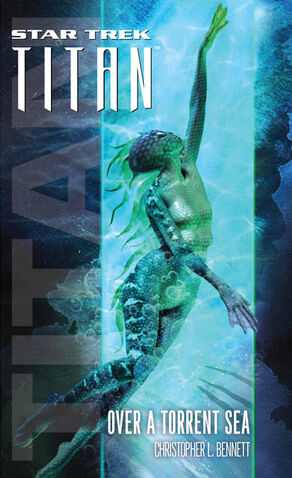
Over a Torrent Sea
Star Trek Titan: Over a Torrent Sea
© 2009 Christopher L. Bennett
356 pages

Only weeks after the calamitous events of Destiny, the good ship Titan is resuming its mission to explore the further reaches of the galaxy. The discovery of a waterworld mysteriously abounding in life attracts the ship's attention, but (surprise!) their peaceful exploration quickly becomes fraught with peril when an asteroid threatens to impact and a sentient ,whale-like species turn on the Titan crew in confusion, fear, and pain. A plot deep in scientific wonder and mysteries unfolds, and Bennett surprises with some astounding character drama late in the book. The Troi-Tuvok-Dr.Ree story is especially impressive from the emotional angle, though its primacy is threatened by a last-ditch effort on the part of another character to save the day by facing some of her worst inner demons.
Torrent Sea is fifth in the Titan series, and my only major grumble with it is that most of the Titan books up to this point and even beyond it seem to have the same basic plot: Titan cannot enter a star system without crashing into a Prime Directive conflict. I don't know about Red King, but from Orion's Hounds on through to Seize the Fire, the Prime Directive plays a central role. They've been good stories, too, for the most part, it's just odd that the editors don't seem to have caught on. Torrent Sea is an especially strong version of this, because the problems show that the Prime Directive is in place to stop the good guys from making matters worse by trying to help. As in all Bennett novels, this one is inundated by science (which makes me happy) and humor, the author being especially fond of sarcasm and understatement. The amount of character drama and emotional turmoil toward the end of the book rocked me: I wasn't expecting it, and it played out well. Especially impressive is Bennett's handling of the development of sentience and technology in a waterborne race: I used to think that if whales were intelligent, we couldn't tell because they don't have hands to make tools with, but a race in this book succeeds through a kind of bioengineering. Fascinating stuff. He's usually an exceptional author, and it is no accident that his Orion's Hounds and this rank now as my favorite Titan novels.
Related:
© 2009 Christopher L. Bennett
356 pages

Cover art and design by Cliff Nielson and Alan Dingman, featuring Aili Lavena, an aquatic member of the Titan crew who has a primary role in the exploration of the world and the book.
Only weeks after the calamitous events of Destiny, the good ship Titan is resuming its mission to explore the further reaches of the galaxy. The discovery of a waterworld mysteriously abounding in life attracts the ship's attention, but (surprise!) their peaceful exploration quickly becomes fraught with peril when an asteroid threatens to impact and a sentient ,whale-like species turn on the Titan crew in confusion, fear, and pain. A plot deep in scientific wonder and mysteries unfolds, and Bennett surprises with some astounding character drama late in the book. The Troi-Tuvok-Dr.Ree story is especially impressive from the emotional angle, though its primacy is threatened by a last-ditch effort on the part of another character to save the day by facing some of her worst inner demons.
Torrent Sea is fifth in the Titan series, and my only major grumble with it is that most of the Titan books up to this point and even beyond it seem to have the same basic plot: Titan cannot enter a star system without crashing into a Prime Directive conflict. I don't know about Red King, but from Orion's Hounds on through to Seize the Fire, the Prime Directive plays a central role. They've been good stories, too, for the most part, it's just odd that the editors don't seem to have caught on. Torrent Sea is an especially strong version of this, because the problems show that the Prime Directive is in place to stop the good guys from making matters worse by trying to help. As in all Bennett novels, this one is inundated by science (which makes me happy) and humor, the author being especially fond of sarcasm and understatement. The amount of character drama and emotional turmoil toward the end of the book rocked me: I wasn't expecting it, and it played out well. Especially impressive is Bennett's handling of the development of sentience and technology in a waterborne race: I used to think that if whales were intelligent, we couldn't tell because they don't have hands to make tools with, but a race in this book succeeds through a kind of bioengineering. Fascinating stuff. He's usually an exceptional author, and it is no accident that his Orion's Hounds and this rank now as my favorite Titan novels.
Related:
- Christopher L. Bennett's homepage.
- Star Trek Titan on TvTropes
Wednesday, February 2, 2011
Sword of Damocles
Star Trek Titan: Sword of Damocles
© 2007 Geoffrey Thorne
370 pages

While exploring a dark-matter nebula, the USS Titan receives a distress call from her sister-ship Charon. Braving inexplicable subspace turbulence, Titan proceeds through darkness to find a topsy-turvy solar system where people live in terror of a god whose eye haunts their sky and rains down destruction at the slightest provocation. Sword of Damocles is more a high-concept book than Taking Wing (political/action thriller) and Orion's Hounds (scientific/adventure thriller): the plot is driven by a magnificent distortion in the space-time continuum, one involving temporal mechanics and multidimensional shenanigans. The book begins with its own epilogue, and the plot is similarly contorted, told from multiple perspectives within time and dimensions. As fascinating as the story was, trying to wrap my head around the central idea left me making "o_O" faces at the book, a face not relieved by my perusing of articles on tesseracts.
Though the scientific paradox at work takes up most of the book, Thorne also engages in a good bit of character development, focusing on some of my favorite characters (Commander Christine Vale and Cadet Dukal, the ship's resident Cardassian). He uses two characters -- a mystic Bajoran scientist named Jaza and a strictly rational ensign who sees faith as 'perverse' -- to explore the relationship between science and religion, though it's a timid venture and not altogether successful. Both characters lacked the nuance necessary for an effective take on that subject, though I enjoyed seeing their friendship grow throughout the book. It's not as though they had much of a choice in the matter, given that they had been thrown thousands of years into the past and were mucking around the ruins of a Luna-class ship, ostensibly the Titan.
Sword offers an interesting story and a fair bit of character development in a mind-twisting setting. Definitely memorable and mostly enjoyable, though I'm hoping for a little lighter fare next time. This is apparently Thorne's first full-length novel: strong first showing, I'd say.
Related:
© 2007 Geoffrey Thorne
370 pages

While exploring a dark-matter nebula, the USS Titan receives a distress call from her sister-ship Charon. Braving inexplicable subspace turbulence, Titan proceeds through darkness to find a topsy-turvy solar system where people live in terror of a god whose eye haunts their sky and rains down destruction at the slightest provocation. Sword of Damocles is more a high-concept book than Taking Wing (political/action thriller) and Orion's Hounds (scientific/adventure thriller): the plot is driven by a magnificent distortion in the space-time continuum, one involving temporal mechanics and multidimensional shenanigans. The book begins with its own epilogue, and the plot is similarly contorted, told from multiple perspectives within time and dimensions. As fascinating as the story was, trying to wrap my head around the central idea left me making "o_O" faces at the book, a face not relieved by my perusing of articles on tesseracts.
Though the scientific paradox at work takes up most of the book, Thorne also engages in a good bit of character development, focusing on some of my favorite characters (Commander Christine Vale and Cadet Dukal, the ship's resident Cardassian). He uses two characters -- a mystic Bajoran scientist named Jaza and a strictly rational ensign who sees faith as 'perverse' -- to explore the relationship between science and religion, though it's a timid venture and not altogether successful. Both characters lacked the nuance necessary for an effective take on that subject, though I enjoyed seeing their friendship grow throughout the book. It's not as though they had much of a choice in the matter, given that they had been thrown thousands of years into the past and were mucking around the ruins of a Luna-class ship, ostensibly the Titan.
Sword offers an interesting story and a fair bit of character development in a mind-twisting setting. Definitely memorable and mostly enjoyable, though I'm hoping for a little lighter fare next time. This is apparently Thorne's first full-length novel: strong first showing, I'd say.
Related:
- Star Trek Titan at TvTropes
- Sword of Damocles at Memory Alpha
- Geoffrey Thorne at Memory Alpha
Thursday, December 30, 2010
Seize the Fire
Star Trek Typhon Pact: Seize the Fire

© 2010 Michael A. Martin
499 pages

In the wake of the last great Borg War, most of Starfleet is tasked with helping to pick up the pieces. Only a few ships, the USS Titan among them, are allowed to continue Starfleet's mandate of exploration. Despite being lucky in this regard, Captain William Riker doesn't want to go on his merry way into the unexplored expanses of the galaxy and with no thought to his comrades back home -- thus, he opts to investigate the possibility of a powerful terraforming technology not unlike that of the Genesis Device. When he confirms his suspicions, though, he finds the technology in the hands of the Gorn Hegemony. The Gorn have their own reasons for wanting the device, as one of their most precious breeding worlds has been ruined by excess solar activity. While their possessing this device -- which, like Genesis, could be used to destroy civilizations "in favor of its new matrix" -- is problematic enough, the leading Gorn general seems intent on using it on a planet already inhabited. Though the Prime Directive forbids Riker from interfering, he must find a way to do so and perhaps gain access to the "eco-sculptor" at the same time.
Star Trek's reptilian species fascinate me: the Gorn were first mentioned in "Arena", which contains one of the most outstandingly campy fights in televised history, and spotted once in Enterprise, but have since not garnered much attention. Michael A. Martin does for them what David Mack did for the Breen, turning standard villains into large, complex political entities. Just as Mack did, he tells part of the story from the viewpoint of Gorn characters, some of them sympathetic. This nation- and world-building was the strongest portion of the novel for me, though I also appreciated Martin's use of Gnalish crewmembers board the Titan: Michael Jan Friedman introduced them in Reunion, and his Stargazer novel Progenitor spotlighted them. The plot's possible resolutions seemed obvious from the start, though the road there took some unexpected twists and turns. I enjoyed the novel, and even read most of it in one sitting. Some characterization seemed strange, particularly in the case of Riker's XO (Christine Vale), but I've not read enough Titan novels to say for sure. The novel's greatest weakness was Martin/Riker's interpretation of the Prime Directive. The directive forbids Starfleet personnel from interfering in the natural evolution of a pre-warp society: they can't be so much as contacted without first displaying the ability to use warp drive. This "natural evolution" clause has been extended to prohibiting Starfleet personnel from stopping asteroid collisions with planets, and in Voyager Tom Paris was demoted and tossed into the brig for interfering in a similar case. As outrageous as that is, in Seize the Fire the planet in question is being targeted by an outside power, a warp power, and Riker's belief that he can't interfere makes him look like a legalistic chump.
I'd say Seize the Fire is fairly enjoyable: not outstanding, but not mediocre, either.
Related:
- Michael A. Martin at Memory Alpha
- Star Trek Titan at TvTropes
- Typhon Pact at TvTropes
- Seize the Fire at Memory Alpha
Labels:
Michael A. Martin,
Star Trek,
Star Trek Titan,
Typhon Pact
Monday, November 29, 2010
Orion's Hounds
Star Trek Titan: Orion's Hounds
© 2005 Christopher L. Bennett
400 pages
On the cover: Marina Sirtis as Deanna Troi; Daphne Ashbrook as Melora Pazlar; CGI as Dr. Ree.

When Captain William Riker accepted command of the USS Titan, he looked forward to continuing the mission that drew him to Starfleet in the first place -- the peaceful exploration of the galaxy and promotion of Federation ideals. In its few few months of operations, however, the Titan and her crew have been bogged down by political wrangling and high-stakes rescue missions. Now, at long last, the Titan is heading into deep space to see what the future holds.
Scotty might say of the future that “there be whales here!” Soon after entering uncharted territory, powerful waves of panic, confusion, and grief overwhelm the telepathically sensitive crewmembers of the Titan, especially Commander Tuvok at tactical. Tuvok, Troi, and others identify the source of their agitation as a nearby school of vast creatures (cosmozoans) who live in the vacuum of space -- a school being hunted by humanoids who use the corpses of the sentient cosmozoans (“space jellies”) as ships. Horrified at the prospect of ritualized murder and exploitation, Riker and the Titan seek to meditate a peace. Naturally, the situation is not as simple as it seems.
Though David Mack’s crossover Destiny trilogy gave my proper introduction to the Titan crew, I began planning to visit the Titan series as soon as I finished The Buried Age and decided I wanted to read more of this Christopher L. Bennett. He doesn’t disappoint: while his character drama is just as strong as Mack’s or Kirsten Beyer’s, he adds to it a fascinating science story with ethical dilemmas a-plenty. Cosmozoans are an interesting subject in themselves. They are life forms quite different from us, existing in space as comfortably as we stride on land or as fish in the ocean, finding a home in turbulent stellar nurseries and fighting on a scale beyond ship-to-ship combat. The villains are nuanced, appearing both cruel and civilized at times: while subscribing to a hunter culture, they’re not universally obsessed by it. There’s no obvious disconnect between Martin and Mangel’s Titan and Bennett’s: the ship's crew is evolving realistically, the many varied characters invented to staff the Titan still adjusting to their many differences. I appreciated Bennett’s way of conveying telepathic communication, which made it clear that telepathy isn’t necessarily the direct beaming of sentences into someone’s head, but actual feelings that are difficult to articulate. His attention on two of Titan’s more exotic crewmembers (an aquatic and a hilarious grandmotherly insectoid) was another high point.
Orion’s Hounds is an especially satisfying Titan novel, full of interest and humor, and I am glad that Mack and Bennett kindled my interest in the Titan series . I picked the novel up at Sunday lunch and spent the day with it, distracted only by my finding a Trek production on YouTube that merited my attention (Of Gods and Men, a 40th anniversary ‘gift to the fans’ from many of the Trek actors) As much as I’d like to read Over a Torrent Sea next (Bennett’s other Titan novel), I’ll probably read the chronologically next book in the series.
Related:
© 2005 Christopher L. Bennett
400 pages
On the cover: Marina Sirtis as Deanna Troi; Daphne Ashbrook as Melora Pazlar; CGI as Dr. Ree.

When Captain William Riker accepted command of the USS Titan, he looked forward to continuing the mission that drew him to Starfleet in the first place -- the peaceful exploration of the galaxy and promotion of Federation ideals. In its few few months of operations, however, the Titan and her crew have been bogged down by political wrangling and high-stakes rescue missions. Now, at long last, the Titan is heading into deep space to see what the future holds.
Scotty might say of the future that “there be whales here!” Soon after entering uncharted territory, powerful waves of panic, confusion, and grief overwhelm the telepathically sensitive crewmembers of the Titan, especially Commander Tuvok at tactical. Tuvok, Troi, and others identify the source of their agitation as a nearby school of vast creatures (cosmozoans) who live in the vacuum of space -- a school being hunted by humanoids who use the corpses of the sentient cosmozoans (“space jellies”) as ships. Horrified at the prospect of ritualized murder and exploitation, Riker and the Titan seek to meditate a peace. Naturally, the situation is not as simple as it seems.
Though David Mack’s crossover Destiny trilogy gave my proper introduction to the Titan crew, I began planning to visit the Titan series as soon as I finished The Buried Age and decided I wanted to read more of this Christopher L. Bennett. He doesn’t disappoint: while his character drama is just as strong as Mack’s or Kirsten Beyer’s, he adds to it a fascinating science story with ethical dilemmas a-plenty. Cosmozoans are an interesting subject in themselves. They are life forms quite different from us, existing in space as comfortably as we stride on land or as fish in the ocean, finding a home in turbulent stellar nurseries and fighting on a scale beyond ship-to-ship combat. The villains are nuanced, appearing both cruel and civilized at times: while subscribing to a hunter culture, they’re not universally obsessed by it. There’s no obvious disconnect between Martin and Mangel’s Titan and Bennett’s: the ship's crew is evolving realistically, the many varied characters invented to staff the Titan still adjusting to their many differences. I appreciated Bennett’s way of conveying telepathic communication, which made it clear that telepathy isn’t necessarily the direct beaming of sentences into someone’s head, but actual feelings that are difficult to articulate. His attention on two of Titan’s more exotic crewmembers (an aquatic and a hilarious grandmotherly insectoid) was another high point.
Orion’s Hounds is an especially satisfying Titan novel, full of interest and humor, and I am glad that Mack and Bennett kindled my interest in the Titan series . I picked the novel up at Sunday lunch and spent the day with it, distracted only by my finding a Trek production on YouTube that merited my attention (Of Gods and Men, a 40th anniversary ‘gift to the fans’ from many of the Trek actors) As much as I’d like to read Over a Torrent Sea next (Bennett’s other Titan novel), I’ll probably read the chronologically next book in the series.
Related:
- Christopher L. Bennett's annotations
- Orion's Hounds on Memory Alpha
- Star Trek Titan on Memory Alpha
- Star Trek Titan on TvTropes
Saturday, November 20, 2010
Taking Wing
Star Trek Titan (Book One): Taking Wing
© 2005 Michael Martin & Andy Mangels
370 pages

The last Next Generation movie, Nemesis, saw most of Picard's senior staff move on to different assignments after the mass-assassination of the Romulan Senate by Shinzon, who was stopped only by the death of Commander Data among dozens of others. William Riker finally accepted a command of his own -- the new USS Titan -- and his newly-wed partner Deanna Troi joined him there as the ship's chief counselor and diplomatic officer.
After a long ten years fighting the Borg and the Dominion, Riker is excited about the Titan's place in history: the Luna-class ship is part of a class dedicated to scientific enterprise and exploration, and Riker and his crew will be setting forth on a long-term mission that will take them far beyond the Federation borders. Even before they are underway, however, the admiralty informs Riker that they need him to take a page from his mentor's book and head for Romulus to meditate between various ambitious factions in the post-Shinzon Romulus who want a say in where the Empire goes next. The new leader Tal-Aura rules a divided camp and does not yet have the support of the Romulan fleet, while the long-oppressed Remans simmer on the edge of revolt.
Titan introduces a wealth of new characters into the new extended universe, and from a variety of species: Riker's chief medical officer "superficially resembles" a dinosaur who specializes in obstetrics, and another officer hails from a race who live underwater. Since the Titan crew featured in Destiny, I already know some of them, but the variety is fascinating. While the political plot turned me off the first time I "tried" to read this in 2005 (I gave up after twenty pages, which baffles me now), it is not as bad as I remembered or feared, and another thread following a Starfleet operative disguised as a Romulan and attempting to make contact with the Romulan underground -- who is caught, imprisoned, and forced to organize a little prison riot -- allows a favorite character of mine to join the Titan crew. The Remans themselves are given some life by Martin and Mangels: in Nemesis they only existed as mooks and as an evil viceroy.
The Titan series has been popular with Trek literature readers, and though I've not experienced it in full, Taking Wing offers a taste of what's to come. There's no scientific exploration, but the characters have my attention. The plot kept me interested even though I thought I knew how it would end (I didn't), and I'll definitely be continuing in the series. I keep thinking I bought The Red King (#2) five years ago as well, but I didn't see it in my box of Trek books from that period, and I'm not sure I bought it. My next Titan read will thus be Christopher L. Bennett's Orion's Hounds, and er..well, the reason I revisited the Titan series was so I could read more of him. I'm looking forward to it. I'm also looking forward (next year) to continuing in the A Time to series which lead up to Nemesis, as judging from this book both the Federation and Picard were put through the wringer.
© 2005 Michael Martin & Andy Mangels
370 pages

On the cover: Johnathan Frakes as Captain William Riker; Dina Meyer as Commander Donatra; Marina Sirtis as Commander Deanna Troi; and Jude Cicolella as Commander Suran.
After a long ten years fighting the Borg and the Dominion, Riker is excited about the Titan's place in history: the Luna-class ship is part of a class dedicated to scientific enterprise and exploration, and Riker and his crew will be setting forth on a long-term mission that will take them far beyond the Federation borders. Even before they are underway, however, the admiralty informs Riker that they need him to take a page from his mentor's book and head for Romulus to meditate between various ambitious factions in the post-Shinzon Romulus who want a say in where the Empire goes next. The new leader Tal-Aura rules a divided camp and does not yet have the support of the Romulan fleet, while the long-oppressed Remans simmer on the edge of revolt.
Titan introduces a wealth of new characters into the new extended universe, and from a variety of species: Riker's chief medical officer "superficially resembles" a dinosaur who specializes in obstetrics, and another officer hails from a race who live underwater. Since the Titan crew featured in Destiny, I already know some of them, but the variety is fascinating. While the political plot turned me off the first time I "tried" to read this in 2005 (I gave up after twenty pages, which baffles me now), it is not as bad as I remembered or feared, and another thread following a Starfleet operative disguised as a Romulan and attempting to make contact with the Romulan underground -- who is caught, imprisoned, and forced to organize a little prison riot -- allows a favorite character of mine to join the Titan crew. The Remans themselves are given some life by Martin and Mangels: in Nemesis they only existed as mooks and as an evil viceroy.
The Titan series has been popular with Trek literature readers, and though I've not experienced it in full, Taking Wing offers a taste of what's to come. There's no scientific exploration, but the characters have my attention. The plot kept me interested even though I thought I knew how it would end (I didn't), and I'll definitely be continuing in the series. I keep thinking I bought The Red King (#2) five years ago as well, but I didn't see it in my box of Trek books from that period, and I'm not sure I bought it. My next Titan read will thus be Christopher L. Bennett's Orion's Hounds, and er..well, the reason I revisited the Titan series was so I could read more of him. I'm looking forward to it. I'm also looking forward (next year) to continuing in the A Time to series which lead up to Nemesis, as judging from this book both the Federation and Picard were put through the wringer.
Labels:
Andy Mangels,
Michael A. Martin,
Star Trek,
Star Trek Titan
Subscribe to:
Comments (Atom)