Down and Out in the Magic Kingdom
© 2003 Cory Doctorow
202 pages
In the not-very-distant future, death is an inconvenience, and material goods are no longer scarce. Instead, the currency of society is reputation, and Jules needs all of his reserves to get through the next year of his life. The trouble began when he was shot dead at Disney World. A brain backup was soon downloaded into a freshly-grown clone, and soon he was back in business keeping the old Disney World -- an artifact from the distant past, run by volunteers who loved the primitive animatronics --in working order. Something had changed in the brief blip of time he spent unconscious, however: a group of fellow "adhocs" running Disney World decided to inflict change on the Hall of Presidents, and they could only be after the Haunted Mansion next. Jules is desperate to hold back the tide, but in the months to come he will be alienated from his closest friends and find himself strapped to a medical gurney, unable to speak.
Down and Out in the Magic Kingdom was Cory Doctorow's first novel, and I read it purely for the author. DisneyWorld has no attraction for me, and that disinterest meant that I didn't actually care what happened in the novel. Most interesting for me were elements of Doctorow's worldbuilding. In his future, mental states can be downloaded into computers, and people make backups of themselves frequently. This is not just a precaution against death; people can effectively erase negative periods of their lives by reverting to an earlier version of themselves. Bioengineering extends to custom clones, as teenage girls sport trendy faces, and musicians use augmented bodies (pianists with long fingers) that help them in their craft. There's also a neural interface that allows people to interact with society's digital layer merely with their heads; one of the first things people do when encountering friends or strangers is to glance at their "Whuffie", the reputation system that functions as society's currency. ("Whuffie" is like reddit karma, but you can buy stuff with it. The Orrville had an episode where the crew visits a planet with this kind of currency. Brief clip here.)
Fans of DisneyWorld may find this far more appealing than I did. His later novels have captivated me in a way that this one didn't even begin to.
Pursuing the flourishing life and human liberty through literature.
"Once you learn to read, you will be forever free." - Frederick Douglass
Showing posts with label Corey Doctorow. Show all posts
Friday, September 21, 2018
Thursday, August 16, 2018
Pirate Cinema
Pirate Cinema
© 2012 Cory Doctorow
384 pages
All Cecil B. DeVille wanted to do was make movies. He didn't mean to ruin his family's lives or start a revolution. In the not-too-distant future, consumer electronics have concealed chips which monitor and report web activity, and when that involves streaming or downloading copyrighted material, the reprisal is extreme: three-time offenders have their household internet connection terminated for a year. When Cecil's hobby of downloading movies and remixing their scenes to make new stories catches the attention of the authorities and his home loses connection, the results are devastating: Cecil's father loses his job and his sister begins sliding into academic failure. Horrified by the repercussions, Cecil flees to the streets, there to befriend eccentrics who have dropped out of society. Raiding dumpsters for food and living in an abandoned bar, Cecil finds the knowledge, the tools, the will, and the friends that he needs to fight back.
At the heart of this teen political thriller is the debate over intellectual property. This is a recurring theme in Doctorow's work, but the center of everything here. In the book's world, the American entertainment/recording industry has essentially captured Parliament: both of the major party-alliances pass whatever bill it urges. While attending an illicit screening of remix films, Cecil learns that a bill is heading toward Parliament which will allow for the incarceration of anyone -- even minors -- who breach very broadly-defined copyright laws. Even excerpting scenes for use in a YouTube movie review could land a kid in serious jail time. Armed with a self-built laptop sans corporate spyware, Cecil and friends launch an agitation campaign to spread the word and hopefully force an upset. As with Little Brother, Doctorow uses the novel to debate an issue. Doctorow's publication history indicates that while he's a proponent of looser copyright laws, there are limits to how far that can be taken. Here, the moments of nuance as other characters challenge Cecil's presumptions are overshadowed by the flagrant bullying of the entertainment industry, who divide their time between creating garbage films and bankrupting or jailing kids.
I found Pirate Cinema interesting from every angle; from Cecil's obsessive interest in producing films by creatively remixing scenes from one particular actor's vast corpus of works, to his exploration of an illicit society -- living in abandoned buildings, exploring underground London and looking for places to host film screenings, finding technological workarounds to counter technological surveillance, and of course the debate itself. Because his story is set in London, Doctorow also unleashes the full power of British English. Doctorow's other novels set in America were written or edited so well to match an American voice that the hurricane of British lingo took me by surprise. I'd be really curious about a Brit's perspective, whether his use of slang flows well or if its just a little much. (Imagine a narrator who sounds like Eggsy from Kingsman: The Secret Service, prior to wearing suits and speaking RP.) My used copy of the book is a discard from a Canadian library, though, so there may be an American edition out there that refers to dumpsters and drugs instead of skips and sugar.
Although part of the novel are unrealistic -- the lack of dangerous and seriously disturbed people among the homeless who Cecil meets, for instance, and the over-the-top villainy -- I found Pirate Cinema both clever and fun. Intellectual property and copyright issues are an on-going issue as we find ourselves more and more immersed in an ocean of content. What makes this novel especially interesting is that people really do edit films the way Doctorow describes; I've seen trailers made for movies that don't exist (Titanic 2: Jack's Back) ,witnessed the crew of Deep Space Nine react to Star Trek 2009, (they disapproved), and watched 'movies' that used footage from video-games, sometimes edited or framed to make it more cinematic. Improvisation with already-existing materials is the basis of culture and innovation: even at a professional level. I can't help but think of John Carmack of ID Software creating a way to have side-scrolling PC games by using the first level of Mario as his subject. Cecil's is a case that's more troublesome: while he IS using footage in original ways, the film itself is someone else's product, and it cost them to produce it.
© 2012 Cory Doctorow
384 pages
All Cecil B. DeVille wanted to do was make movies. He didn't mean to ruin his family's lives or start a revolution. In the not-too-distant future, consumer electronics have concealed chips which monitor and report web activity, and when that involves streaming or downloading copyrighted material, the reprisal is extreme: three-time offenders have their household internet connection terminated for a year. When Cecil's hobby of downloading movies and remixing their scenes to make new stories catches the attention of the authorities and his home loses connection, the results are devastating: Cecil's father loses his job and his sister begins sliding into academic failure. Horrified by the repercussions, Cecil flees to the streets, there to befriend eccentrics who have dropped out of society. Raiding dumpsters for food and living in an abandoned bar, Cecil finds the knowledge, the tools, the will, and the friends that he needs to fight back.
At the heart of this teen political thriller is the debate over intellectual property. This is a recurring theme in Doctorow's work, but the center of everything here. In the book's world, the American entertainment/recording industry has essentially captured Parliament: both of the major party-alliances pass whatever bill it urges. While attending an illicit screening of remix films, Cecil learns that a bill is heading toward Parliament which will allow for the incarceration of anyone -- even minors -- who breach very broadly-defined copyright laws. Even excerpting scenes for use in a YouTube movie review could land a kid in serious jail time. Armed with a self-built laptop sans corporate spyware, Cecil and friends launch an agitation campaign to spread the word and hopefully force an upset. As with Little Brother, Doctorow uses the novel to debate an issue. Doctorow's publication history indicates that while he's a proponent of looser copyright laws, there are limits to how far that can be taken. Here, the moments of nuance as other characters challenge Cecil's presumptions are overshadowed by the flagrant bullying of the entertainment industry, who divide their time between creating garbage films and bankrupting or jailing kids.
I found Pirate Cinema interesting from every angle; from Cecil's obsessive interest in producing films by creatively remixing scenes from one particular actor's vast corpus of works, to his exploration of an illicit society -- living in abandoned buildings, exploring underground London and looking for places to host film screenings, finding technological workarounds to counter technological surveillance, and of course the debate itself. Because his story is set in London, Doctorow also unleashes the full power of British English. Doctorow's other novels set in America were written or edited so well to match an American voice that the hurricane of British lingo took me by surprise. I'd be really curious about a Brit's perspective, whether his use of slang flows well or if its just a little much. (Imagine a narrator who sounds like Eggsy from Kingsman: The Secret Service, prior to wearing suits and speaking RP.) My used copy of the book is a discard from a Canadian library, though, so there may be an American edition out there that refers to dumpsters and drugs instead of skips and sugar.
Although part of the novel are unrealistic -- the lack of dangerous and seriously disturbed people among the homeless who Cecil meets, for instance, and the over-the-top villainy -- I found Pirate Cinema both clever and fun. Intellectual property and copyright issues are an on-going issue as we find ourselves more and more immersed in an ocean of content. What makes this novel especially interesting is that people really do edit films the way Doctorow describes; I've seen trailers made for movies that don't exist (Titanic 2: Jack's Back) ,witnessed the crew of Deep Space Nine react to Star Trek 2009, (they disapproved), and watched 'movies' that used footage from video-games, sometimes edited or framed to make it more cinematic. Improvisation with already-existing materials is the basis of culture and innovation: even at a professional level. I can't help but think of John Carmack of ID Software creating a way to have side-scrolling PC games by using the first level of Mario as his subject. Cecil's is a case that's more troublesome: while he IS using footage in original ways, the film itself is someone else's product, and it cost them to produce it.
Friday, June 15, 2018
Homeland
Homeland
© 2013 Corey Doctorow
400 pages
Two years ago, an innocent teenager was swept up on the streets and thrown into a blacksite prison run by the Department of Homeland Security. Initially a suspect for being near the scene of an explosion, Marcus Yallow's refusal to unlock his phone or give DHS his access codes for his computer and email made him an object of special abuse for the people running this illicit site -- and their abuse turned him into a revolutionary, determined to throw a light on government malfeasance and restore privacy through technological and political means. Now Marcus is approached by an old ally under tense circumstances, and handed a drive that contains a key unlocking 4 gigs of explosive information -- information that she wants shared if she happens to disappear. Her paranoid proves to have been justified, and Marcus finds himself with a choice. What dark secrets are buried in those 810,000 files -- and what will happen when &; if he lets them lose on the internet?
Since the events of Little Brother, martial law in San Francisco is over, but the city is still deteriorating. Unemployment, foreclosures, and bankruptcy plague the city, even affecting Marcus' own parents. His new job as the resident tech guru for an independent political candidate is one of the few bright areas on the horizon, but being linked to some new WikilLeaks-style dump might spell the end of that. Homeland addresses most of the same issues as Little Brother in the same way, including the passages where Marcus explains his security precautions to the reader -- how he partitions a drive, creates virtual machines to run programs without exposing his files, that sort of thing. The greatest difference between Little Brother and Homeland is that in in the first book, Marcus believes the problem can be solved politically, that the wrong people are in office. In Homeland, however, Marcus has seen the "good" president since elected prove himself an ally, not an enemy, of the surveillance & police state. Although Marcus never in as dire straights as the first book -- despite being kidnapped by goons once, arrested once, and nearly stampeded several times as he participants in an Occupy San Francisco protest that grows ever-bigger by the day -- this is still a thriller, one with some interesting side trails like the Burning Man event and a guest appearance by Wil Wheaton. As with Little Brother, the book has a couple of essays at the back -- this time on the importance of activism, and for the same reason that Marcus continues struggling even though there's no winning. To do nothing is to cede the field to complete subjugation and defeat.
If someone were curious about this series, reading only Little Brother would be safe. Homeland does teach its readers to put not their trust in princes, a lesson anyone should take to heart. I'm personally ten years sober from believing in any politicians. There are a few I admire -- chiefly, Rand Paul, who doesn't just criticize FISA and unlawful drone assassinations, but has actively filibustered against them -- but even if he were put into the office of president I would expect him to be immediately warped by it.
© 2013 Corey Doctorow
400 pages
Two years ago, an innocent teenager was swept up on the streets and thrown into a blacksite prison run by the Department of Homeland Security. Initially a suspect for being near the scene of an explosion, Marcus Yallow's refusal to unlock his phone or give DHS his access codes for his computer and email made him an object of special abuse for the people running this illicit site -- and their abuse turned him into a revolutionary, determined to throw a light on government malfeasance and restore privacy through technological and political means. Now Marcus is approached by an old ally under tense circumstances, and handed a drive that contains a key unlocking 4 gigs of explosive information -- information that she wants shared if she happens to disappear. Her paranoid proves to have been justified, and Marcus finds himself with a choice. What dark secrets are buried in those 810,000 files -- and what will happen when &; if he lets them lose on the internet?
Since the events of Little Brother, martial law in San Francisco is over, but the city is still deteriorating. Unemployment, foreclosures, and bankruptcy plague the city, even affecting Marcus' own parents. His new job as the resident tech guru for an independent political candidate is one of the few bright areas on the horizon, but being linked to some new WikilLeaks-style dump might spell the end of that. Homeland addresses most of the same issues as Little Brother in the same way, including the passages where Marcus explains his security precautions to the reader -- how he partitions a drive, creates virtual machines to run programs without exposing his files, that sort of thing. The greatest difference between Little Brother and Homeland is that in in the first book, Marcus believes the problem can be solved politically, that the wrong people are in office. In Homeland, however, Marcus has seen the "good" president since elected prove himself an ally, not an enemy, of the surveillance & police state. Although Marcus never in as dire straights as the first book -- despite being kidnapped by goons once, arrested once, and nearly stampeded several times as he participants in an Occupy San Francisco protest that grows ever-bigger by the day -- this is still a thriller, one with some interesting side trails like the Burning Man event and a guest appearance by Wil Wheaton. As with Little Brother, the book has a couple of essays at the back -- this time on the importance of activism, and for the same reason that Marcus continues struggling even though there's no winning. To do nothing is to cede the field to complete subjugation and defeat.
If someone were curious about this series, reading only Little Brother would be safe. Homeland does teach its readers to put not their trust in princes, a lesson anyone should take to heart. I'm personally ten years sober from believing in any politicians. There are a few I admire -- chiefly, Rand Paul, who doesn't just criticize FISA and unlawful drone assassinations, but has actively filibustered against them -- but even if he were put into the office of president I would expect him to be immediately warped by it.
Saturday, June 9, 2018
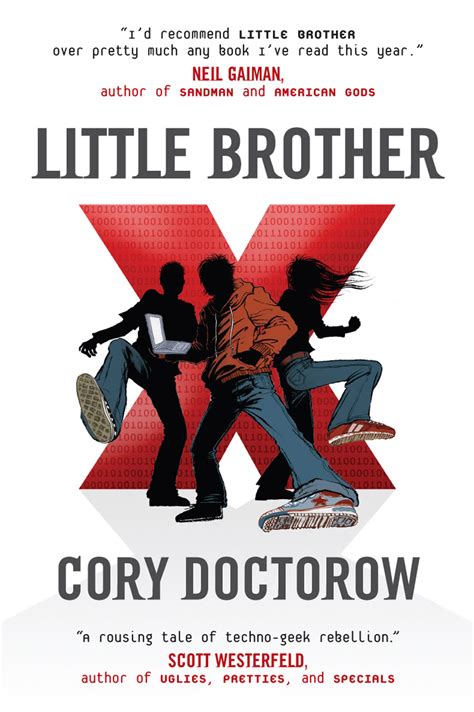
Little Brother
Little Brother
© 2008 Corey Doctorow
380 pages
Following the destruction of the Bay Bridge in San Francisco, a nightmare begins for a high school student who is scooped up by police in the aftermath. Not only has one of his friends been seriously wounded, but Marcus' presence near the bridge and his suspicious computer equipment make him a person of interest to the authorities, doubly so when he refuses to unlock or decrypt his devices and information for them. If he’s innocent, he has nothing to hide, right? But Marcus has been rebelling before this, mostly to elude his school’s draconian security measures. and his initial stubbornness turns into revolutionary resolve when he realizes that the authorities are not merely mistaken: they are malevolent. He seems doomed in the police state that San Francisco has become overnight, where the demonization of any dissent alienates Marcus from his family and friends, but there are other allies waiting in the wings, and they and his own resolve will spur him on.
So begins Little Brother, a man vs state story that combines the alienation and surveillance of 1984 with modern cybersecurity tools. At its best, Little Brother is a technologically savvy thriller, a defiant championing of civil liberties amid the war on terror, and a call to arms to readers to get serious about learning to defend themselves against abuse. This continues after the novel: there are several essays included after the story on the nature of security. At its worst, the arguments are one-sided, with only one attempt at mutual understanding. The security apparatus of the State is so extensive, however – both in the story in real life – that I can’t seriously begrudge Doctorow just wanting to fire up righteous indignation. Easily my favorite aspect of Little Brother was the pervasive cybersecurity information: Marcus doesn't just do things, but as a narrator he's conscious that he's speaking to an audience, and explains how encryption or whatever is he's doing at the moment works. Winston's intelligence as cyberpunk rebel extends not only to tech, but to the nature of resistance: he realizes that certain tactics will only strengthen the government's hand against him, so the trick is to find ways to keep them off balance -- sometimes by appearing to retreat.
Little Brother is an exceptional read, a smart thriller that takes its teen readers seriously. If you are concerned about the status of civil liberties across the world, the surveillance state, or curious about how tech can both amplify and mitigate the problem, it's one to take a look at.
The story's use of a couple of young dissidents who fall in love underground reminded me strongly of a song called "By Morning" by folk-punk songwriter Evan Greer. He wrote it in tribute to several young people who were imprisoned on charges of terrorism for harassing an animal testing lab. The song begins at 1:15.
And if they come for us by morning, with that "knock knock" on the door --
I'll hold you a little closer as they reach the second floor
And if I have to give my name, know I won't be giving yours
I'll run my hands through your hair, say it's them that's really scared
Because they know love is stronger than their bars can ever be.
Related:
© 2008 Corey Doctorow
380 pages
Following the destruction of the Bay Bridge in San Francisco, a nightmare begins for a high school student who is scooped up by police in the aftermath. Not only has one of his friends been seriously wounded, but Marcus' presence near the bridge and his suspicious computer equipment make him a person of interest to the authorities, doubly so when he refuses to unlock or decrypt his devices and information for them. If he’s innocent, he has nothing to hide, right? But Marcus has been rebelling before this, mostly to elude his school’s draconian security measures. and his initial stubbornness turns into revolutionary resolve when he realizes that the authorities are not merely mistaken: they are malevolent. He seems doomed in the police state that San Francisco has become overnight, where the demonization of any dissent alienates Marcus from his family and friends, but there are other allies waiting in the wings, and they and his own resolve will spur him on.
So begins Little Brother, a man vs state story that combines the alienation and surveillance of 1984 with modern cybersecurity tools. At its best, Little Brother is a technologically savvy thriller, a defiant championing of civil liberties amid the war on terror, and a call to arms to readers to get serious about learning to defend themselves against abuse. This continues after the novel: there are several essays included after the story on the nature of security. At its worst, the arguments are one-sided, with only one attempt at mutual understanding. The security apparatus of the State is so extensive, however – both in the story in real life – that I can’t seriously begrudge Doctorow just wanting to fire up righteous indignation. Easily my favorite aspect of Little Brother was the pervasive cybersecurity information: Marcus doesn't just do things, but as a narrator he's conscious that he's speaking to an audience, and explains how encryption or whatever is he's doing at the moment works. Winston's intelligence as cyberpunk rebel extends not only to tech, but to the nature of resistance: he realizes that certain tactics will only strengthen the government's hand against him, so the trick is to find ways to keep them off balance -- sometimes by appearing to retreat.
Little Brother is an exceptional read, a smart thriller that takes its teen readers seriously. If you are concerned about the status of civil liberties across the world, the surveillance state, or curious about how tech can both amplify and mitigate the problem, it's one to take a look at.
The story's use of a couple of young dissidents who fall in love underground reminded me strongly of a song called "By Morning" by folk-punk songwriter Evan Greer. He wrote it in tribute to several young people who were imprisoned on charges of terrorism for harassing an animal testing lab. The song begins at 1:15.
And if they come for us by morning, with that "knock knock" on the door --
I'll hold you a little closer as they reach the second floor
And if I have to give my name, know I won't be giving yours
I'll run my hands through your hair, say it's them that's really scared
Because they know love is stronger than their bars can ever be.
Related:
- 1984, George Orwell. Little Brother is commonly referred to as "1984 for the 21st century", which is a gross exaggeration. Even so, Little Brother makes numerous hat-tips to Orwell's dystopia beyond the surveilliance state: one of Marcus' online pseudonyms is pronounced "Winston", for instance.
- No Place to Hide, Glenn Greenwald. The story of Edward Snowden and the surveillance apparatus of the NSA.
Thursday, February 15, 2018
Overclocked
Overclocked: More Stories of the Future Present
© 2016 Cory Doctorow
388 pages
I’d never heard of Cory Doctorow before this week, but I encountered his name on a list of promising SF authors and looked him up. Amazon obliged my curiosity with a flash sale on one of his collections of short stories, and so I began reading Overclocked. A collection of short pieces ranging from stories to novellas, Overclocked has some fun with SF classics and exploring concepts like intellectual property, 3D printing, robotics, and artificial intelligence. AI is particularly important, with several stories using characters who have duplicated their consciousness and downloaded it into other carriers so they could achieve multiple goals simultaneously. Doctorow freely borrows titles and concepts from other SF works, which is not surprising given that he believes strict legal protections of intellectual property smothers creativity and innovation; this belief finds expression in several stories here, particularly "After the Siege". I took an immediate liking to these stories, aided in part by the fact that his best-known novel, Little Brother, is a YA man-vs-state scenario.
The stories:
"I, Robot" has the most fun with SF classics, throwing both Asimov and Orwell in a blender and creating a world where Oceania has always been at war with Eastasia and both have partially roboticized societies....but the societies in question are very different. It features robots, transferable consciousnesses, and a little futuristic law-enforcement.
"When Sys Admins Ruled the Earth". A bioweapon has been released across the northern hemisphere and the world seems to be ending...but a handful of server admins are keeping the Internet up and the hope of recovery alive -- at least as long as the power generators hold out.
"Anda's Game" : a young teenager who finds meaning by playing in an elite women-only gaming clan is faced with a dilemma when she discovers a community of young Mexican girls online who are forced to play the game all day doing minor tasks to generate in-game gold, which is then sold for real money online. Taking their plight seriously might mean abandoning her friends...
"After the Siege" is easily the longest and darkest, detailing the life of a young woman who is orphaned while her city is besieged by outside powers in retaliation for its open-culture philosophy,The story features an outsider who calls himself a wizard and who -- as the fearful and naive girl is turned by the war into a wary, cynical young woman -- seems ever more suspicious. This story has the same premise as the short piece which opens the collection, "Printcrime", but is enormously expanded. In that one, the police destroy and imprison a man who was using a 3D printer to reproduce copyright-protected goods.
"The Man Who Sold the Moon" is a nod to Heinlein, at least in its title. A man forced to look Death in the face encounters a friend who will change his life by dragging him to a Burning Man event, and is enlisted in a project to create a unique robot. When the friend has his own encounter with Death, however, a crowdfunded attempt to realize one of the stricken man's dreams takes readers to the moon. The technical accomplishment drives the story, but a lot of its heart is the three main characters' attempts to find meaning in an all-too mortal life now overshadowed by the threat of cancer.
"I, Rowboat". The most speculative of the stories, this features a sentient rowboat programmed with Asimov's Laws of Robotics attempting to protect some human shells (rented out to human consciousnesses who like to relive the days of having flesh and such) from a sentient coral reef. There are plentiful Asimov references here, including a robot religion called Asimovism, and a rogue personality which refers to itself as R. Daneel Olivaw. The amount of consciousnesses being uploaded and downloaded from host to host -- at one point the boat downloads himself into a human shell -- can get confusing, especially when a consciousness has been temporarily cloned. (At one point the rowboat downloads himself into a human shell to effect a rescue, and has a conversation with his rowboat self.)
All in all, I most definitely got my .99 cents worth and hope to try Little Brother at some point.
© 2016 Cory Doctorow
388 pages
I’d never heard of Cory Doctorow before this week, but I encountered his name on a list of promising SF authors and looked him up. Amazon obliged my curiosity with a flash sale on one of his collections of short stories, and so I began reading Overclocked. A collection of short pieces ranging from stories to novellas, Overclocked has some fun with SF classics and exploring concepts like intellectual property, 3D printing, robotics, and artificial intelligence. AI is particularly important, with several stories using characters who have duplicated their consciousness and downloaded it into other carriers so they could achieve multiple goals simultaneously. Doctorow freely borrows titles and concepts from other SF works, which is not surprising given that he believes strict legal protections of intellectual property smothers creativity and innovation; this belief finds expression in several stories here, particularly "After the Siege". I took an immediate liking to these stories, aided in part by the fact that his best-known novel, Little Brother, is a YA man-vs-state scenario.
The stories:
"I, Robot" has the most fun with SF classics, throwing both Asimov and Orwell in a blender and creating a world where Oceania has always been at war with Eastasia and both have partially roboticized societies....but the societies in question are very different. It features robots, transferable consciousnesses, and a little futuristic law-enforcement.
"When Sys Admins Ruled the Earth". A bioweapon has been released across the northern hemisphere and the world seems to be ending...but a handful of server admins are keeping the Internet up and the hope of recovery alive -- at least as long as the power generators hold out.
"Anda's Game" : a young teenager who finds meaning by playing in an elite women-only gaming clan is faced with a dilemma when she discovers a community of young Mexican girls online who are forced to play the game all day doing minor tasks to generate in-game gold, which is then sold for real money online. Taking their plight seriously might mean abandoning her friends...
"After the Siege" is easily the longest and darkest, detailing the life of a young woman who is orphaned while her city is besieged by outside powers in retaliation for its open-culture philosophy,The story features an outsider who calls himself a wizard and who -- as the fearful and naive girl is turned by the war into a wary, cynical young woman -- seems ever more suspicious. This story has the same premise as the short piece which opens the collection, "Printcrime", but is enormously expanded. In that one, the police destroy and imprison a man who was using a 3D printer to reproduce copyright-protected goods.
"The Man Who Sold the Moon" is a nod to Heinlein, at least in its title. A man forced to look Death in the face encounters a friend who will change his life by dragging him to a Burning Man event, and is enlisted in a project to create a unique robot. When the friend has his own encounter with Death, however, a crowdfunded attempt to realize one of the stricken man's dreams takes readers to the moon. The technical accomplishment drives the story, but a lot of its heart is the three main characters' attempts to find meaning in an all-too mortal life now overshadowed by the threat of cancer.
"I, Rowboat". The most speculative of the stories, this features a sentient rowboat programmed with Asimov's Laws of Robotics attempting to protect some human shells (rented out to human consciousnesses who like to relive the days of having flesh and such) from a sentient coral reef. There are plentiful Asimov references here, including a robot religion called Asimovism, and a rogue personality which refers to itself as R. Daneel Olivaw. The amount of consciousnesses being uploaded and downloaded from host to host -- at one point the boat downloads himself into a human shell -- can get confusing, especially when a consciousness has been temporarily cloned. (At one point the rowboat downloads himself into a human shell to effect a rescue, and has a conversation with his rowboat self.)
All in all, I most definitely got my .99 cents worth and hope to try Little Brother at some point.
Subscribe to:
Comments (Atom)