Sunday, January 13, 2019

Book-coveting

I do a lot of window shopping for books, taking photos of new ones that have my interest so I can check on reviews, prices, etc. later on when I don't have a hot coffee in hand.   I noticed just recently that I have ten recent photos, which is juuuuust right for a list!

If I had to pick three most-likely candidates from this list, they would be Shotguns and Stagecoaches,   Ticker,  and Plight of the Living Dead.


..whoops. Ten pictures, eleven books. 


Invisible Man and Everybody Lies


This week I've finished two books of interest, the first being a classics club entry (Invisible Man), and the other a book on big data and statistics.  Everybody Lies  played true to its title, opening with ways that analysis of data gleaned from Google searches and such shows that people lie to both one another and ourselves  (claiming one thing in surveys and demonstrating quite another in what we search for) before shifting to  the uses of 'big data' in general. Very amusing and interesting at first, but after it shifted I wasn't quite as enthused.

Invisible Man marked my first classic for the year, and follows an un-named narrator as he  moves from a southern college for promising young black students to 1950s Harlem. He is effectively forced out of college after giving a college trustee an inexplicable tour of local areas that the school administration would prefer weren't so close to the college, and becomes an activist in a generic movement in Harlem,  which fights for the mob's attention against a black nationalist group.  The narrator is constantly being manipulated by those he interacts with, and power, or influence, drives everyone. There's a fair bit of absurdism here, so much so that many of the characters seemed insane at times.  What stood out most was the tortured relationships between blacks and whites, laden as they were with conceits and psychological games.  For instance, one character urges the narrator that lies are always the best way to handle 'white folk' -- tell them what they want to hear.  It's not difficult to imagine circumstances where whites then regard blacks as inherently treacherous and use that to justify further marginalization. It's all incredibly unhealthy.


Wednesday, January 9, 2019

LikeWar

LikeWar: The Weaponization of Social Media
© 2018 P.W. Singer & Emerson T. Brooking
412 pages


The digital world is not simply one in which people can tweet restaurant reviews from the very table at which they're ignoring their dinner date.  It is a world which has made the border between peace and war practically nonexistent, and allowed virality to become the shaper of reality.  LikeWar introduces us to urban gangs who war not over territory, but their online reps -- to states quickly creating different ways of manipulate both their and others' populaces, and to modern celebrities who have built colossal followings and become world leaders on nothing but theater.  The image created here is frightening, a proposed future where unreality is king.  That's not to say we're abandoned to despair, because the social media platforms themselves are facing increasing pressure to police  the activity they effectively promote, and in the last year have in fact began banning various personalities. That in itself is potentially problematic, carrying a strong odor of partisanship,  and is only the first move in what will presumably be a very long cat and mouse game.

Singer and Brooking begin with a quick history of the internet and of the predominant platforms, chiefly  Google, Facebook, and Twitter.  This is not simply background, because these three dominate social media,  and their success at becoming the primary carriers means the platforms are easy to weaponize; once something ignites there, it can take over.  The algorithms that push rising content accelerate  it all the more, as does negative attention when people comment their boos and hisses.  Politicians, recognizing the power of virality, are following its siren call to become ever more extreme and nonsensical. Other algorithims, helpfully promoting related content to what users are already viewing,  can be used to railroad users into viewing ever more extreme content  -- unless they themselves backtrack. In a such  a way vapid morons become millionaires, and ISIS turns Google into its brand promoter.

If  promoting hate and ignorance were not bad enough,   the railroading takes users deep into a filter bubble,  with the effect that people are now beginning to live in different realities from one another.  There is so much content out there that people can experience an apparent variety of thought which is  in actuality fairly constrained compared to what's outside the bubble.  It is incredibly easy for people to listen to perspectives from their own side, appreciate their apparent rationality, and scratch their heads in wonder that other people don't see this.  But the divergent realities can also be a tool of those who wish to manipulate us; famously, in 2016,  the State of Russia promoted fractiousness within the US by employing social media warriors to create divisive content from different ideologies; others pushed the same content forward by commenting and promoting it.  These were not small scale maneuvers, either; some  were quoted and retweeted by prominent personalities, and would be shared over a hundred million times before they were caught and deleted.  Even worse, some states like that of China's are starting to use people's social media against them directly, by turning it into the basis of "social credit rating" that will help or hinder them in society based on how faithful to the Party they are. 

This is a daunting book, but one those living in the 21st century need to read -- not only so they can understand what they're seeing in society, to appreciate why things have developed they way they have, but so readers can evalute ourselves. No one is immune from this; we all go for narrative, we all follow familiar scents and find our internet bubbles cozy.  No one can keep us off the railroad but ourselves. Actively disengaging,  actively scrutinizing what we see, and actively pursuing other tracks are our only hope for not becoming part of the problem.


Tuesday, January 8, 2019

She Has Her Mother's Laugh

She Has Her Mother's Laugh: The Powers, Perversions, and Potential of Heredity
© 2018 Carl Zimmer
672 pages


Overhearing discussion of heredity a few hundred years ago would have meant only one thing:  being in the presence of noblemen, who stood to inherit their fathers' titles, lands, rights, and responsibilities.  Heredity quickly became a scientific concept,  and is now more commonly associated with biology than law, but genes aren't all we inherit. She Has Her Mother's Laugh is a meaty exploration of the history and present tracking of inheritance, genetic and otherwise.

Much of the book is a history of attempts to figure out heridity, beginning with mental impairment and the suspicion that it was something which could be passed down from generation to generation. This came of age when interest in biological inheritance was white-hot: Darwin and Huxley were at work, and various animal fanciers were creating ever-more elaborate breeds of pigeons and the like by monitoring traits from generation to generation and promoting the birth of different  variants.  It wasn't at all difficult for people to decide that imbecility was a distinct trait which could be controlled against, if all its present carriers were prevented from reproducing. This 'effort' was initially conceived as sterilization, but in the 1940s those efforts took on ghastly and murderous proportions Hitler's regime.

Aside from the outstandingly massive moral problems of controlling other people, including their ability to beget life,  there's also the scientific problem that "imbecility" is not one thing, created  by one trait. Mental impairments are diverse, and stem from all manner of biological hiccoughs. Many people in the Victorian age who were 'imbeciles' merely suffered from a metabolic disruption: they were unable to process a substance common in foodstuffs, and ingesting it slowly poisoned them, giving their skin an odd hue and eroding their mental faculties.  Children who were diagnosed early with this syndrome could be put on an appropriate diet, and be perfectly healthy members of society. Biology is chemistry in action, but the genes aren't the only chemicals in the solutions: they're constantly interacting with the substances of their mother's body, or the outside environment. Even if eugenicists had won, we would still have sick and infirm people, because there are so many variables. 

Other 'inheritance' issues are similarly problematic.  Take race, for instance; the human eye might look at a Norwegian, a Nigerian, and a Chinese citizen and declare them to be three obviously different kinds of people, but if that same eye were to look at their genes it would be unable to tell much of a difference beyond ordinary individual distinctions. Humans, for all our passionate in-grouping and out-grouping,  are far more alike than we are different -- biologically.  That doesn't mean our in-grouping and out-going is irrelevant; it  probably won't ever go away, because crucial to understanding human inheritance is realizing we are fundamentally cultural creatures. We don't come out of the womb sniffing wine and venturing opinions about the ballet, but we're as hungry for teaching as we are for food. When compared to chimpanzee juveniles, human youths are far more imitative.   Heredity cannot only apply to genes, or even biology (we also inherit bacteria from our parents):  it has to apply to culture, as well,

Zimmer also includes a chapter on CRISPR, and the admittedly scary potential that puts in our hands. Yes, we can eradicate genetic disease. We  can also turn our children into gross experiments, tinkering with their bodies to produce barbies or ubermensch. Society needs to think long and hard about the implications.

She Has Her Mother's Laugh is a steak of a book, of obvious interest to anyone with an appetite for human biology.

Some of my highlights:
"In Morgan’s own research on flies, he had learned to respect the power of the environment. His students discovered one strain of flies that developed normally if they were born in the summer but tended to sprout extra legs if they were born in the winter. It turned out that the researchers could get the same outcomes in their lab simply by changing the temperature in which they reared the fly eggs. It was thus meaningless to talk about the effect of their mutation without taking into account their environment."

“It was my child who taught me to understand so clearly all people are equal in their humanity and that all have the same human rights,” Pearl [Buck] wrote. “Though the mind has gone away, though he cannot speak or communicate with anyone, the human stuff is there, and he belongs to the human family.”

"To eliminate imperfection would demand eliminating humanity itself."

"We were three people of African, Asian, and European descent from three corners of the world. Three races, some might say. And yet we shared far more than what set us apart."

"Textbooks say that the human body has about two hundred cell types, but recent studies have rendered that figure a laughable understatement. No one can say how many cell types there are, because the more scientists examine cells the more they break down into more typed. Immune cells may all carry out the same mission to save us from pathogens and cancer, but they are an army with hundreds of divisions. All our cell types are seperate branches on the body's genealogical tree, like rival dynasties descended from a first monarch."

Sunday, January 6, 2019

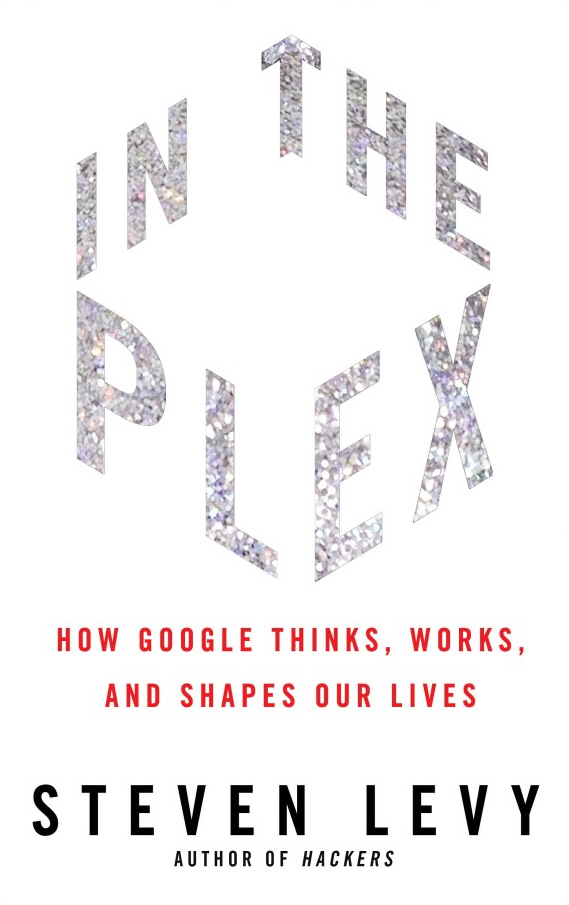
In the Plex

In the Plex: How Google Thinks, Works, and Shapes Our Lives
pub. 2011 Steven Levy
437 pages


Full disclosure: I was a passionate Googler ten years ago, an early adopter of anything that the Mountain Brook, CA firm produced -- even programs like GoogleDesktop, which I never even used. It was when Google devoured YouTube and started making its mark on there that the plucky upstart of the internet started looking a little more dangerous -- and with every passing year I've become a little more concerned about the amount of internet traffic Google controls.   Regardless of whether one trusts or fears Google, however, it is an incredible company with extraordinary influence on the web. In the Plex is a fanboyish history of how it came to be, from its early origins in a dorm room to its present goliath state, with various aspects of Google's culture and various products being examined in turn.

Those of us logged into the English-speaking net scarcely need to know what Google began as:  Google's initial product was so successful that it's wormed its way into our language. What is most remarkable about Google is how it changed the internet, and changed expectations.  That story really begins with Gmail -- a product which was produced by a Google employee on the side, then officially sanctioned once the triumvirate in charge of Google had experienced it.  Gmail's enormous free storage option -- an entire gigabyte of storage, an amount that flabbergasted Bill Gates when he heard of it --  allowed people the luxury of never having to delete their mail. That didn't just mean they no longer had to save everything to their computers; it meant they could keep every little thing from conversations to emailed receipts online, and considering how much use emails get by other websites, that could mean a sizable amount of their lives would now be shared with Google.  Prior to Google and facebook, privacy was a web hallmark;  unless you were a network engineer monitoring ISP traffic, people couldn't tell who you were unless you told them -- and I was encouraged to not tell or trust anyone. It took years of conversation between close AIM friends before I'd consent to voice chat, let alone sending picture.

Gmail changed that, and it wouldn't be the last time Google changed our expectations about what normal online. Now instead of seeing ads that were  static billboards, erected on websites in the hopes of catching some eyes,  the web would be increasingly filled with very personal ads -- solicitations to buy a book we'd just been looking at online,  ads in Spanish after using DuoLingo or watching Butterfly Spanish on Youtube,  announcements of Caribbean cruises after GoogleMaps is used to look at the Mexican coast.  GoogleMaps' associated project, Latitudes, even tracked users locations --  if they wanted. And when Google ventured into the smartphone market and purchased Android,  location tracking became the norm....and even if user try to opt out, on some level it still occurs because the phone has to communicate with cell towers and satellites.   Other projects were even more controversial, like Google's desire to start scanning the world's books and provide them for free, online.

Google is an unusual company in that it started with the ambition of a nonprofit: to make the world a better place. Levy believes this philosophy is real and still guides Googled despite their incredible wealth and influence on the web.  And there's no denying that Google's products have transformed the internet in a positive way;  GoogleMaps alone is an incredible tool, offering not only maps but information layered within the maps -- reviews of restaurants, the ability to see the street's landmarks, to browse through user-submitted photos.  YouTube, too, isn't just a place for funny clips: it holds hour upon hours of educational content, and allows people to pursue their interests and passions.  Between Google Search, Maps, and YouTube,  we  have the computer databanks of the Enterprise-D at our command.

I thoroughly enjoyed this history of Google  and its facets, but  keep in mind it's written by an ardent admirer, whose love for "cool" firms like Google and Apple manifest itself in a nasty contempt for others, like Microsoft.. He refers to Microsoft employees as "Gates' minions", which makes Levy sound like less a serious author and more like a blogger with an axe to grind.  Levy's admiration for Google also means he doesn't fully examine the  potentials for abuse inherent in one company running so much internet traffic. Chrome, for instance, has virtually taken over, and Microsoft is building a new Edge browser around its source code Chromium. What will it mean when 80% of web traffic is Chrome-based?

Wednesday, January 2, 2019

Classics Club Schedule, 2019

I have 21 months left to finish my Classics Club list, with 22 books remaining. I'm not sure what happens if one fails to complete the list -- perhaps it involves being attacked by moody English teachers, I'm not sure.   Anxious to avoid such a fate, I plan to make classics my priority this year, and have developed a tentative schedule for this year that will make 2020's classic requirements relatively light.  Most of the sets (save January's) have a paired connection, like Rome, travel,  and so on.  If I actually get this done, I'll  reward myself with a little bottle of scotch.

January:
Invisible Man, Ralph Ellison
Moby-Dick, Herman Melville

February
The Aeneid, Virgil
The Conquest of Gaul, Julius Caesar

March
The Moviegoer, Walker Percy
Love in the Ruins, Walker Percy

April
The Decline and Fall of the Roman Empire, Vol. 1,  Edward Gibbon
The Vicar of Wakefield, Oliver Goldsmith

May
Life on the Mississippi, Mark Twain
The Swiss Family Robinson, Johann David Wyss

June
A Farewell to Arms,  Ernest Hemingway
Catch-22, Joseph Heller

July
The Grapes of Wrath, John Steinbeck
The Sun Also Rises, Ernest Hemingway

August
The Education of Henry Adams,  Henry Adams
The Three Musketeers, Alexander Dumas

September
The Histories, Herodotus

October 
The Hunchback of Notre Dame, Victor Hugo
The Jungle, Upton Sinclair

November
War and Peace, Tolstoy

December
The Brothers Karamazov, Fyodor Dostoeyesky

This leaves The Federalist Papers as the odd man out for 2020.   I wanted to make it the September read (September 17 is Constitution Day, a date presumably unremarked on by anyone other than con-law professors), but The Histories seems formidable.  We'll see what happens!