Monday, December 30, 2013

The View from the Summit

The View from the Summit: The Remarkable Memoir from the First Person to Conquer Everest
© 1999 Sir Edmund Hillary
310 pages


The Himalayan Mountain range boasts the highest peaks on the surface of the globe; its heights equal the cruising altitude of a cruising jetliner. . In 1954, Sir Edmund Hillary and  Tenzing Norgay accomplished what many before had perished attempting: they reached the summit of Mount Everest.The View from the Summit tells the story of Hillary’s ascent up the mountain,  presented within a  partial biography of his life.  Beginning with its climactic triumph, that perilous day in 1954,  View then offers a look back, to Hillary’s childhood in New Zealand, where he began as a beekeeper. However humble that might sound, it was considered duty serious enough to warrant officials attempting to prevent Hillary from risking his life,  not that he let their concerns stop him from joining the air service. Hillary never shrunk from death; even after besting Everest, he went on to a series of similarly extreme adventures.  Merely climbing Everest wasn’t good enough, no; he had to climb several other peaks in the range, shoot the rapids of the Ganges,  trek across both the North and South Poles (once with Neil Armstrong) and give a speech upon being knighted. (His first thought after becoming a Peer of the Realm: “Oh, God, I’ll have to buy new overalls.”)  He was in short quite the character, pugilistic and stubborn; even the death of loved ones didn’t stop him from taking on challenges. His many accomplishments don’t include writing like a journalist; readers will find this tale of outdoors adventure tending toward the technical  the feats are more exciting than their telling.  His sober, factful approach has its own appeal, however.   Those interested primarily in the ascent of Everest should know that this is only a partial account of that challenge;  High Adventure  is Hillary's chief Everest memoir.


Friday, December 27, 2013

The Men Who United the States

 The Men Who United the States: America's Explorers, Inventors, Eccentrics and Mavericks, and the Creation of One Nation, Indivisible
© 2013 Simon Winchester
496 pages


The Men who United the States is a storied account of how the American people came to realize their ‘manifest destiny’, from the explorers who plied rivers and mapped the vast expanses to the technological tools that knit the continent together. It is organized thematically, utilizing the five elements of Chinese mythology: wood,  earth, water, fire, and metal.  Although most sections cover the full expanse of American history, the focus of each moves forward; ‘metal’ largely concerns revolutions in communications technology,  culminating in the Internet  while ‘fire’ covers the effects of the steam and combustion engines. Politics and war are downplayed: this is the tale of explorers and inventors whose dangerous  and enterprising deeds made political dreams a factual reality.  Winchester is a personable author, often inserting his attempts to retrace the tracks of some intrepid but doomed explorer along mountain passes or through river rapids. It's an odd element in a work of history, but works well enough despite sometimes bordering on off-topic.  Winchester makes for a winsome host through the annals of American explorers, and his work of adventure, history, and technological progress are sure to find a warm reception among readers.


Thursday, December 26, 2013

The Phantom Menace

Star Wars Episode I: The Phantom Menace
© 1999 Terry Brooks

The Phantom Menace was the first movie in the new 'prequel' trilogy of the Star Wars saga, which told the story of a promising young Jedi who was seduced by the Dark Side of the Force, even as the Republic which he served was corrupted by the master of the dark inside into the Galactic Empire. It is easily the least-liked of the Star Wars movies, featuring a young boy who is far too precocious ("Are you an angel?") and the majestic silliness of Jar-Jar Binks.   Terry Brooks' challenge in creating a novelization of this story was thus considerable, and he tries valiantly. He cleans up parts of Jar-Jar's language; while much the psuedo-ebonics remains ("Dat", "dis", and so on),  his unique turns of phrase ("Dat's baaaad bombin'!")  are sterilized, with mixed effect.  The dialogue is fleshed out to make some of the characters' decisions more understandable; Qui-Gonn Jinn only takes a fourteen year old girl with him into a wretched hive of scum, villainy, and obnoxious aliens only after she reveals her extensive self-defense training. Anakin, too, gets a little development, demonstrating his awareness of how he can manipulate his own mental state; he tells Jar-Jar that the bumbling Gungan's fear attracts abuse to him.  There's also a scene with the Sand People that becomes more interesting when the plot of Attack of the Clones is taken into consideration, though I don't know if Brooks knew what Lucas had planned for Anakin's poor mother.  While Brooks doesn't improve the original nearly as much as Matthew Stover did with Revenge of the Sith,   it's a step in the right direction, making a previously juvenile story a bit more sensible.  Books in the EU universe like Darth Maul: Shadow Hunter and Cloak of Deception do the lion's work in that department, however.

Related:
Revenge of the Sith, Matthew Stover. For my money, the gold standard of movie novelizations.
Darth Maul. Shadow Hunter; Michael Reaves
Cloak of Deception, James Luceno


Tuesday, December 24, 2013

This week: Christmas reads, science in the city, and social telegraphy

Dear readers:

            A blessed Yuletide and a merry Christmas to those of you in the northern hemisphere, as we celebrate the rebirth of the Sun – or the birth of the Son, if you prefer. The library is closing early today and I’m heading home for the week with an armful of books,  to be read between the caroling and snacking and time spent with family.  I’m still trying to wind the year down with lighter reading, so this week I’m carrying home two Star Wars novels (to complement my annual Christmastime rewatch of the entire Star Wars saga), and reading The View from the Summit, Sir Edmund Hillary’s telling of his travail up Mount Everest.

            In recent weeks I’ve finished two books that haven’t gotten comments previously; A Scientist in the City, which was interesting enough, and The Victorian Internet. A Scientist in the City, published in 1994, peeks into the science that makes city function.  That science is more material than social, though the behavior of people within the urban environment appears occasionally as data in traffic projections.  [author] examines the physics that define strengths and weaknesses of different building materials, and explains subjects like the generation of electricity. He doesn't cover systems by themselves, and water treatment is ignored completely. I liked it well enough, but it's definitely dated and on the thin side.  The book ends with several different projections for the City of the Future: our options are Trantor, the Matrix, and suburban sprawl with bullet trains.


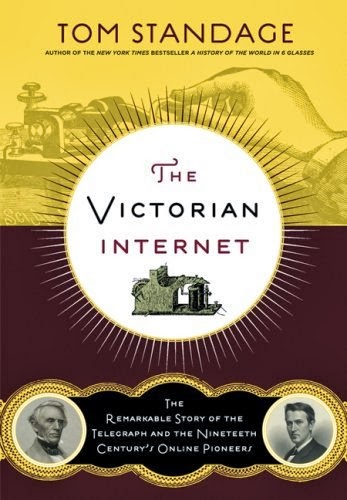
            Before that, I enjoyed Tom Standage's The Victorian Internet, which tried to convey to readers that the internet now completely transforming their lives was not without precedent. It's a breezy history of how electricity transformed communications and helped create the modern world. We creatures of the 21st century can't appreciate how radically life changed for those of the 19th; our idea of technological revolution is smaller computers, or ubiquitous touchscreens. The nineteenth century took civilizations held by the same limits that had enclosed humans for millennia prior -- the speed of transportation and communication maxing out at a horse's gallop -- and threw them into a completely new world. Cities could communicate with other cities in mere seconds; economies were revolutionized by merchants' ability to keep track of broader markets and manage their inventory more efficiently. Although the comparison is slightly overstated-- for telegraphs required intermediaries for most people to use them to communicate -- the telegraph's transforming effects on society do bring to mind the way the internet worked its way into our everyday lives in the 1990s, when this book was published; the creation of military scientists and the domain of tech geeks, it has conquered so much of society that many essential functions depend on that. The telegraph didn't become quite that pervasive, but it was a tool of friendship and romance as well as business and politics, and it started our slide toward being plugged into the electronic, digital world. The Victorian Internet  is on the lighter side, but definitely useful.

    I've also finished small is beautiful in recent weeks, and thought it tremendous but I'm not ready to try to comment on it yet.

Saturday, December 21, 2013

Black Rednecks and White Liberals

Blacks Rednecks and White Liberals
© 2005 Thomas Sowell
360 pages


Thomas Sowell's provocatively-titled Black Rednecks and White Liberals casts a critical eye toward  conventional understandings of race, class, and history, collecting a half-dozen extensive essays in one volume. Although each essay is written as a standalone piece, some concern common subjects and refer to one another.  Sowell principally writes on African-Americans and Jews here, aside from an apologia written on Germany.  His central argument essentially blames the welfare state for the continuing degradation of black Americans, by way of historical arguments, one of them deliciously twisted -- the title essay.

"Black Rednecks and White Liberals" sets the stage by contending that the woeful culture of poverty keeping urban blacks in a despairing state is not one which they created themselves, but one inherited from poor whites, and specifically the poor whites who emigrated from a border region of Scotland during a specific timeframe in which Scottish 'crackers' of the area were slobbering savages, having not yet been tamed by the graces of English civilization. The poor whites of this ‘cracker culture’  exhibited the same self-defeating behaviors lamented over in the ghetto today; a disdain for education and work, a painfully abbreviated approach to the English language,  wanton sexuality,  and a gleeful embrace of violence, along with an ‘honor’ system that promoted the use of such violence.   It is Sowell’s opinion that southern blacks were acculturated into the behaviors of the ‘white trash’ and dragged it around the country with them. Given its self-defeating nature, Sowell comments that this cracker culture largely died out among the poor whites, and even the first waves of southern blacks who carried it around the country – but after the 1960s, when the welfare state  sprang into being,  those behaviors were propped up – being no longer culled by the scythe of sheer necessity.  After arguing for this, Sowell later builds off it in an essay on education, and again in his final essay on the historical perspective, condemning modern approaches as too forgiving, too soft:  blacks and whites who lifted themselves up out of poverty and despair did so not by accepting substandard English as their cultural heritage, nor by taking self-esteem classes, but by acknowledging the relative inferioty of their station in life to others:. The Scots became intellectual titans after abandoning Gaelic for English, and consequently gaining access to the English literary world, and the Japanese adopted western means of science, government, and economics to catapult from feudal island to global power in the Meiji revolution. In putting aside defensive pride and setting a superior standards for themselves, they both catapulted themselves from backwards hinterlands to first-world countries who would be active players in shaping world history..

Thomas Sowell, it should be noted, is black himself, and is a product of this process of enlightenment, having been reared in the kind of schools he now advocates,  having set for himself superior standards.  To multicultural sensibilities, he may seem like a self-loathing black man at times, for all the abuse he heaps on poor blacks and whites and for all he waxes poetic about the glorious intellectual and moral history of the west, problematic as it was. Were he white, Sowell would almost certainly be condemned as a racist, and a cavalier of western chauvinism.  His entire argument is simultaneously thought-provoking and problematic. Some is straightforward history, like his account of slavery or the reactions of northerners to white southern emigrants, which as they are quoted sound exactly like what you might expect to hear of those participating in 'white flight' decades later.  It's not surprising that long-term residents of an area would react with hostility toward the sudden intrusion of poor immigrants, flooding into areas the residents rightfully considered their own.  Sowell's belief that the culture of contemporary 'ghetto blacks' was one passed down directly by 'crackers' is a much harder sell. Given that slaves were owned not by 'white trash', but by the plantation elite, would they really have spent enough time around the 'crackers' to acquire the values? And why would they adopted those values, considering that impoverished white sharecroppers were just as economically miserable as themselves, and loathed the former slaves to boot?  The statistics Sowell quotes to demonstrate that the black story of the 20th century is sometimes one of regress are damning: even if a reader doesn't accept his condemnation of welfare as causing the erosion of black family life, and stymieing the natural processes that would reverse self-destructive behaviors,  the  analysis is staggering in its implications.  This isn't exactly a national secret -- Bill Cosby has written books despairing about the woeful condition of black family life and communities in the latter half of the 20th century -- but Sowell's  work puts the decline into sharp focus.

Although I find Sowell's contempt for the poor, self-defeating they may be, highly uncomfortable -- especially his frequent brandishment of 'cracker', which in certain counties of the Deep South is a pejorative on the level of kike or wop -- I appreciated various elements of this collection. The almost tributary history to Germany's ancient cultural heritage, for instance, was a relief compared to the  Omnipresent Nazi approach to German history, and the statistical work offers data that can be considered regardless of one's opinion on the unintended consequences of particular welfare policies. I'm increasingly sympathetic to the idea that improperly-designed welfare can exacerbate social problems, but think it more likely that certain destructive behaviors are endemic to the human experience, rather than being the legacy of Scottish emigrants to urban ghettos. Not for nothing have humans created so many religions, philosophies, and institutions to curb the worse of our instincts. Though readers will find a lot of food for thought in this collection, it has a sometimes bitter edge. 


Things that Matter

Things that Matter: Three Decades of Passion, Pastimes, and Politics
© 2013 Charles Krauthammer
400 pages


Things that Matter collects articles spanning at three decades, largely culled from The New Republic, giving voice to psychologist-turned-cultural observer and journalist Charles Krauthammer as he watches the ebb and flow of America’s fortunes at home and on the global scene.  Although he opens with essays of a more personal note (commenting on the pleasures of ‘taking in’ baseball, especially when rooting for a perennially losing team), politics undergirds most of the collection. He describes himself as a conservative, though one whom today's standards would judge a centrist, and the body of articles bears that judgment out.

 Although Krauthammer's  opinions fall within a broad enough spectrum that he can't be dismissed as an ideologue or a reactionary (he is baffled by resistance to gay marriage, for instance, and derides Social Security as a Ponzi scheme even while proposing a way to make it financially stable),  he's liable to take the most flak for his acceptance of the notion of American Empire, and his approving attitude toward interventionist schemes in other countries. Of course, he writes, they could have been better managed --  we're always so wise after the lives and money have been wasted, aren't we? Of note is Krauthammer's various pieces concerning Jews and Israel; he sees the tiny nation-state as Jewry's best hope, but says this with a hint of anxiety, for it seems to him of his fellow Jews' putting all their eggs in one vulnerable basket. With the abiding hope of Jews for centuries past now realized,  what will the Jewish people make of their future? Will Israel sustain them, and their identity, or will some future crisis  ravage them again...perhaps permanently? It has happened before, he says, reminding readers not versed in biblical history that once there were two Hebrew kingdoms, Israel and Judah, and Israel was destroyed, its people scattered to the winds:  the children of Judah, now gathered as Israel, can be broken again.   Aside from his attitude toward war, Krauthammer is never politically obnoxious, and in fact frowns on the nature of politics today. In going negative, he offers:

      Delta Airlines, you might have noticed ,does not run negative TV ads about USAir. It does not show pictures of the crash of USAir Flight 427, with a voice-over saying "USAir, airline of death. Going to Pittsburgh? Fly Delta instead."
     And McDonalds, you might also have noticed, does not run ads reminding viewers that Jack in the Box hamburgers once killed two customers. Why? Because Delta and McDonalds know that if the airline and fast-food industries put on that kind of advertising, America would soon be riding trains and eating box-lunch tuna sandwiches.
      Yet every two years the American politics industry fills the airwaves with the most virulent, scurrilous, wall-to-wall character assassination of nearly every political practicioner in the country -- and then declares itself puzzled that America has lost trust in its politicians."

Things that Matter is an interesting, thoughtful collection of miscellaneous pieces,  presumably of interest to Americans who have heard of him. (I hadn't, but have a weakness for reflective essay collections.) 


Tuesday, December 17, 2013

Into Thick Air

Into Thick Air
© 2003 Jim Mauser
388 pages


            Jim Mauser might be interested in the view from the Seven Summits, the highest points of each continent, were it not for the fact that they have accessibility issues. To Mauser, any place you can’t bike to isn’t worth bothering with. When Discovery offers to drop Mauser in the middle of nowhere and film him attempting to find his way back to civilization, Mauser has a better idea: why not finance and film his traveling to the seven lowest points on Earth – the seven anti-summits?   And so he embarks on a six-continent journey (Antarctica lowest point being covered by a very large pile of ice), through war zones and Passover, assailed by dogs, hurricanes, and crowds of children joyfully attempting to stone him,  to six of the lowest spots on Earth. Although his destinations are anticlimactic in the extreme, it’s the journeys getting there that makes this book. Mauser is rivaled only by Bill Bryson for the sheer entertainment value of his narrative, and is similar to him stylistically,  but Mauser records his world journeys with a botanist’s eye.  Those eyes are open to the full sweep of the glorious panorama of nature around them  -- the wildly divergent climates, the abundance of mesmerizing and often lethal fauna. Central to Mauser's story, like many travelers' tales, are the people he meets along the way, their kindnesses and eccentricities recorded along the way. Mauser isn't quite as vulnerable as world trekkers; his anti-summits are made in six completely different legs that take the better part of a decade to complete, and his starting locations for each leg seemed to be a week away from his destination, at best.  Even so, he's at considerable risk given his luck at pedaling into a place right before drama hits -- like a sudden case of the monsoon in South America -- and people around the world offer him friendly smiles and a stomach full of local cuisine. Into Thick Air is a fantastic cycle-touring book, treating the reader to a wide spectrum of human cultures and natural environments, with plenty of wry humor and scientific commentary on the way.